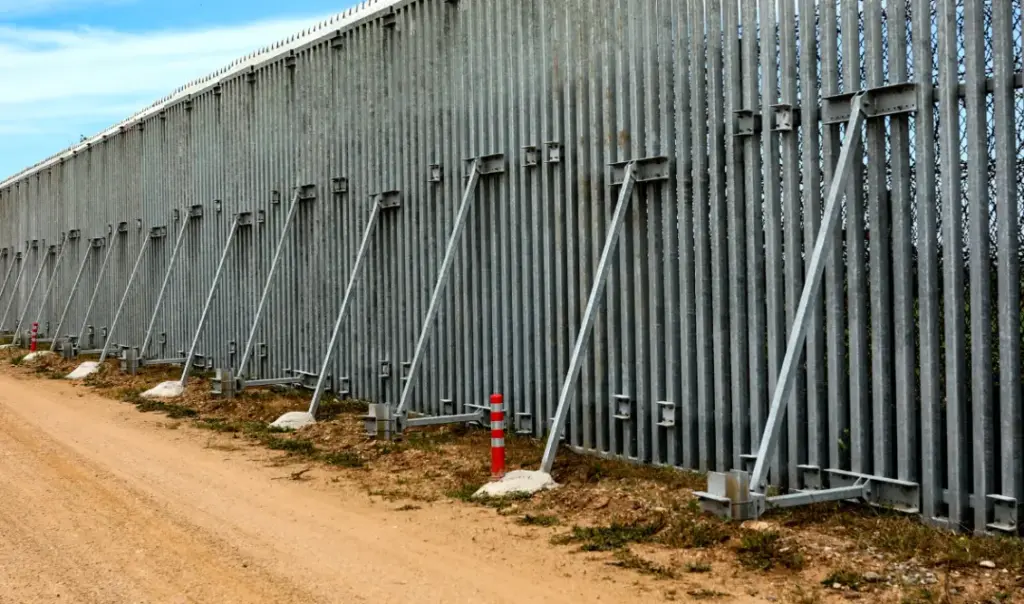
Complete coverage of the Greece-Turkey land borders with the aim of fully preventing migrant caravans from the neighboring country was announced yesterday from Evros by the Minister of Citizen Protection, Michalis Chrysochoidis. Migration flows from Evros have decreased significantly due to the fence, and for this reason the government decided to extend it from end to end, as it not only functions as a deterrent for irregular migrants but also for flooding phenomena. This was at least proven during this winter, where in contrast to previous years, thousands of acres of cultivated land did not flood since the torrential waters crashed against the walls of the structure. Additionally, M. Chrysochoidis revealed that new personnel hirings are coming for the Border Guard departments, since the government’s goal is to completely eliminate the problem of illegal immigration.
Read: Chrysochoidis from Evros: “Fence construction will continue” – “We don’t have a migration problem”
Chrysochoidis from Evros: “Greece does not have a migration problem”
The Minister of Citizen Protection visited sections of the Evros fence yesterday, accompanied by senior officers of the Corps, witnessing firsthand the success in reducing the entry of illegal migrants from Turkish territory. “Here daily battles are fought for the security of the homeland. Today the flows from Turkey are very low, almost insignificant. Greece does not have a migration problem. This is due to the fact that flows from neighboring Turkey have decreased significantly, but at the same time the guarding, monitoring and control of the borders, as I told you, is daily and does not allow these flows,” emphasized Mr. Chrysochoidis in his statements. The works are naturally a deterrent factor for the migrant caravans organized by human traffickers. However, achieving this reduction is largely due to the border guards themselves who fight a daily battle against the cunning human traffickers. These are the same people who in the spring of 2020 prevented the invasion of thousands of migrants and criminal elements during the “hybrid war” that neighboring authorities tried to provoke. It was the culmination of an organized effort spanning years that was prevented, saving the country from tragedy. The Minister of Citizen Protection thanked these people, announcing immediate hirings to strengthen services for preventing illegal immigration. “We further strengthen border services here in Evros and simultaneously strengthen services on the second line, namely in Rodopi, Xanthi, Kavala, so that the entire length of Egnatia and all borders with other countries, such as Bulgaria, are secure.” Of particular interest was the minister’s reference to the Evros fence which proved to be an artificial barrier against flooding: “It is very important and encouraging that this project, the fence, during the major floods just two months ago, not only held, but also functioned as flood protection, with the result that the damage done to the area, necessary due to the floods, was much less.” The extension of the fence was also a demand of the area’s residents themselves who saw for the first time their properties, homes and crops not flooding from torrential waters.
Frontex and Coast Guard increase pressure on trafficking networks
The “sealing” of Evros and the vertical increase in Coast Guard patrols in cooperation with Frontex in the Eastern Aegean appears to have extremely complicated the human trafficking networks, which are now turning towards Libya. It is characteristic that for the first time in the last 20 years, on the island of Lesbos and specifically at the Kara Tepe facility, only 270 illegal migrants reside. The shameful images of previous years where thousands of people were crammed on top of each other have been eliminated. This specific facility has a capacity of 3,381 guests. The situation is similar in open or closed facilities in the rest of island Greece, however things have become particularly difficult in Crete. In the last 1.5 years, flows have increased vertically and serious problems are recorded. The Libyan sea is used daily by human traffickers who transport thousands of migrants to Greece, Italy and Spain. Somalis, Egyptians, Pakistanis, Afghans, Algerians and residents of other neighboring countries.