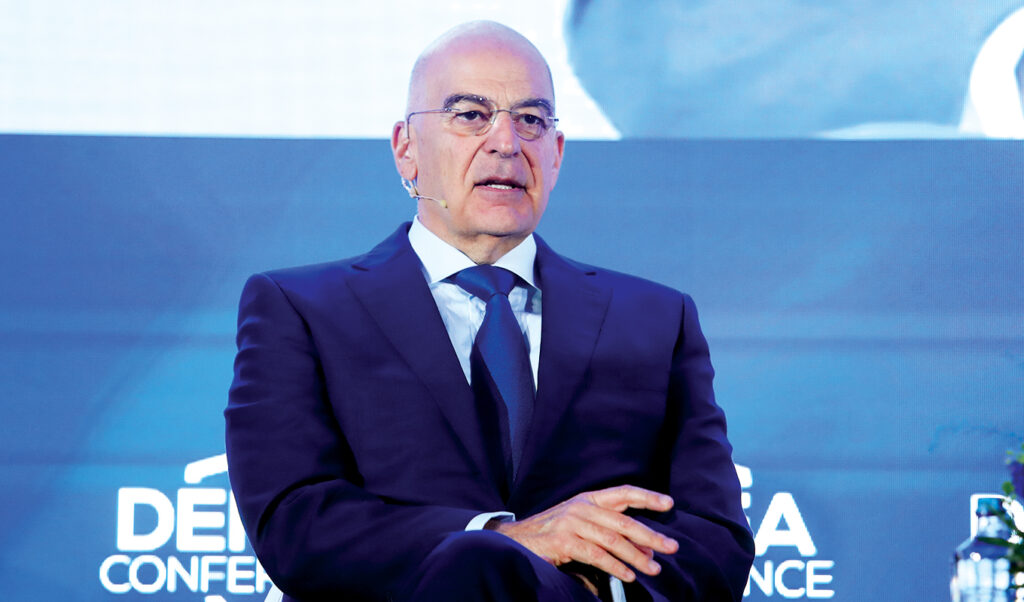
Defense Minister Nikos Dendias, in a discussion with journalist Pierros Tzanetakos today at the opening of the “DEFEA CONFERENCE 2026,” outlined the new reality taking shape in the Armed Forces with innovation as its cornerstone. The conference is being held at the Metropolitan Expo exhibition center at Athens International Airport “Eleftherios Venizelos.”
Read: Greek Armed Forces: New era of deterrent power with advanced weapons systems
Dendias: “We must borrow technology and know-how”
Speaking about the 25% participation of Greek defense industry companies in every procurement program, Dendias stated he doesn’t believe “in the future of very large platforms, but in the future of ‘smart’ platforms,” adding that until we reach full capability, “we must borrow technology and know-how.”
“With this 25% we implement. We apply it in all programs, with flexibility, more in some areas, less in others, but 25% is the average,” he explained.
When Pierros Tzanetakos noted that the Armed Forces’ procurement spending, as described in “Agenda 2030,” reaches 30 billion euros, Dendias explained that the amount to be absorbed by domestic industry is “over six billion euros.”
“That’s the base,” he said, adding: “We calculate that over 10 billion euros can be absorbed by Greek capabilities. That means we’re approaching 30% to 33%. I hope the Greek ecosystem will pleasantly surprise us and be able to absorb more.”
Specifically regarding small and medium enterprises in the defense and technology sectors, Dendias emphasized that “reality has changed” and “solutions to tomorrow’s problems won’t come from yesterday’s ‘dinosaurs,’ but from new innovative companies that will face reality head-on and create solutions we haven’t even conceived of yet.”
He added: “In drones, anti-drones, autonomous systems at sea, autonomous underwater systems, autonomous land systems, we can excel in all modern fighter equipment, in ships that will change form over time, moving more toward autonomy and less toward what we have in mind, like the big ship with the large crew and cannons. All these will gradually cease to be the main combat tools, others will be. And today’s wars, missiles, ballistic missiles, missiles with anti-missile capabilities – the list of new reality opening before us is endless.”
“In this new reality, not only Greece, but small countries that have flexibility, that have companies that can quickly change direction, have the advantage. The advantage doesn’t belong to large old companies that followed procedures humanity invented at the beginning of the 20th century,” he clarified.
“Greek small and medium enterprises have a tremendous advantage, like all small and medium enterprises in the European Union, and our culture helps in this, open-mindedness helps. If you will, democratic governance helps, if you will, the spirit of the Renaissance helps, the ability of humans to face their future freely, not to do exactly what they were told, as they were told, without being able to move a little further or a little sideways,” the Defense Minister noted.
Referring to the Greek Defense Innovation Center (ELKAK), he emphasized: “It was a new reality in Greece. A reality that brought structural change. ELKAK answers questions that the Greek Armed Forces pose to Greece’s defense innovation ecosystem.”
“ELKAK brings tremendous change to how we think, operate, communicate. I mean communicate – the Armed Forces on one side, the ecosystem on the other,” he explained.
Regarding changes in the Armed Forces, he explained: “We must change everything to be able to respond to modern challenges. Except for our principles and values, everything else must change. We’re on a very good path to do this, and ‘Agenda 2030’ indicates exactly that.”
“Greek Armed Forces have acquired characteristics of speed and flexibility”
Referring to the Armed Forces’ presence in Cyprus, he emphasized: “The Greek Armed Forces have acquired characteristics of speed and flexibility that didn’t exist in their history. They didn’t exist because there wasn’t the need, not because the Armed Forces were bad. I gave the order to the Greek Air Force to cover the airspace of the Republic of Cyprus against threats from Iran at 12:00 noon on the day the order was given. At 7:00 PM that evening, Greek aircraft with the entire support team were already at ‘Andreas Papandreou’ base. The same order was given to the Greek Navy at 12:00 noon. At 10:30 PM that night, Greek frigates sailed for the Eastern Mediterranean. The British Navy needed more than 20 days for the same threat to be able to send frigates, project power, to cover the bases at Akrotiri in the Republic of Cyprus.”
“Within two years, we acquired the ability to produce thousands of drones”
Dendias expressed his pride in the Greek Armed Forces, while also referring to the drone production capability in Greek Armed Forces factories. “Within two years, we acquired the ability to produce thousands of drones and have mobile drone production units, to have Greek-made anti-drone systems,” he said.
“We have,” he added, “a very long road ahead of us, many things to change still, many things to absorb and observe, but I think we’re in good shape and on a good path.”
Dendias emphasized that the Armed Forces mission to Cyprus was conducted under Article 42, paragraph 7, of the European Union Treaty, explaining: “European solidarity exists.”
“Of course,” he continued, “blood ties connect us with the Republic of Cyprus, I won’t hide my words here. Cyprus for us is a sister state, Cypriots are our brothers. But there’s an institutional framework. That was the institutional framework within which we operated.”
“We don’t pursue Turkey-centric policy”
“We don’t create ad hoc anti-Turkish coalitions. We don’t pursue Turkey-centric policy. We do what’s needed each time to be able, within the existing framework, to defend what are the important interests of Hellenism, the important interests of Europe, the important interests of our peoples,” he clarified.
“There’s a window and there’s a door and there’s a road and there’s a highway for resolving the Greek-Turkish difference. Because Greece doesn’t claim anything from Turkey, anything Turkish, according to International Law or any reasonable legal analysis on this planet,” he explained.
“It depends on the other side of the Aegean. It depends on the Turkish government. I believe the Turkish people have nothing to divide with us, on the contrary, they have feelings of friendship toward us. It depends, therefore, on the Turkish government to understand that the operational framework in the 21st century can only be a framework that refers to International Law and the International Law of the Sea,” he added.
When asked about the possibility of Greek presence in the Strait of Hormuz, Dendias explained that Greece has the capability, as it already operates 200-300 miles away based in Djibouti for years, “in an environment where we’re threatened, in an environment with missile launches, drones,” with Greek frigates having “shot down enemy drones.”
“Therefore,” he added, “we are familiar with this dangerous environment in the region.”
“We have the institutional obligation to protect our ships”
Regarding freedom of navigation, he analyzed that for Greece “it’s extremely important, it’s part of International Maritime Law,” continuing: “We also have the institutional obligation to protect our ships and mainly, above all, to protect our ships’ crews, human lives, so under clearly measured conditions, clearly defined through specific orders, with specific analysis, together with our European partners and friends, together with our American allies. And provided a clear operational framework has been created.”
“There must be very clearly defined specifications and of course, there must be the procedure according to internal legal order. A KYSEA decision is needed, government will is needed, probably consultation with the entire Greek political system is needed, which, I think, understands how tremendously important the implementation of International Maritime Law is for Greece,” Dendias clarified.
On the conference sidelines, the Defense Minister met with Cyprus Republic President Nikos Christodoulides and NATO Deputy Secretary General Radmila Shekerinska.
The conference was attended by Cyprus Republic President Nikos Christodoulides, EU Commissioner for Defense and Space Andrius Kubilius, MP Tasos Chatzivasiliou, MP and honorary GEETHA chief Admiral (ret.) Evangelos Apostolakis, GEETHA Chief General Dimitrios Choupis, Army Chief Lieutenant General Georgios Kostidis, Navy Chief Rear Admiral Dimitrios-Eleftherios Kataras, Air Force Chief Air Marshal Dimosthenis Grigoriades, Cyprus National Guard Chief Lieutenant General Emmanuel Theodoros, representatives of Security Corps chiefs, DEFEA director Vasilis Barkas, Greek Defense Manufacturers Association (SEKPY) president Anastasios Rozolis, and defense industry representatives.