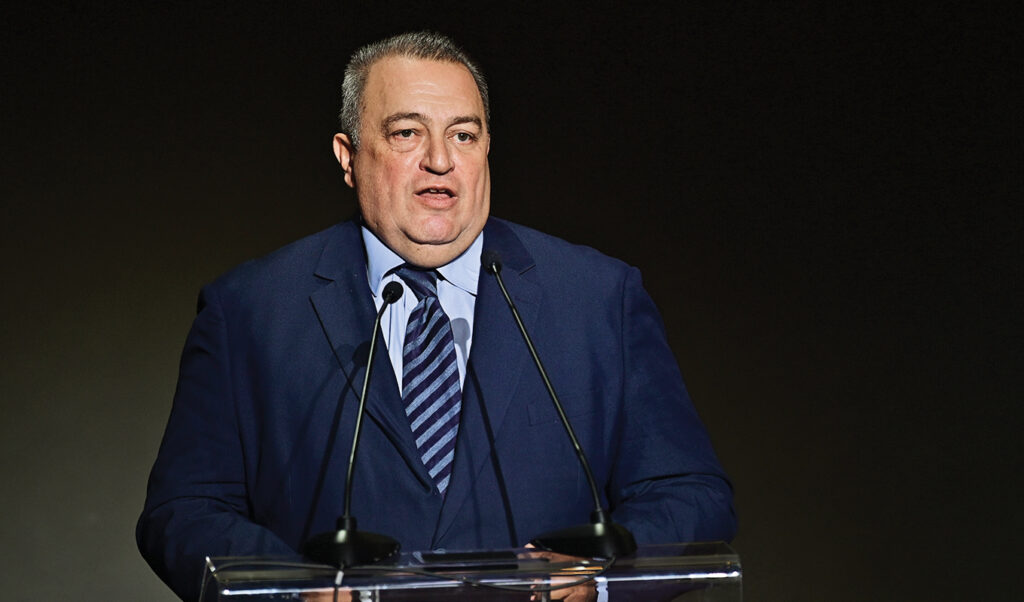
“Both Karamanlis’ presence at the New Democracy congress and his absence will signal something,” stated New Democracy MP Evripidis Stylianidis, speaking on Parapolitika 90.1 radio show “That One and Me” with journalists Stella Gantona and Thanasis Fouskidis. Specifically, when asked if he agrees that Mr. Karamanlis doesn’t need a special invitation to attend the congress, he replied: “I don’t want to get into that, because whether the former prime minister will be invited or will come is also his own matter. But certainly whatever he decides to do, it certainly signals something. In other words, his absence cannot be without content, just as his presence cannot be without content. In my opinion, however, these issues should not exist today. This should not be news. We need to heal the reason why they exist.”
“From what I understand, we have entered a pre-election climate, confrontations are intensifying, often logic goes to extremes, we try to find excuses everywhere to disagree, this doesn’t help, because the situation requires exactly the opposite. It requires broader consensus regarding the reform of the country’s constitutional charter, it requires a calm approach to international developments within which we must be to monitor what is happening and promote our national interests, and of course it requires sobriety in dealing with economic or other crises that may further torment the Greek people,” Mr. Stylianidis noted.
Evripidis Stylianidis: You can never know what will happen regarding the timing of elections
Regarding the timing of national elections, he said: “The ideal time and the institutional time and the right thing would be to go in spring, but in such a political environment you can never know what will happen. In any case, we are in the last year, meaning we are not deviating from the prime minister’s original commitment, but it’s good that four-year terms are maintained.”
Regarding the OPEKEPE and wiretapping cases, he noted: “Because I am both a lawyer and a politician, I know how to draw the dividing line between issues that must be dealt with systematically, impartially and uninfluenced by Justice and those that must be dealt with by politics. I have the feeling that in recent years politics has exceeded the boundaries of the distinct roles between these two powers in the sense that not all opposition confrontation can be confined only to issues that have anyway been referred from Parliament to Justice. Nor is it right to say that Justice is good or bad. We must let Justice do its job within the framework of its competencies, uninfluenced, with calm, with a sense of responsibility and justice and not under pressure either from public opinion or the pressure of political confrontations. Some issues are unpleasant, both the surveillance issue and the OPEKEPE issue and various other administrative issues and of course the Tempe issue are issues that hurt us all and sadden us, but at some point this cleanup had to start in certain sectors that other times the political leadership didn’t dare to do, it happened now. The issue is for it to be done correctly, to be done calmly and not to be done with passions because the balance between absolute impunity and absolute punitiveness is very difficult.”
“We must respect the European Prosecutor’s Office whether we agree with it or not”
Regarding the European Prosecutor’s Office, he said: “The European Prosecutor’s Office is an institution that we have approved and we must respect it whether we agree or disagree with it, and of course Justice has its own self-control mechanisms, if something doesn’t work properly there. Therefore, it makes no sense for a politician to comment on decisions.”
“Non-parliamentary ministers are judged primarily by the prime minister who chose them”
Finally, when asked if he believes non-parliamentary ministers are adequately judged, he replied: “Non-parliamentary ministers are judged primarily and absolutely by the prime minister who chose them, meaning if they don’t produce results for him, he is obliged to replace them. Secondarily, they are judged by the people because their decisions have a positive or negative impact and this certainly constitutes a compass for the Prime Minister and the government.”