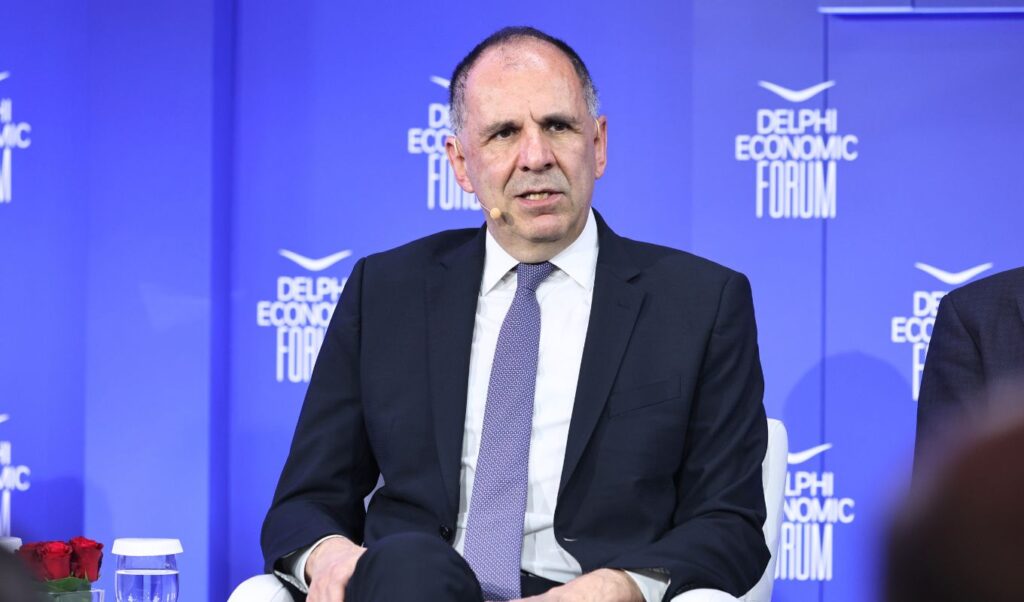
George Gerapetritis participated today, Wednesday (22/04) in a panel at the 11th Delphi Economic Forum on the Western Balkans. The Foreign Minister characterized the integration of the Western Balkans into the European Union as a credibility issue for Europe, emphasizing that Europe “will be stronger and more resilient” if “its neighbors become members.”
Gerapetritis from the 11th Delphi Economic Forum: We cannot imagine Europe without the Western Balkans
“We promised something that we failed to implement fully and timely. And my ambition as a minister preparing for the EU Council presidency in the second half of 2027 is to truly welcome one or more Western Balkan states into the European family,” he emphasized characteristically, later predicting that this will happen during the Greek presidency.
As the minister underlined, earlier today, the six Western Balkan member states in Greece approved the Delphi Declaration, which continues the 2003 Thessaloniki Declaration, when Greece, then the only member state from the region within the European Union, took the initiative to become the driving force for Western Balkan states’ integration into the European family.
“We must try to move from words to action,” the minister noted, emphasizing that he will visit all capitals in the coming months so Greece can offer technical assistance to Western Balkan states.
Mr. Gerapetritis characterized the Western Balkans as an integral part of our regional identity, noting that this is why we return to Thessaloniki 2003. “During these 23 years, there were many disappointments and Europe failed to offer a clear vision for enlargement,” he noted.
Subsequently, he called on the EU to send a “strong message that the Western Balkans’ path to Europe is a one-way street and that we must fully strengthen this path. It is a matter of stability, prosperity and peace”.
“We must try to reverse the possible disappointment or fatigue that Western Balkan states and peoples might feel,” he emphasized, adding: “The integration of Western Balkan states is essentially a path toward Europe’s reunification. And I believe this is truly important. Western Balkan states are at the heart of Europe. We cannot imagine Europe without the Western Balkans.”
“Europe will be stronger and more resilient under the current geopolitical situation if our neighbors become full members of the European Union,” he noted.
“Goal is economic convergence with the EU,” said Serbia’s Minister for European Integration
For his part, Serbia’s Minister for European Integration Nemanja Starović reminded that Serbia started its EU accession negotiations in 2014 and in recent years we have achieved much, although currently Montenegro and Albania are considered pioneers in the process. He noted, however, that 21 years ago, it was North Macedonia that was considered the pioneer.
“We should not view the enlargement process as a race or some kind of game about who will finish first, but we must focus on the structural reforms we implement in our own countries and the specific benefits they bring to citizens, leading us toward European Union membership,” he stated.
He emphasized that in Commission reports Serbia is the best candidate country, but believes it was a victim of political criteria. “What matters are the reforms that benefit the people and bring us closer to the European community there.” “The ultimate goal is not European Union membership,” he characteristically emphasized. “European Union membership is the very important means that leads us to the ultimate goal, which should be convergence with the EU environment and this cannot be fully achieved without membership”.
From this perspective, he noted that Serbia is on a good path, having already surpassed the psychological barrier of 1,000 euros monthly salary and in the next five years, according to program forecasts, it will reach 1,700 euros per month.
What Montenegro’s Deputy Minister for EU Affairs Ivan Ivanišević declared
Additionally, Ivan Ivanišević, Deputy Minister for EU Affairs of Montenegro, stated that European integration is a long-lasting process, emphasizing that “we are today as a society united in promoting these common European values, not only in Montenegro, but throughout the West.” “In the Balkans, we firmly believe that our path will be useful for all neighboring countries,” he said, thanking Greece for its continued support. “Our goal is to close all negotiation chapters as soon as possible and begin the final stage of accession.”
He also expressed satisfaction that a working group in Brussels for Montenegro’s accession preparation will soon be approved and that the process will be the model for future accession treaties. “We need guarantees today to avoid conflicts. We must truly show that the European Union and Europe as a continent have learned many lessons and that we can offer integrated solutions for the future,” he added.
Glauk Konjufca: “We must not allow these six Western Balkan countries to become five”
“It’s important to be fully committed to our values,” emphasized Glauk Konjufca, Kosovo’s First Deputy Prime Minister and Minister of Foreign Affairs and Diaspora, noting that in Kosovo people still view the EU integration process more positively than anyone else.
He noted that the Thessaloniki promise will be fulfilled if his country is granted candidate status, which was requested in December 2022. “We must not allow these six Western Balkan countries to become five,” he emphasized.
Ambassador of Bosnia-Herzegovina to Athens: “The path to the integration process is very difficult”
The path to the integration process is very difficult, but we must be optimistic, noted Dragan Vuković, Ambassador of Bosnia-Herzegovina to Athens.
He thanked Greece for providing great support on many issues. He emphasized that Bosnia-Herzegovina must make great efforts in various sectors and needs European Union investments, economic investments in the country. He stressed that the process is complex and decision-making difficult. The positive aspect, as he mentioned, is that all parties in Bosnia-Herzegovina and all sides agree on the goal.
Zoran Dimitrovski: “Need for a specific timeline for accession”
“It is very important that Greece, as a country in our immediate neighborhood, supports us,” noted Zoran Dimitrovski, Deputy Foreign Minister of North Macedonia, welcoming the news shared by Mr. Gerapetritis that during the next Greek EU presidency, they will welcome members from the Western Balkans.
He noted it’s problematic that so much time has passed since Thessaloniki 2003, and that the problems countries faced were rather bilateral issues with neighbors. “Having changed the Constitution several times, having changed the flag, the name etc., we need more predictability on our path to becoming European Union members,” he emphasized.
He noted that the name change process was very painful, but ultimately the country became a NATO member. “I believe this constitutes a very good example of how differences between countries should be resolved and, ultimately, give impetus to European integration,” he said, expressing willingness to start negotiations with Bulgaria as well.
He also emphasized the need for a specific timeline and noted that some countries are approaching the European Union, like Montenegro and Albania. “It’s very important that the other four Western Balkan countries don’t remain a black hole in the heart of the European Union,” he stressed. “We need a policy of predictability for all Western Balkan countries.”
Albania’s Minister for Europe and Foreign Affairs, Ferit Hoxha: “We have said everything to keep the flame for integration alive”
“I am truly excited that in the coming years we will see a different situation, because this is a credibility issue,” noted Ferit Hoxha, Albania’s Minister for Europe and Foreign Affairs.
“In our countries, in our societies, we have said everything to keep the flame of enlargement and our future alive, as citizens desired, but we must meet expectations,” he emphasized, adding: “We must truly ensure that promises from both sides will finally find the opportunity to become reality, and we have been waiting for this moment for a very long time.”
He also noted that enlargement has returned as a central issue in the European Union and that we must not let it disappear before we utilize it fully.
“On November 13, Albania had not opened any chapter in the process. On November 17, last week, we had opened three chapters. This is progress. This is real work. This happens when both sides respond to our commitment, our work, our energy, but also to the will of the European Commission and member states.”
“There was never a moment when enlargement did not prove beneficial for the European Union, for citizens, for countries that joined, for societies that integrated,” he concluded.