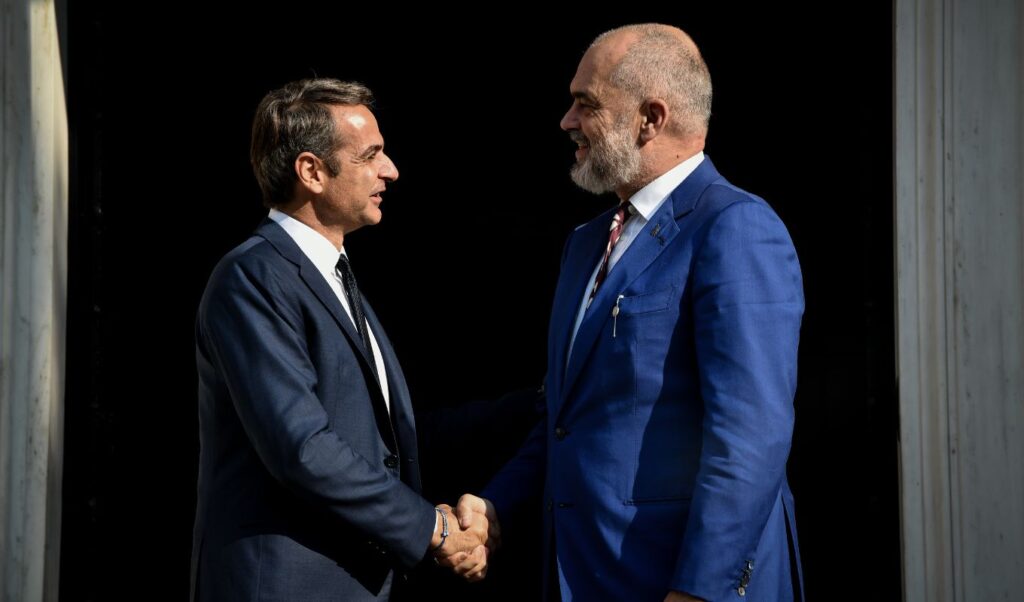
Albania’s Prime Minister Edi Rama is in Greece to meet with Greek Prime Minister Kyriakos Mitsotakis during his participation in the Delphi Economic Forum.
Read: Kyriakos Mitsotakis: Meeting with Edi Rama Wednesday morning at Maximos Mansion
Despite the differences that divide Athens and Tirana, the two leaders maintain good communication, which was severely damaged by the removal of Fredi Beleri from his mayoral position in Himara. Since then, communication channels have been largely restored, though problems remain. Turkish support and backing has increasingly infiltrated Greek-Albanian relations in recent years, appearing to significantly influence Albania’s decisions and pushing it toward an aggressive stance against Greece.
“Edi Rama feels suffocated by his role as prime minister of small Albania”
Professor of International Relations and New Democracy parliamentary spokesperson Dimitris Kairidis delivers harsh criticism of Albania’s Prime Minister through parapolitika.gr. As he states: “There are some leaders who find their country’s size too small for their ego and ambitions. Edi Rama is certainly one of them, feeling suffocated by his role as prime minister of small Albania. However, he should know that pride is one thing and narcissism is another, which for a country like Albania that seeks Greece’s agreement and that of other Europeans to advance its EU accession process, doesn’t help. Rama is recognized by some and certainly self-identifies as charismatic. Whether he is also prudent remains to be seen.”
Bilateral relations between Greece and Albania are characterized by a series of deeply rooted differences that create a complex diplomatic landscape. One of the main friction points is the issue of the Greek minority in Northern Epirus. For the Greek side, protecting minority rights is a key demand, as the majority of Greeks believe these rights are systematically violated. Foreign Minister Giorgos Gerapetritis has repeatedly raised this issue in meetings with his counterparts Igli Hasani (June 3, 2025) and Eliza Spiropali (December 16, 2025), characterizing the protection of the Greek minority as “a major priority for our country, a bridge of understanding and a strong link in the relationship between the two countries.”
The Albanian side maintains that the state treats the minority fairly. Specifically, the property issue constitutes a major “thorn.” However, in his interview with “Kathimerini” (April 19, 2026), Edi Rama justified his government’s stance on this matter. “Property rights remain a broader issue throughout the country, it’s not something that exclusively concerns the Greek minority. Greeks and Albanians living in the same village face the same challenges,” he stated, attributing the problem to “difficult historical legacy” and the destruction of property titles during the 50 years of communism, while also mentioning cases where property titles were granted to the wrong people. On the Greek side, however, there is a sense that the minority is disproportionately affected and, although Albania claims that the cleanup of the land registry in areas like Himara proceeds regardless of owners’ origin, the process remains extremely complex and a source of ongoing friction.
A critical strategic field of disagreement is the EEZ delimitation between the two countries. Although Greece and Albania had signed an agreement in 2009 that defined the EEZ based on the median line, a year later, in 2010, the Albanian Constitutional Court rejected it, questioning the full effect of certain Greek islands, adopting Turkey’s rhetoric. The issue has now been referred to The Hague for resolution, with Greece claiming the extension of maritime zones to 12 nautical miles, as provided by the agreement Greece achieved with Italy.
Simultaneously, Albanian nationalism constitutes Greece’s main concern in bilateral relations. At the center of this concern is the Cham issue, promoted by extremist organizations in the country. For Athens, these claims create irredentist perceptions and a revisionist attitude attributed to Turkish support.
Beyond the remaining differences, Greek foreign policy focuses on developing and establishing good neighborly relations with Albania. The two countries cooperate within NATO and UN frameworks, while Foreign Minister Giorgos Gerapetritis has supported the neighboring country’s EU accession within the framework of Union enlargement through Western Balkans integration, as decided at the 2003 Thessaloniki Summit.