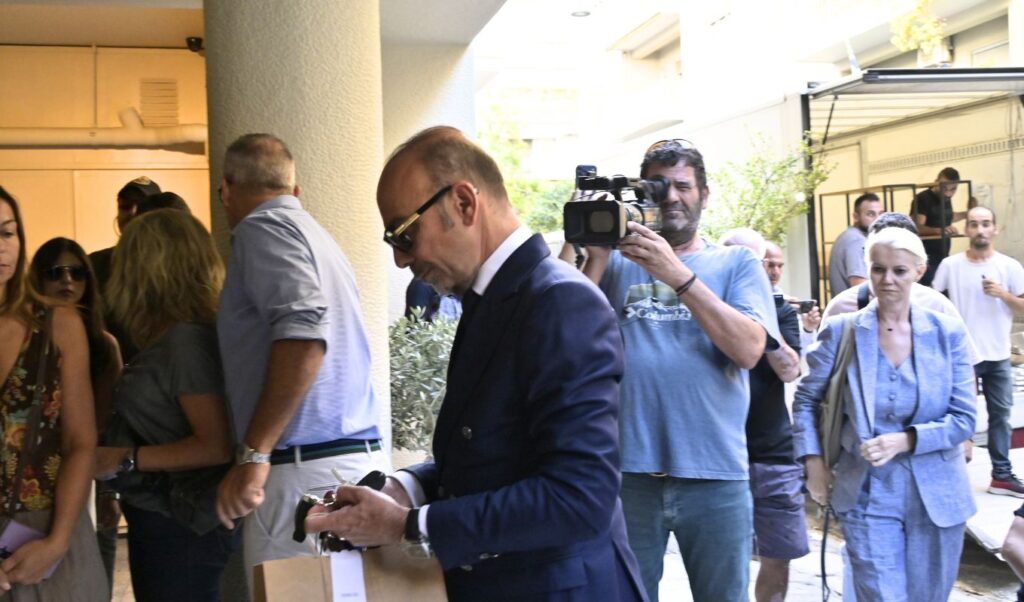
Giorgos Mazonakis remained connected to the plasmapheresis machine at the clinic on Karneadou Street in Kolonaki for a considerable period of time, according to information obtained from the machine’s recorded logs. Specifically, at 14:14 the device was activated, though the procedure had not yet begun. At 14:23, the first warning signal was recorded, while at 14:37 the procedure commenced.
Giorgos Mazonakis: The first treatment pause and the call to emergency services
At 15:22, the first treatment pause was recorded, with the machine halting the procedure. Between 15:22 and 15:45, three additional warnings were logged. At 15:45, an attempt to restart the machine was reportedly made, but it stopped again almost immediately. The call to emergency services (EKAV) was placed at 16:11. From the first pause at 15:22 to the emergency call at 16:11, 49 minutes had elapsed. During this window, three warnings had been recorded, a restart of the machine had been attempted, and ultimately the call for emergency assistance was made.
The digital log provides precise timestamps. What is now critical is clarifying exactly what each warning signal indicated, what Giorgos Mazonakis’s condition was at each point in time, and what actions were taken in the 49 minutes leading up to the emergency call.
Nikolousis’s explanation
Speaking to parapolitika.gr and Anna Emmei, hematologist Manolis Nikolousis — a bone marrow transplant specialist and director at the Yas Clinic Group — explained the possible causes that could trigger a warning signal on the specific machine, emphasizing that the patient’s clinical condition is always the determining factor. According to Nikolousis, one possible cause is inadequate blood flow due to low blood pressure. A warning signal may also be related to thrombosis in the vein where the catheter was inserted, which, as he clarified, is not life-threatening on its own.
Another possible cause is a kink in one of the tubing circuits of the plasmapheresis system, resulting in disrupted flow. In rarer cases, the hematologist noted, a warning may even be triggered by a malfunction of the machine’s optical sensors. Additionally, if the vein walls collapse around the catheter, blood flow may become restricted and the procedure cannot continue normally.
The above possibilities explain what could lead the machine to trigger a warning. However, they do not by themselves answer the central question of the case: what caused the specific warnings that were recorded, and what was Giorgos Mazonakis’s condition at those moments.
On this precise point, Nikolousis places particular emphasis on the patient’s clinical picture: “When the patient is not doing well, the procedure stops regardless,” he noted. Of particular significance is the restart attempt recorded at 15:45, which followed the first treatment pause and three additional warning signals. According to Nikolousis, the significance of a restart depends on the reason that caused the machine to stop. A tubing issue, for example, can be addressed without requiring the entire procedure to be restarted from the beginning.