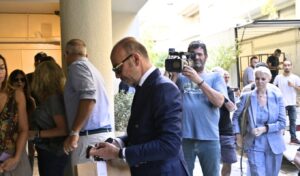
Ioanna Gaka, the doctor charged with manslaughter with possible intent in connection with the death of 54-year-old Giorgos Mazonakis, obtained her credentials from a private institution in Honolulu, Hawaii, marketed as a “Quantum University.”
Read also: Two doctors face investigators over Mazonakis death – Charged with possible intent (Images & Video)
Giorgos Mazonakis: The fake Hawaii degree of the unqualified doctor — online courses and a marketing strategy
In her CV, doctor Ioanna Gaka lists a second master’s degree (MSc) in Quantum Medicine from Quantum University. However, as McGill University in Canada has pointed out, it “is not a university. Rather, it is described as an online ‘institution of higher learning'” which, by its own description, “is not accredited by an accrediting agency recognized by the United States Secretary of Education.”
According to the same sources, “the desire to impress is a core element of Quantum University’s marketing strategy. Its catalogue makes this clear again and again, to the point of absurdity. ‘Earning a doctoral degree allows you to use the title of Dr.,’ it states. It also ‘recognizes you as an authority’ and gives you the qualifications ‘to be certified by many respected and prestigious professional associations, organizations, and certifying bodies.'”
The catalogue of offered courses includes titles such as “Mastering Singularity,” “The HeartMath Experience,” and “Quantum Physics and Health.” All education is delivered entirely online, with the institution providing students with tablets containing 250 hours of pre-recorded material. As stated on its website, “courses include a total of 12 to 20 hours of video lectures and presentations, delivered via a playlist of individual videos ranging from 2 minutes to 2 hours in length.”
“Quantum medicine is a baseless term” — the Greek Physics Association weighs in
The public disclosure of Ioanna Gaka’s credentials and her use of the term “quantum medicine” prompted a response from the Greek Physics Association, which denounced it as a “baseless term,” adding that “the uncritical and improper use of scientific terminology to lend credibility to unsubstantiated claims is not limited to the word ‘quantum.'”
Official statement from the Greek Physics Association
The Greek Physics Association (GPA) considers it useful to clarify the meaning of the term “quantum,” given its widespread use in public discourse.
A quantum phenomenon is one that has been observed and is interpreted within the mathematical framework of quantum physics. Such phenomena were first observed in the early 20th century and led to a quantum description of reality. Notable examples include thermal radiation, atomic and molecular radiation, the wave behavior of matter, quantum tunneling, and entanglement.
The predictions of quantum theory have been verified through exhaustive and systematic observation. By the late 20th century, it became possible to encode information at the level of a single atom, giving rise to quantum computers, the quantum internet, quantum communication, and the emerging field of quantum intelligence. These achievements in quantum information science have established the internationally recognized term “Second Quantum Revolution,” with significant applications in biology, medicine, and knowledge processing.
Can we extend these successes of quantum physics further? Vision and creative imagination are certainly necessary — but they cannot replace the painstaking work of systematic scientific research. A prime example of this overreach is the baseless terms “quantum medicine,” “quantum healing,” and “quantum consciousness,” introduced by Deepak Chopra in 1989 in the United States [1]. Although these “pioneering” ideas attracted public interest, they were shown to lack sufficient scientific grounding. Chopra himself acknowledged in 2007 that he had used the term “quantum medicine” as a literary metaphor, and that in this context, the word “quantum” bears no relation to quantum physics [2].
As a mark of complete disapproval, the American Physical Society awarded him the “Ig Nobel Prize” in 1998 — a satirical prize given to unsubstantiated claims that gain public attention, with the aim of ridiculing and debunking them [3]. The “degrees” awarded by the so-called “Quantum University” in Hawaii are not recognized, as McGill University in Canada has noted [4], since the institution “abuses physics for the purpose of training quacks.”
The uncritical and improper use of scientific terminology to bolster unsubstantiated claims is not limited to the word “quantum.” Critical thinking and rational discourse are essential tools for navigating the overwhelming flood of information available today.
Georgiadis: “When you hear ‘quantum medicine,’ it’s a scam”
“If you hear ‘quantum medicine’ — which Maria Karystianou also invokes — it is a fraud. There is no scientifically recognized quantum medicine. There is no university, no legitimate medical school that teaches quantum medicine,” said Health Minister Adonis Georgiadis on Tuesday morning.
He also stated that “Ilias Theodoropoulos — the second defendant in the case of Giorgos Mazonakis’s death — had no involvement with the medical equipment; he was providing alternative nutrition plans and vitamins. From what I have been told, he and Gaka were doing different things. As Health Minister, I urge people not to trust alternative treatments — when you hear ‘quantum medicine,’ run the other way. The fact that a fraudster has been found does not mean all of alternative medicine should be condemned.”