
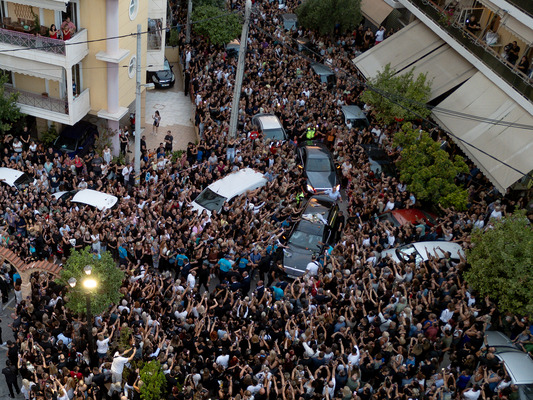
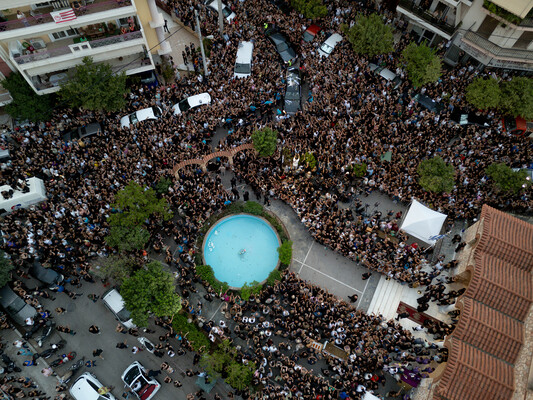
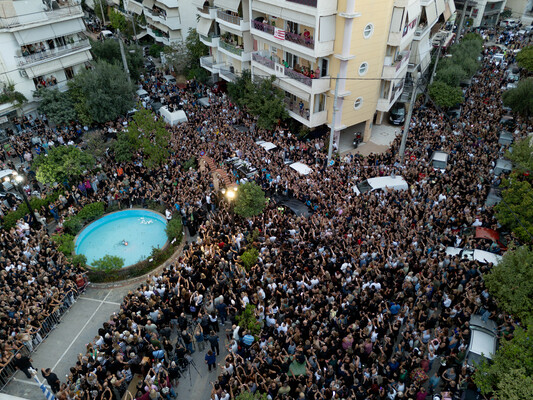
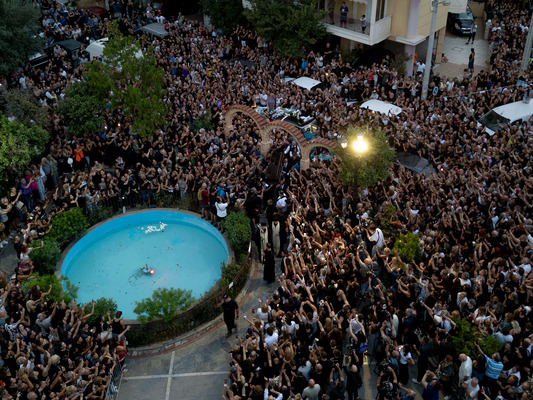
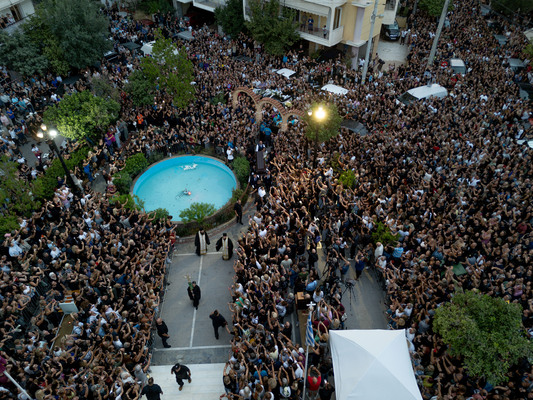
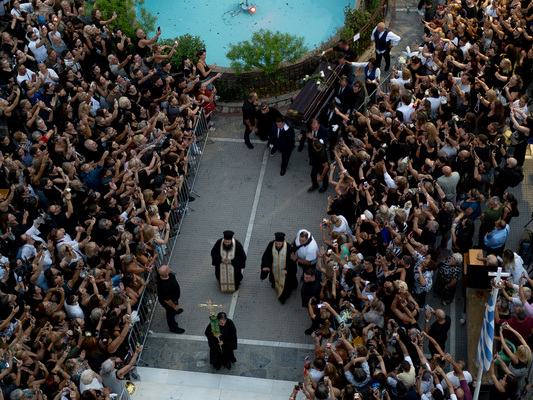
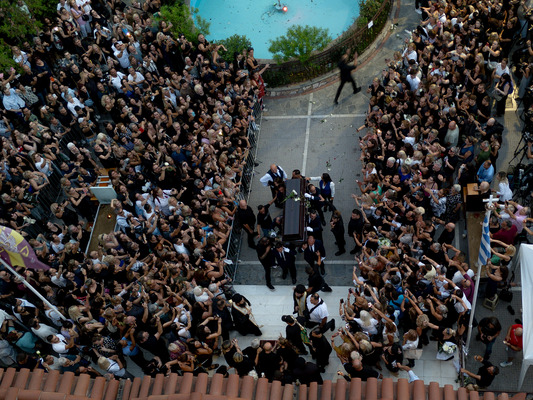
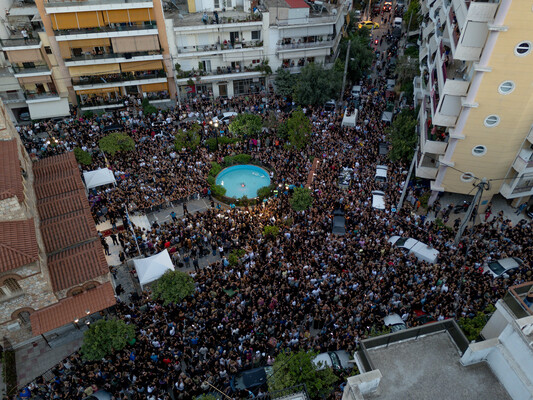
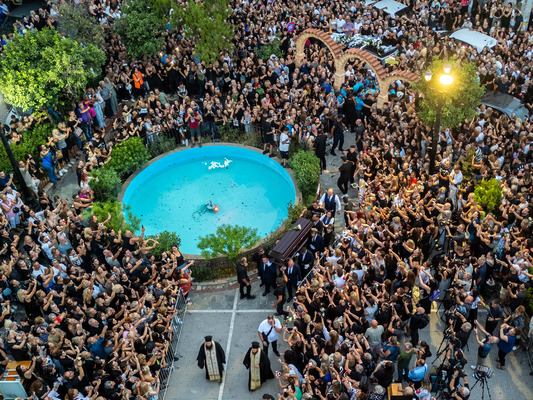
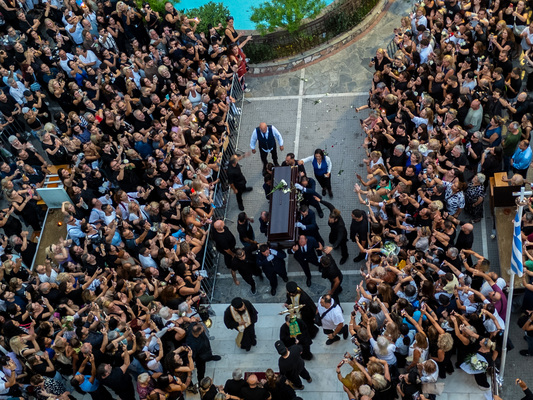
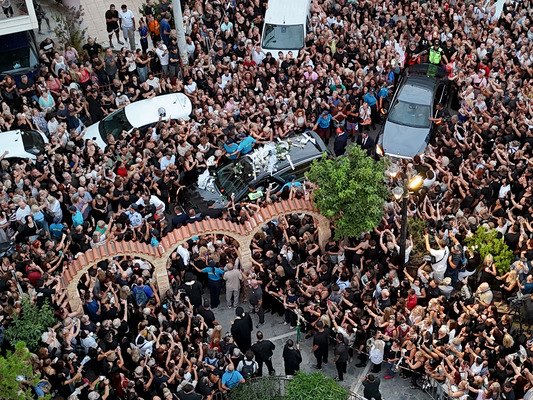
Giorgos Mazonakis undoubtedly touched the souls of Greeks everywhere — and far beyond. Every song and melody he created became the soundtrack to cherished moments in people’s lives, forever tied to the music of the beloved artist who passed away on Wednesday at the age of 54. The crowds that gathered waited patiently to say their own goodbye to their Giorgos, who returned — far too soon — to his old neighborhood of Nikaia.
The camera lens captured in full the overwhelming grief and the sea of people who flooded the Holy Church of Agia Triada to pay tribute to one of Greece’s greatest artists.



Who was Giorgos Mazonakis
Giorgos Mazonakis was born and raised in Nikaia, Piraeus, with roots in Siteia, Crete. He grew up listening to classic Greek folk songs from voices like Stratos Dionysiou, Giannis Parios, Marinella, and Charoula Alexiou, alongside a heavy diet of foreign rock music. It didn’t take long — by the age of just 15 — for him to realize that becoming a professional singer was his true calling.
He first performed at a nightclub in Patras, where in the summer of 1992 he was discovered by Universal Music (then known as Polygram). With his distinctive temperament, unique vocal delivery, and forward-thinking artistic vision, Giorgos Mazonakis went on to transform the Greek nightlife entertainment scene through a series of hugely successful performances at some of Athens’ most prominent venues.
He also performed extensively across Greece, Cyprus, Germany, and Australia, as well as in several American cities including New York, New Jersey, Atlantic City, and Chicago. A best-of compilation featuring his greatest hits was also released in Italy, following the success of his song “Mou Leipseis” in an automotive advertisement there.
In 2002, he recorded two songs by Stamatis Kraounakis for the soundtrack of Nikos Panagiotopoulou’s film “I’m Tired of Killing Your Lovers” — “Kamikazi” and “Ximeroni Pali.”
His debut album, “Mesanychta kai Kati” (“Midnight and Something”), was released in 1993. The following year, his album “Me ta Matia na to Les” sent him straight to the top of the charts with hits such as “3 to Proi” (“3 in the Morning”), “Aniko se Mena” (“I Belong to Myself”), and “Mi Mou Zitas” (“Don’t Ask Me”). In 1996, the single “Mou Leipseis” (“I Miss You”) was released and went gold. A string of CD singles and albums followed, including “Paidi tis Nychtas” (“Child of the Night”) in 1997, which went platinum, and the single “Thelo na Gyriso” (“I Want to Go Back”), with lyrics by Nikos Vourliotis, among others.
A defining chapter in Giorgos Mazonakis’ artistic journey was the radical transformation he brought to the way live performances were staged. Under the guidance of choreographer Konstantinos Rigios, the artist chose to reimagine the layout of the venues where he performed, introducing lounge-style seating — complete with sofas — for audience members. This innovation fundamentally changed the dynamic between performer and crowd, creating a far more intimate and immersive atmosphere.