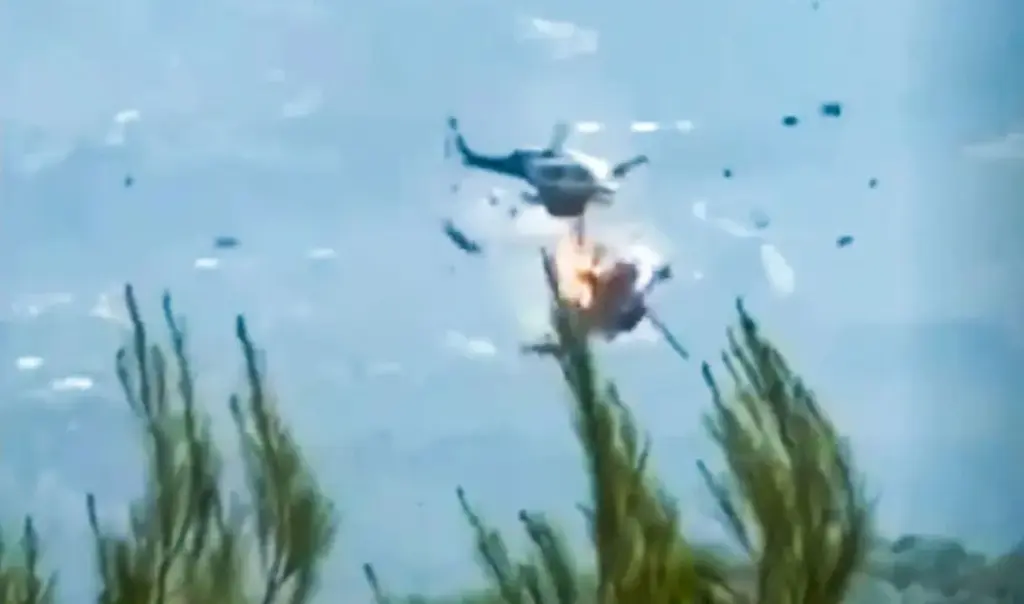
A full investigation is underway into the mid-air collision between two Bell firefighting helicopters that occurred in the Psatha area during aerial firefighting operations targeting the massive wildfire burning across the Attica-Boeotia region. Authorities are examining all possible scenarios that may have led to the accident, from human error and potential mechanical failure to the operational conditions prevailing at the time of the mission.
Read also: Two firefighting helicopters collide while battling the Psatha wildfire
Helicopter collision: What experts Fragkoulis and Karaiosifidis say
Speaking to Mega TV, aeronautical engineer and aviation accident investigator Fragkoulis described the incident as a “tragic mistake,” noting that the collision footage raises serious questions that the investigation must answer. As he explained, if it is confirmed that one of the two helicopters was performing a coordination role, this raises a significant concern — because, as he stated, coordination helicopters are not permitted to also participate in firefighting operations.
He stressed that before any firm conclusions can be drawn, the Fire Service must clarify the exact role of the second helicopter — specifically, whether it was acting as a coordination aircraft or whether it was also actively participating in aerial firefighting.
“The second helicopter was coming in to land. The first helicopter sustained massive damage from the skids of the other aircraft. The collision destroyed the main rotor. What they need to tell us is whether the helicopter that struck the other one with its skids was the coordination helicopter. A coordination helicopter that also participates in firefighting is strictly prohibited. A coordination helicopter carries a Fire Service officer on board and operates at a higher altitude than the other helicopters,” Fragkoulis stated.
Also speaking to Mega TV, aeronautical engineer Faidon Karaiosifidis offered his own assessment:
“From what we can see, these are two helicopters belonging to the contractor company that leases aerial assets. We’ve had quite a few of them this season — they are two Bell 212 ST aircraft. And from what we can make out, they were flying in formation. It appears the lead helicopter was much closer to the fire than the one behind it, and there was a sudden change in altitude — a descent — which reduced the distance between them, causing the collision. We also learned that one of the helicopters, the second one, apparently failed to maintain controlled flight and performed an emergency landing.”
He continued: “From what we can see, the flight paths of the two helicopters essentially converged — meaning the second helicopter ended up inside the rotor disc of the first. With a destroyed rotor disc, a helicopter literally drops like a stone. It’s a miracle that we didn’t end up with both aircraft going down in this incident. These helicopters can carry around four tonnes of water and can perform water scooping from relatively shallow sources. They have been fighting hard over the past few weeks. Unfortunately, this is the second crash involving a helicopter from the same company — at the end of June, we had another one in the Epirus region.”
The two helicopters were operating in formation
According to initial findings, the two helicopters were conducting their mission in formation, as is standard practice in aerial firefighting operations. Such missions require absolute coordination between crews, strict adherence to safety separation distances, and well-defined approach and withdrawal procedures from the fire front.
The central question investigators must answer is what caused the loss of the required separation between the two aircraft and how they came to be on a collision course. The answers are expected to emerge from the official expert investigation, which will examine all available data with the aim of establishing the exact circumstances of the accident and drawing reliable conclusions about the cause of the tragedy.
First findings from video footage
Based on available video of the incident, preliminary assessments suggest the second helicopter may have struck the first, which appears to have been leading the formation. However, experts caution that the footage alone is insufficient to draw definitive conclusions.
The investigation is expected to examine all available data, including the movements of both helicopters, flight conditions, crew communications, weather conditions, and the technical state of the aircraft.
According to retired Lieutenant General Adrianos Goubарsis, the investigation should focus on how the two helicopters were being communicated with and guided in the moments before the collision, as well as who held responsibility for their operational coordination.
He argues that the two helicopters should never have been on a trajectory that posed a risk of contact, and suggests the possible involvement of a ground coordinator who — as he contends — did not hold the necessary authority to manage air traffic.
The key questions driving the investigation
In the wake of the Bell helicopter collision, authorities are tasked with answering a series of critical questions:
- How did the two helicopters end up in such close proximity?
- Was there a clearly defined separation between their flight paths?
- Who held final coordination authority over the movements of the aerial assets?
- Were there any communication failures between the crews or operational command centers?
The answers are expected to emerge only after the official investigation into the incident has been completed.
View this post on Instagram
Related Posts