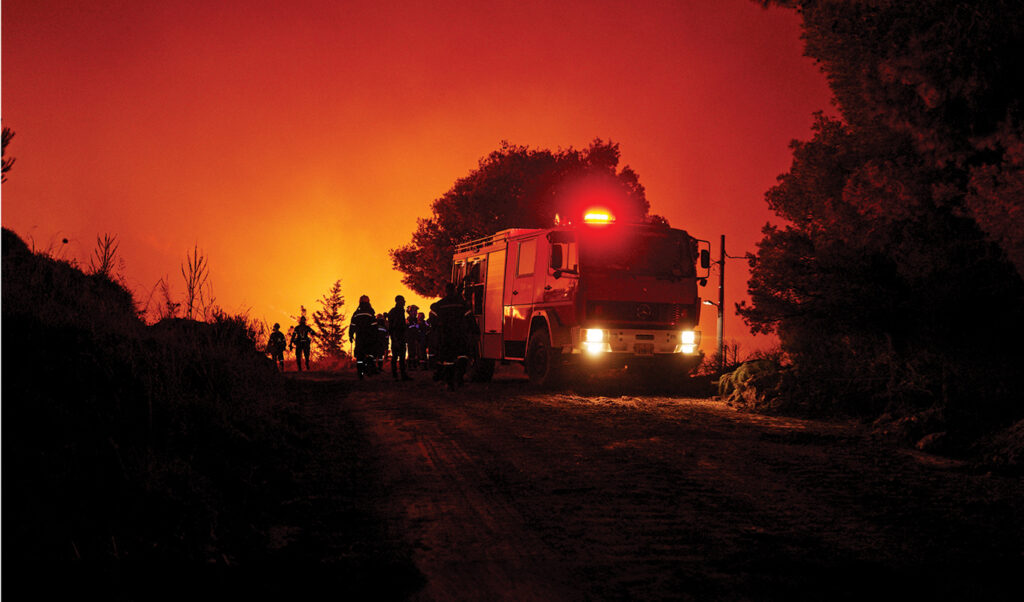
As large wildfires break out with increasing frequency and the climate crisis pushes Greece’s Civil Protection mechanism to its limits, approximately 3,600 volunteer firefighters are standing on the front lines, shoulder to shoulder with their paid colleagues. Despite growing public interest in joining the corps, equipment shortages, limited institutional support, and the everyday challenges of balancing personal and professional life continue to undermine the institution.
Read also: Wildfires: Seven arrests in just days for arson — €9,360 fine issued over the Heraklion fire
As volunteer fire chief Pavlos Kokkos — vice president of the Panhellenic Association of Volunteer Firefighters and deputy head of the Volunteer Fire Brigade of Hydra — tells PARAPOLITIKA, there are currently just under 3,600 active volunteer firefighters serving across the country. “The number of active volunteer firefighters in Greece right now stands at just under 3,600 — men and women alike. As you can imagine, that number remains limited relative to the country’s actual needs,” he says.
In recent years, he explains, more and more citizens have expressed interest in joining the corps — particularly in the wake of the devastating wildfires that have scarred many parts of Greece. Yet this heightened willingness to serve does not always translate into a higher number of active volunteers, as many end up leaving. According to Kokkos, the root cause lies in a fundamental misunderstanding — both by the state and by the Fire Service itself — of what firefighting volunteerism actually means. In practice, this means volunteer firefighters still lack the support they need, and the daily difficulties they face drive many to frustration and, ultimately, resignation.
“Greece currently has around 3,600 volunteer firefighters — a figure that rises to 1.1 million in Germany and 340,000 in Austria.”
“The real challenge is retaining volunteer firefighters, not just recruiting them”
Kokkos believes one of the most pressing problems is that a large part of Greek society still doesn’t fully understand what it means to be a volunteer firefighter. “Most people don’t know the difference between a volunteer firefighter, a Civil Protection volunteer, and a general volunteer,” he says. As he clarifies, “under Law 4029/2011, a volunteer firefighter is exclusively someone who offers their services to the Fire Service without pay and is formally integrated into its structure. They are governed by the full legal and regulatory framework of the Fire Service. All other citizens who provide firefighting and rescue services without compensation are classified either as Civil Protection volunteers or simply as volunteers.”
Major natural disasters often serve as a catalyst for young people to put on the volunteer firefighter’s uniform. “Particularly after every large natural disaster, we see a surge of interest from young people who want to give back to society,” Kokkos notes. But despite that enthusiasm, the real challenge, he stresses, is something else entirely. “The goal isn’t just to attract new volunteer firefighters — it’s primarily to retain them. Staying active requires continuous training, significant personal commitment, physical presence at stations, and participation in high-risk operations. Without tangible support from the state, many find it hard to keep going year after year,” he says, noting that the Panhellenic Association of Volunteer Firefighters has repeatedly submitted proposals to upgrade the institution and has already secured some meaningful changes. These include increasing the basic training hours for new volunteer firefighters from 120 to 150, and raising the mandatory retirement age from 60 to 65. Despite these positive developments, Kokkos believes there is still a long road ahead.
“Despite our ongoing efforts to modernize firefighting volunteerism in Greece, we almost always find closed doors and deaf ears,” he says bluntly. Volunteer firefighters come from no single professional or social background. The corps includes public and private sector employees, self-employed professionals, scientists, tradespeople, farmers, students, and even active military and law enforcement personnel.
The largest age group falls between roughly 25 and 40 years old, while the presence of women has been steadily growing in recent years. “Women serve on equal terms, train to the same standards, and participate in the same operational missions,” Kokkos notes, adding that “the common thread connecting all of them is a desire to serve and a willingness to accept the responsibility that comes with the role of volunteer firefighter.”
“An indispensable part of the operational force”
The contribution of volunteer firefighters becomes even more critical during the wildfire season, when demand surges and Fire Service units are simultaneously managing dozens of incidents across the country. Although no official nationwide statistics exist to capture how many operations involve volunteer firefighters, Kokkos argues that in many parts of Greece they form an indispensable part of the operational force.
“We don’t have official figures showing what percentage of nationwide operations we participate in. What I do know is that in many areas of Greece where volunteer fire brigades and stations are active, our colleagues are an integral part of the operational force — and without their involvement, managing the heightened demands of those areas, especially during wildfire season, would be extremely difficult,” he says. It is worth noting that there are currently 25 volunteer fire services operating across Greece, covering areas where the establishment and operation of professional services is not feasible. In those communities, volunteer firefighters are effectively the primary operational force for responding to emergencies. That said, the picture is not uniform across all stations. According to Kokkos, many volunteer firefighters assigned to professional fire stations are not being utilized to their full potential, because “in many cases, due to a lack of basic personal protective equipment, they are assigned mainly to telephone operator duties, with no opportunity for further operational involvement.”
“Greece needs more trained volunteer firefighters”
The increasingly frequent and destructive wildfires make strengthening the volunteer firefighting institution an urgent priority, according to Kokkos. “The climate crisis has fundamentally transformed the operational environment. Fires are now larger, more intense, last for more days, and are more frequently accompanied by extreme weather events such as floods and violent storms,” he stresses, explaining that “this means Greece needs more trained volunteer firefighters who can decisively reinforce the work of the Fire Service and build greater resilience in local communities against natural disasters.”
He also reminds us that the responsibilities of volunteer firefighters extend well beyond forest fires. “Our operational involvement, under the legal framework that governs us, covers all the duties and obligations of a permanent firefighting officer — with the exception of investigative functions. The absence of systematic state support for volunteerism within the Fire Service therefore deprives the country of a force multiplier at a time when the demands on firefighting and rescue services are already enormous and growing,” he makes clear.
Kokkos believes Greece lags significantly behind the European model of firefighting volunteerism. In Germany, he points out, approximately 1.1 million volunteer firefighters serve alongside around 35,000 professionals, with some 24,000 volunteer fire stations compared to just around 100 professional fire services. In Austria, around 340,000 volunteers serve alongside approximately 6,000 professionals, with more than 4,500 volunteer fire services in operation. “The same pattern holds across virtually all European countries. In Greece, we have just over 3,500 volunteer firefighters, while professionals number around 17,000. We have just 25 volunteer fire services — compared to over 4,500 in Austria,” he notes, adding that “in reality, a country with a smaller population than Greece — such as Austria — has roughly 70 times more volunteer firefighters and 750 times more volunteer fire services.”
“Staying active requires continuous training, significant personal commitment, physical presence at stations, and participation in high-risk operations.”
“Volunteer firefighters ask only for the tools they need”
Despite their selfless service, volunteer firefighters continue to face serious shortages — particularly when it comes to basic equipment. Kokkos reveals that approximately 600 new volunteer firefighters who graduated from the most recent intake (the 14th volunteer cohort) four months ago have still not received even the most basic gear needed to begin their duties. “They have not received their station uniform, their wildland helmet, their wildland boots, or their gloves — the absolute minimum equipment required to begin fulfilling their mandatory eight-hour shifts at the stations and brigades where they have been posted,” he states.
The problem, he adds, is not limited to new recruits. Many longer-serving volunteers are still waiting for equipment, even years after completing their training. Even more troubling, he says, is the situation regarding gear for urban incidents — including structural firefighting helmets, turnout gear sets, and boots. “This equipment has never been provided by the Fire Service to volunteer firefighters since the very beginning of the institution,” he asserts.
According to Kokkos, many volunteers are forced to purchase costly equipment out of their own pockets, while others simply give up, unable to bear the financial burden. Beyond equipment shortages, volunteer firefighters must daily juggle their professional and family lives with the demands of service — while, as Kokkos notes, some employers still look unfavorably upon employees who are absent during major operations.
For Kokkos, the solution lies in a fundamental upgrade of the institution. “The state must treat volunteerism within the Fire Service as a strategic pillar of Civil Protection — not as a supplementary solution,” he insists. He also argues for more incentives, a modernized legal framework, better training, consistent funding, and the immediate provision of necessary equipment, so that more citizens can serve without being personally or professionally penalized. He considers the cultivation of a volunteering culture from school age equally important. “Our education system and our schools need to actively aim at producing as many engaged volunteers in society as possible,” he says. Closing, he sends a clear message to the state, the Fire Service, and society at large.
“Volunteer firefighters are not asking for privileges. They are asking for the essential tools that allow them to serve safely and effectively where society needs them — and for the institutional framework that will allow their full potential to be realized. Volunteerism does not take jobs away from public sector workers. It adds a multiplying force to the ever-growing need to protect lives, property, and the natural environment,” Kokkos concludes.
In a period when major wildfires, floods, and extreme weather events are testing Greece’s resilience with increasing frequency, volunteer firefighters insist they are asking for nothing extraordinary — just the basics: the equipment they need, institutional support, and the opportunity to be fully utilized, so they can continue to serve safely where society needs them most.
Published in Parapolitika