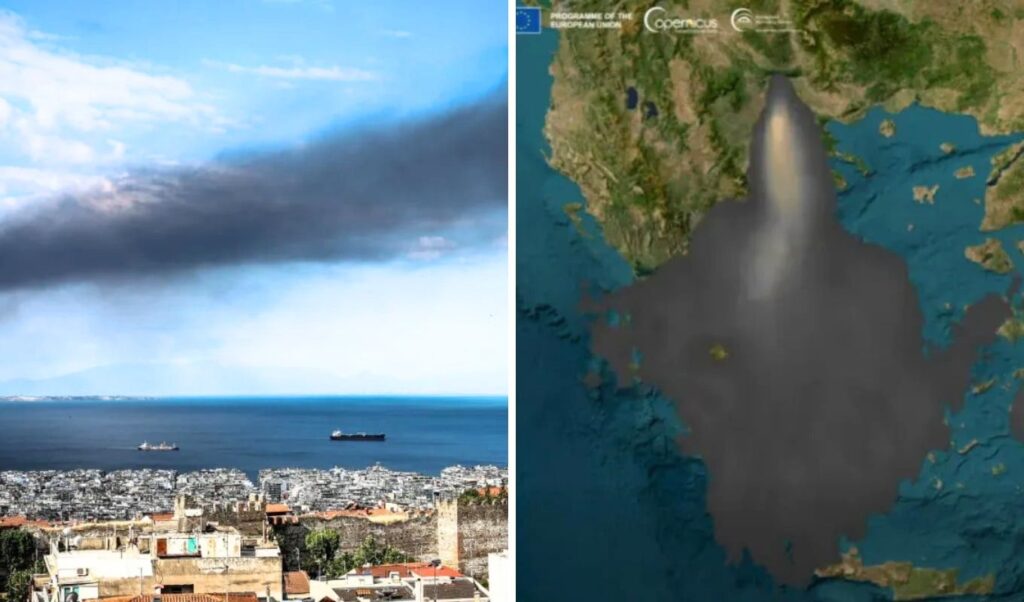
Serious concern is spreading through the scientific community over the dense, toxic smoke cloud that has blanketed the skies above Thessaloniki. The severe air pollution was triggered by a major fire that broke out on Saturday (4/7) in Oreokastro, which continues to engulf two industrial facilities in the area.
Oreokastro fire: Watch the video simulation tracking the smoke plume over Thessaloniki
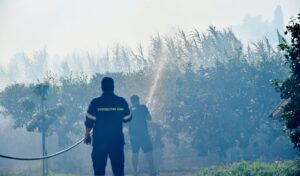
The forest fire that broke out on Saturday in Oreokastro no longer has a single unified active front. However, firefighting forces continue their battle unrelenting, as flames persist inside two factories in the area, continuously generating new hotspots.
The thick, black smoke from the industrial blaze has affected a vast portion of the Thessaloniki metropolitan area. Due to the severity of the situation and the dangerous levels of atmospheric pollution, authorities issued emergency alert messages (112), urging residents in affected areas to take immediate protective measures, stay indoors, and avoid unnecessary movement.
The pilot smoke transport simulation service from AtmoHub is tracking the progression of the smoke plume over the coming hours, based on total column smoke data. Dispersal patterns depend on prevailing meteorological conditions and are continuously updated.
The near-surface simulation indicates impact across the wider Thessaloniki region and southward transport, with potential effects on parts of Thessaly and northern Evia.
According to AtmoHub’s post, the combustion of recyclable materials can lead to elevated concentrations of particulate matter (PM₂.₅ and PM₁₀) and other atmospheric pollutants across the area affected by the smoke plume. The intensity of the phenomenon depends on the materials being burned and the prevailing weather conditions.
Dimosthenis Sarigiannis: A “toxic cocktail” of forest and industrial combustion
Professor of Environmental Engineering at Aristotle University of Thessaloniki, Dimosthenis Sarigiannis, analyzed the characteristics of the phenomenon and highlighted the protective measures citizens must take until the fire is fully extinguished and the smoke disperses.
“This cloud that has covered Thessaloniki’s skies consists of fine particulate matter resulting from incomplete combustion. The fact that there was a combination of forest fire and technical industrial materials from the factories that caught fire — including recycling materials, detergents, and oils — makes its composition even more hazardous,” he said.
“The gaseous particles found in the cloud include volatile organic hydrocarbons, which are particularly irritating to the throat and eyes, while there are also several carcinogenic compounds such as benzene, dioxins, and furans,” he continued, speaking to voria.gr.
Long-term health risks
“Beyond some irritation in the throat and eyes, citizens will not face particularly serious immediate problems, especially given that the fire is being extinguished and the cloud is receding. However, as long as these substances enter the lungs and settle there — or enter the bloodstream through the circulatory system — they can cause significant health problems,” he continued.
“Therefore, the recommendation is to limit our movements as much as possible, and to avoid outdoor exercise,” he concluded.
Nikos Tzanakis: Which vulnerable groups must avoid all exposure
“Citizens must not be complacent. Those suffering from Chronic Obstructive Pulmonary Disease (COPD), asthma, serious heart conditions, or diabetes must absolutely avoid exercise and manual labor outdoors. Pregnant women should also be especially cautious, and we must protect children as the most vulnerable group. The recommendation is to avoid exposure to the outdoor environment entirely,” stated Nikos Tzanakis, Professor of Pulmonology at the University of Crete and Vice President of the Hellenic Thoracic Society, speaking to the same outlet.
Guidelines on masks, windows, and air conditioning
Professor Sarigiannis is also urging people to keep their windows closed, and anyone who must go outside should wear a high-grade mask — specifically a KN95 or FFP2 — and should absolutely avoid moving near the area where the fire broke out.
Regarding air conditioning use, Professor Sarigiannis recommends using the air recirculation mode available on modern units. For air conditioners that do not have this option, he suggests residents cool down using a fan placed in front of a bowl of ice cubes for “natural, chemical-free cooling.”
Risk of soil and crop contamination
When the Meteorological Service forecast a chance of rain, most people felt relieved. However, according to Professor Sarigiannis, “the rain will extinguish the last remaining hotspots and clear the atmosphere, but heavy gases and particles will fall to the ground and cause contamination. It would therefore be advisable to avoid consuming fruit and vegetables from gardens near the affected areas.”
Residents returning home after evacuation urged to take extra precautions
As residents of Filothei and other neighboring settlements return to their homes following the evacuation order issued via the 112 emergency alert system, experts strongly advise them to exercise extreme caution, minimize their exposure to the outdoor environment as much as possible, and avoid strenuous physical activity, which would place an even greater burden on their health.