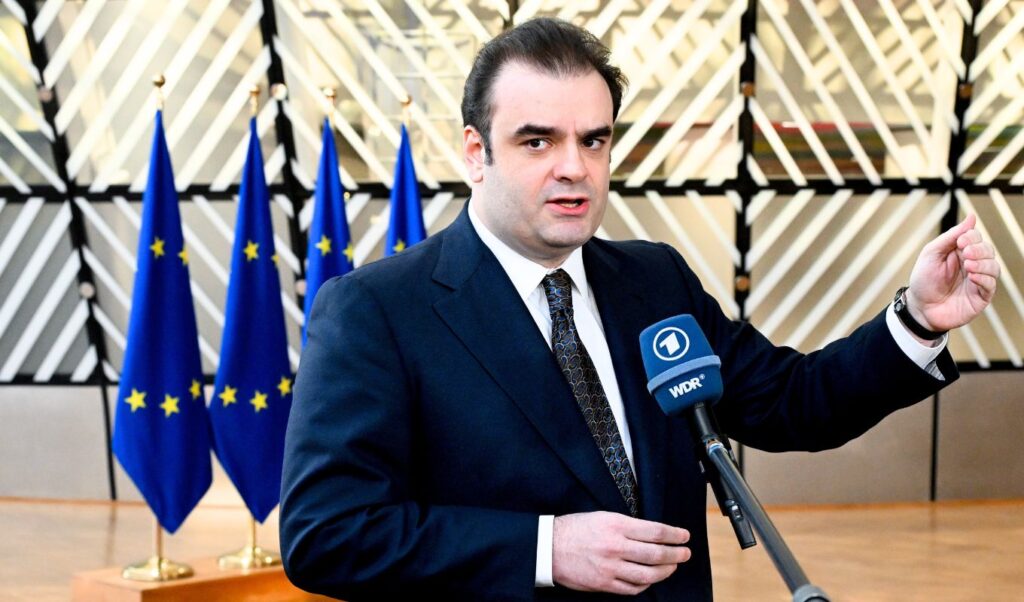
Greece’s Minister of National Economy and Finance and Eurogroup President, Kyriakos Pierrakakis, sat down for an interview on Tuesday (10/11) with Euronews’ “Europe Today” program and journalist Stefan Grobe. Among other topics, he was asked to address inflation across Europe in the context of rising energy prices.
Kyriakos Pierrakakis’ interview with Euronews
Stefan Grobe: Welcome to the President of the Eurogroup, Kyriakos Pierrakakis, Minister of Finance of Greece. We are very pleased to have you with us today. Good morning.
Kyriakos Pierrakakis: Good morning. I’m very happy to be here.
Stefan Grobe: Let’s start with two concerning signals that have emerged recently: rising energy prices and rising bond yields. How worried are you about the economic impact of these developments?
Kyriakos Pierrakakis: We are, of course, monitoring these developments very closely. It’s an issue that European Finance Ministers are discussing — not only at Eurogroup and ECOFIN meetings, but I would say on a continuous basis. We are in constant communication in order to coordinate our actions.
It is clear that we have now entered an era of higher capital costs. The era of cheap money is behind us. Even if we compare 2016 to 2026, the average yield on ten-year bonds in 2016 was 1.1%, while today it stands at 4%.
So we are operating in an environment of higher capital costs, and this is due to a number of factors. Some are fiscal — the average fiscal deficit is twice what it was ten years ago. Others are related to what you just mentioned: energy, increased expenditures, social spending, and greater investment needs.
Stefan Grobe: Greece went through a massive economic and financial crisis, which you know better than anyone. Do you see risks in the current situation, or are we facing entirely different circumstances?
Kyriakos Pierrakakis: Every situation is different. When I speak in my capacity as Greece’s Finance Minister, I am often asked whether there are lessons to be drawn from the Greek crisis.
I usually give two answers. First, that the word “hubris” is Greek. And second, that in politics, I believe more in inspiration than in “lessons” one can teach others.
And the inspiration here is that today there are five countries in Europe running a fiscal surplus in nominal terms: Denmark and the four countries that implemented bailout programs in the previous decade.
We managed to make difficult decisions — some with delay, others as quickly as we could. And today we find ourselves in a position of fiscal strength.
This resilience, which I would say is a defining characteristic of Europe as a whole, and of Greece in particular, is extremely important if we are to meet the very significant challenges that lie ahead.
Stefan Grobe: But are there lessons for Germany? There are many calls for the country to undertake substantial structural reforms. What can Germany learn from Greece?
Kyriakos Pierrakakis: I was recently in Berlin, where I was asked exactly the same question.
And my answer was the same one I gave you just now. I believe in inspiration. I am certainly not the one to give lessons to my good colleague Lars Klingbeil, or to the German government.
I believe Germany knows what it needs to do and what it needs to achieve. It has enormous potential that can unlock significant growth. It is an extraordinarily powerful productive force.
And I would sum it up in one sentence: Europe needs Germany, and Germany needs Europe.
Part of the reform agenda we are prioritizing at the Eurogroup can enhance the growth prospects of every EU member state.
The Capital Markets Union, the Banking Union, our discussions on energy — all of these are elements that can unlock growth potential.
And ultimately they will affect Germany, just as they will affect Greece, and every European citizen watching us. That is precisely why we must move forward.
Stefan Grobe: Speaking of citizens, how concerned are you about inflation? Are you worried that prices will rise again? And how can households be protected?
Kyriakos Pierrakakis: First of all, the 4% inflation figure reported by Eurostat is largely driven by rising energy prices. So the issue is directly linked to your first question — the energy crisis we are facing.
We are trying to coordinate our actions and the support we provide to citizens.
That support takes different forms depending on each country’s fiscal capacity. Our shared goal, however, is to support citizens so they can cope with the challenges of a particularly difficult winter.
Obviously, the best thing we can do is invest in energy infrastructure. That is, I would say, the most sustainable response.
But we also need temporary measures — targeted measures. We need measures tailored to citizens’ needs, ones that provide particular support to the most vulnerable and those most in need.
That is exactly what we are trying to do.
And part of our work at the Eurogroup — something I consider extremely important — is to develop a shared understanding of the problem and a common language for describing it. If we examine the solutions, if we look at how we can respond most effectively…
Stefan Grobe: I’d like to shift topics for a moment. Yesterday, NATO Secretary General Mark Rutte joined you at the Finance Ministers’ meeting. That’s quite unusual. Why was he invited, and what did he have to say?
Kyriakos Pierrakakis: It was indeed a very interesting discussion.
What is the core issue we are examining? I mentioned at the outset that we are operating in an era of higher capital costs.
We must make the best possible use of every euro we spend. We must ensure that every euro delivers maximum value and achieves the greatest possible impact.
At the same time, we have increased defense investment needs. That is precisely why the national escape clause for defense spending exists. Our calculations changed after Russia’s invasion of Ukraine.
So what do we need to understand? How we will respond to these needs.
It’s not just a question of how much we spend. It’s also a question of how we spend our resources.
We know that we are not doing enough joint procurement in the defense sector, and that we are not investing enough in research and development in Europe.
We know that we need greater interoperability among our defense systems.
Therefore, coordination of this effort is essential — not only at the level of Defense Ministers, but also at the level of Finance Ministers, who are called upon to fund these expenditures.
Stefan Grobe: One final, brief question. The Eurozone is heading into a winter of major decisions. There is the issue of Ukraine, the next EU budget, and the succession of Christine Lagarde. Do you believe you can complete these processes and reach agreement by December?
Kyriakos Pierrakakis: That is indeed the timeline we have before us.
Yesterday I was asked about the last item you mentioned — the succession at the European Central Bank. Whether it concerns reforms, decision-making, or filling positions, this is the timeframe within which we are operating.
Christine Lagarde has announced that she will remain in her post until February 7th.
This means that, ideally, a formal decision should be taken by the end of the year — that is, by December. This is a decision that is made at the level of heads of state and government.
And we are not talking about filling just one position. In reality, it is three positions. This is quite an unprecedented situation.
These are the positions of President, Chief Economist, and one seat on the Executive Board. Many view these decisions as one overall package. I think that is a reasonable approach.
In any case, the decision is made at the level of leaders, and the Eurogroup will help facilitate the process. We will be monitoring developments closely, as we always do.
Stefan Grobe: Thank you very much for being with us today.