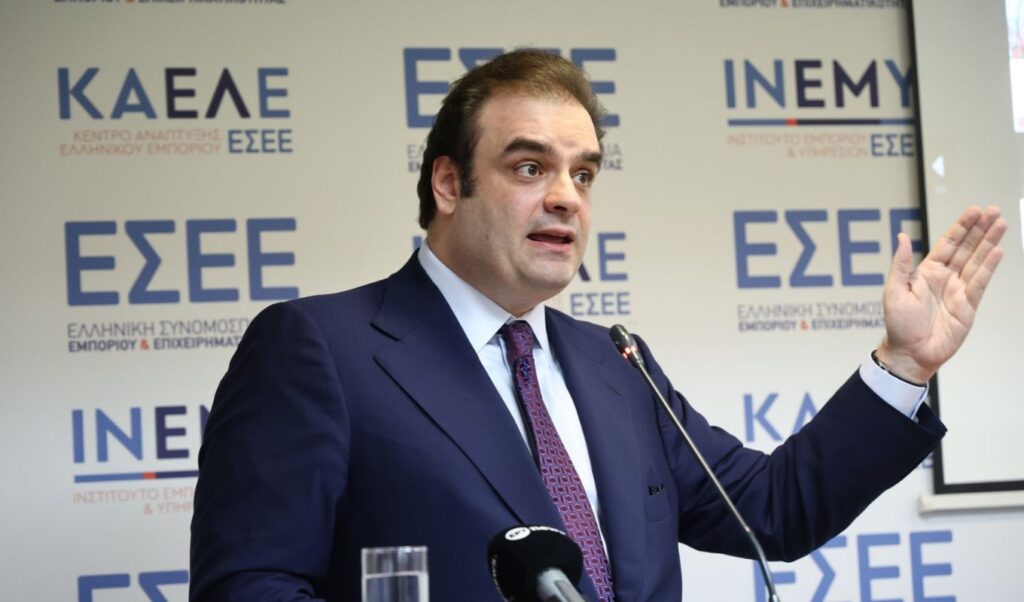
Greece’s Minister of National Economy and Finance, Kyriakos Pierrakakis, has signaled that new business-friendly interventions will be prioritized if additional fiscal space becomes available in the coming years. Speaking at the ESEE event marking Greek Commerce Day — where the confederation unveiled its new “GEOBASE” trade mapping platform — the minister outlined a series of planned measures aimed at easing the tax burden on businesses.
Addressing trade and business-related policy, Pierrakakis stated that current priorities include a further reduction of the advance tax payment, interventions in the presumptive taxation system, and the abolition of the business license fee (telos epitideuatos). He also left open the possibility of additional, yet-to-be-announced measures, should greater fiscal capacity materialize.
Read: Competition heats up for New Democracy’s ballot in Thessaloniki A’ — 18 candidates already locked in
On the reduction of advance tax payments and the business license fee
On the advance tax payment reduction, Pierrakakis acknowledged that the measure carries a significant fiscal cost, noting that a 5% reduction alone amounts to approximately €400 million in the first year. “We would have liked it to be a larger and faster measure,” he said, emphasizing that the goal is to continue reducing the advance payment incrementally year by year.
Regarding the business license fee, the minister confirmed that a timeline for its abolition is already in place, while stressing that such interventions must be balanced against social priorities and fiscal constraints. “I’d rather pleasantly surprise you than disappoint you,” Pierrakakis remarked, explaining that the government aims to direct any additional fiscal room toward businesses — rather than announcing measures before their implementation is financially secured.
The minister also underscored that supporting businesses has been a consistent policy choice of the government since 2019, citing a range of tax and regulatory interventions implemented over that period. He further noted that tackling tax evasion opens up additional room for tax reductions, and referenced this year’s €2.2 billion package of economic measures.
Pierrakakis also placed particular emphasis on the importance of systematically mapping commercial activity, praising ESEE’s newly launched “GEOBASE” digital platform. He stressed that data-driven policy is essential for both businesses and economic planning, noting that “what you can’t measure, you can’t manage — and you can’t change.”
On the broader role of trade in the economy, the minister highlighted that the sector accounts for 10.9% of GDP, with a turnover of €181.3 billion in 2025 and approximately 760,000 jobs — representing 17.3% of total employment.
Stavros Kaфounis
ESEE President Stavros Kafounis placed the focus squarely on the need to boost turnover for retail businesses, linking it directly to tourist spending. He pointed out that if each international visitor to Greece spent an additional €100, the total benefit to the economy could reach approximately €4 billion. In doing so, Kafounis highlighted the importance of increasing tourist spending per capita in the Greek market — not just growing visitor numbers.
Kafounis also stressed the need for stable and fair rules for businesses, as well as policy measures that will enable small and medium-sized enterprises (SMEs) to grow. He described trade as the vital link between production and consumption, calling it a cornerstone of economic activity in every city and neighborhood across the country.
He further noted that the business community had high expectations ahead of the government’s recent announcements at the Thessaloniki International Fair (TIF), and called for bold interventions to support SMEs going forward.
Kafounis concluded by emphasizing that trade is about far more than economic indicators and revenue figures — it is intrinsically tied to the functioning of cities and local communities. He called for a level playing field in which both small and large businesses can grow fairly side by side.
“GEOBASE” maps the geography of Greek commerce
At the event, ESEE unveiled “GEOBASE — The Economic Geography of Trade,” a tool designed to record and spatially visualize commercial activity across the entire country. The platform aggregates and processes data on trade activity at both national and local levels, with the aim of capturing the dynamics of individual markets, the unique characteristics of each region, and the shifts taking place within Greek commerce.