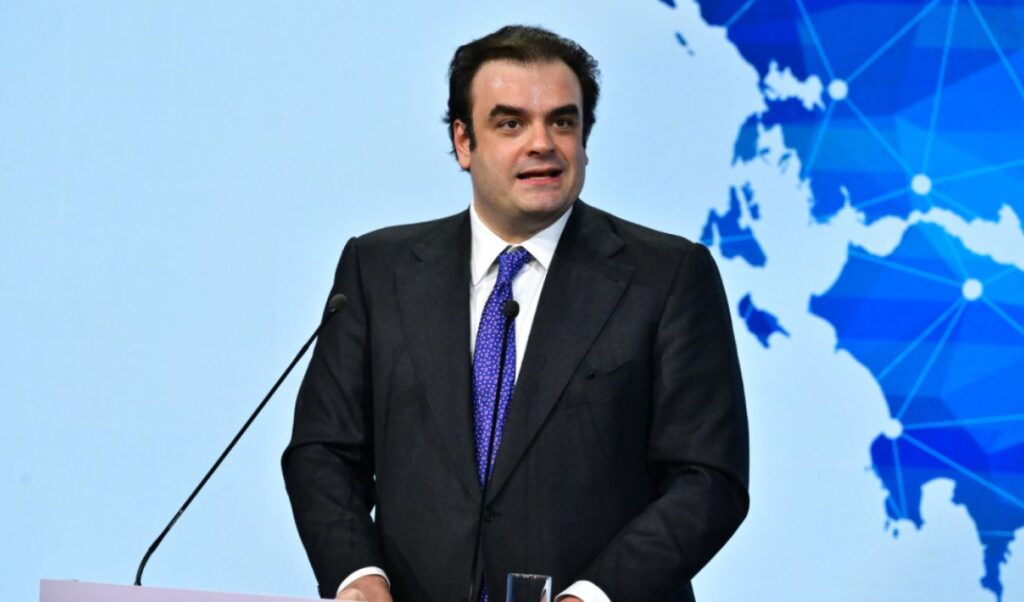
Greece’s Minister of National Economy and Finance, Kyriakos Pierrakakis, has addressed a series of questions surrounding the government’s debt reduction strategy, focusing on early loan repayments, the cost of first memorandum loans, and what he describes as a “fiscal time bomb” that would have confronted the country from 2032 onward.
“Easy decisions look at today — difficult ones look at the next generation,” Pierrakakis stressed, explaining why the government is choosing to direct available resources toward accelerated loan repayments. He first pushed back against the notion that Greece is prematurely repaying “cheap” loans at a 1.5% interest rate, clarifying that the first memorandum loans carry a floating rate of Euribor plus 0.5% — which currently translates to a cost of approximately 3%.
He also made clear that the early repayments are not being financed through new and more expensive borrowing. According to the figures he cited, Greece will borrow €8 billion from the markets this year, while regular debt repayments amount to €8.9 billion.
The €12.8 billion earmarked for early repayments, by contrast, comes entirely from existing cash reserves and the surplus already generated.
As the minister explained, these funds — due to European fiscal rules — cannot be channeled into public benefits or spending. At the same time, their yield is lower than the cost of servicing the debt, making it economically advantageous to use them for debt reduction instead.
Pierrakakis placed particular emphasis on the year 2032, which he identified as a critical turning point when Greece would have faced a significant fiscal burden. Specifically, between €25 and €30 billion in deferred interest accumulated during the crisis years would have begun to be added back onto the national debt.
Even if that burden were spread over a 20-year period, he noted, the country would still have had to pay roughly €1.5 billion in additional costs every single year.
“With these early repayments, we are defusing that time bomb now,” he said pointedly, adding that this policy is already generating savings of approximately €800 million annually in interest payments — and is closing yet another financial loose end left behind by the crisis era.
The minister also drew a direct connection between debt reduction and the government’s future capacity to support citizens. He argued that the sustainability of public debt directly affects the available fiscal space in the medium term — meaning that the more the debt is reduced, the stronger both the economy’s potential and the country’s credibility become.
“Greece paid a very heavy price for the practice of passing its burdens on to the future,” Pierrakakis concluded. “We will not do the same. We will not send the bill to our children again.”