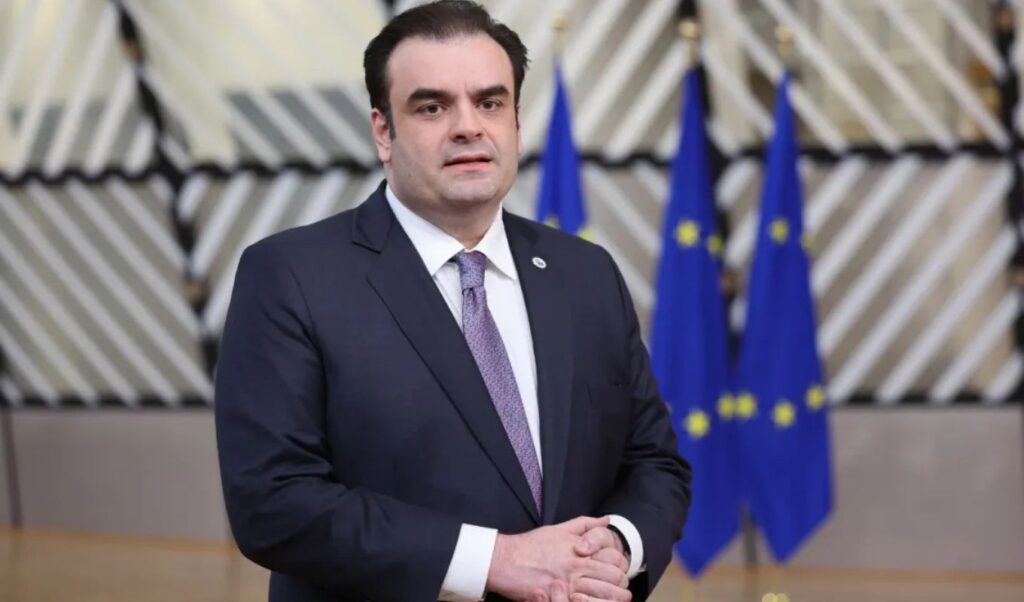
Greece’s Finance Minister and Eurogroup President, Kyriakos Pierrakakis, speaking to the American newspaper Financial Times, emphasized, among other things, that many of the reforms proposed by the Troika of creditors (European Commission, European Central Bank and International Monetary Fund), were “absolutely necessary” for Greece’s current performance.
Pierrakakis tells Financial Times: Many Troika reforms were “absolutely necessary” for Greece’s current performance
Kyriakos Pierrakakis emphasized in his interview with the Financial Times that “there were many reforms within the framework of these stabilization programs that were absolutely necessary.”
It should be recalled that Greece was forced by the troika of creditors to proceed with spending cuts in order to liberalize the economy and gain access to a total of over 250 billion euros in financial assistance during the period 2010 to 2018. The troika (European Commission, European Central Bank, IMF) had been blamed by many Greeks for the difficult years during the debt crisis, when unemployment soared and there was intense political turmoil.
According to the IMF, today Greece is one of five European Union countries that have a primary budget surplus, where tax revenues exceed government spending, excluding interest payments.
The Finance Minister characteristically noted that “it was the sine qua non in order to achieve today’s performance,” referring to the well-known Latin phrase that implies a necessary condition. The Eurogroup President emphasized that the troika’s management of Greece had both “positive” and “negative” aspects, clarifying that “I would suggest that in the future we learn the lessons from this implementation and try, if any country needs help, to apply what worked instead of what didn’t work.”
IMF: Greece is now well prepared to face external shocks
The International Monetary Fund just last week announced that Greece is now “well prepared to face external shocks, including those arising from the war in the Middle East,” partly due to post-2010 reforms to improve tax collection.
At the same time, some of those who shaped the troika program now admit that the reforms were imposed with excessive social cost. It is noted that the painful reforms, which also concerned pensions and the labor market, led to a 25% reduction in GDP between 2008 and 2013. Unemployment soared to 26.6% in 2014 from 8% before the crisis. Demonstrations in central Athens against austerity measures became a daily phenomenon.
The former director of the European Commission’s economic and fiscal policy department, Marco Buti, characteristically stated that “we had excessive austerity [in Greece]. I believe we must recognize this.”
“All these reforms during that period of deep crisis under pressure were not fair and in reality were quite catastrophic,” said former Eurogroup President Jeroen Dijsselbloem, adding that “did we handle it well? No. Are we better? Yes, but at great cost.”
By the end of 2026 Greece will not be the most indebted eurozone country
Kyriakos Pierrakakis stated that “many things have changed,” as by the end of the year, Greece will no longer be the most indebted country in the eurozone. Its total debt, which had peaked at 209% of GDP in 2020, is expected to fall to 137.6% this year, below that of Italy.
It is noted that Greece officially exited the bailout program in 2018, allowing the completion of IMF loan repayment ahead of schedule in 2022. GDP growth in countries that once brought the eurozone to the brink of crisis, including Portugal, Ireland and Spain, now exceeds expansion in the eurozone’s “core” economies, Germany and France. Debt-to-GDP ratios are expected to fall in these four countries by 2027, while they will continue to rise overall in the eurozone and in Italy, France and Belgium, according to European Commission forecasts.
Kyriakos Mitsotakis had stated at the FT Energy conference held last week in Athens that it was an “interesting analogy” that these countries “are actually doing much better fiscally than the rest today.”
Outgoing European Central Bank Vice President Luis de Guindos stated in a recent interview with the Financial Times that “the countries that implemented reforms 10 to 15 years ago are those that today outperform the rest of the eurozone,” adding that “one could argue that there were problems regarding ownership and troika enforcement, but the reality is that, in the end, the reforms paid off.”