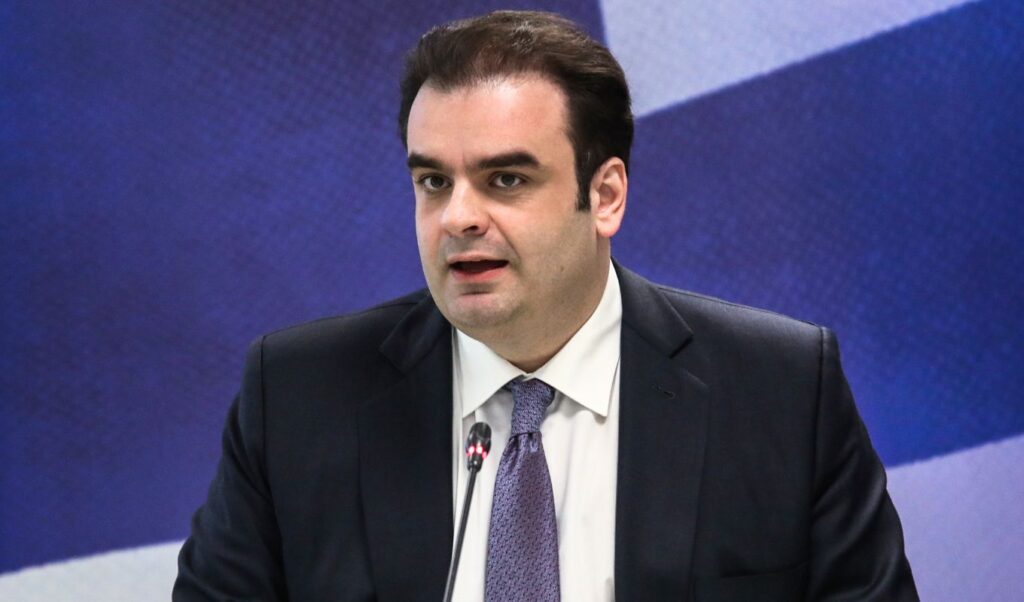
The Minister of National Economy and Finance Kyriakos Pierrakakis announced a supplementary budget of €800 million and a bill that will include new support measures already announced by the government. He also confirmed that the draft law will be put to public consultation within the next week.
Pierrakakis: €800M supplementary budget and new package of measures “coming”
Kyriakos Pierrakakis, speaking at the 2nd Economic Conference of “Imerissia,” announced the €300 enhancement for pensioners, as both the amount and the number of beneficiaries increase. It’s worth noting that for the first time, widows over 60 years old who receive exclusively widow’s pensions are included, instead of the previous 65-year limit, in a move the ministry characterizes as correcting social injustice.
The package of measures includes a €150 enhancement for each child with expanded income criteria, extension of rent reimbursement, and reimbursement of two rents for public servants serving away from their place of residence, such as doctors, teachers, and nurses.
Additionally, new interventions for private debt and primary residence protection are being promoted, including the possibility of releasing bank accounts by paying 25% of the debt, extending the out-of-court mechanism for debts from €5,000 to €10,000 affecting approximately 300,000 debtors, and a new framework for primary residence settlement through out-of-court procedures with separation from other assets.
Furthermore, regarding housing, it was confirmed that after the bill’s passage, new short-term rental licenses like Airbnb will be banned in central Thessaloniki.
Additionally, the same draft law includes the integration of young farmers into the “GAIA” tariff for energy cost reduction, while providing for new taxation of electronic betting companies, from which the economic team estimates stable annual revenues of €100 million for the state.
Detailed speech by Kyriakos Pierrakakis:
“Ladies and gentlemen,
It is my particular joy to be here today with you at the Imerissia conference, and I’m truly pleased because you give me the opportunity to participate in an open discussion with people who are at the forefront of the economy. Together, we are all witnesses to events, changes, dreams, achievements, but also problems, surprises, and disappointments.
The historical moment is difficult, testing us, but at the same time challenging and invigorating us. There appear to be open communication channels between Washington and Tehran with ongoing negotiations, yet we remain in a fragile situation still characterized by significant uncertainties. Moreover, markets don’t operate solely on expectations, but primarily on confidence. It’s on confidence that expectations are built, and confidence requires time to be restored.
In any case, the tremors of such a crisis and the fears it has caused don’t disappear overnight. They objectively need time. The vulnerability of the entire energy network in the broader Gulf and Middle East region was demonstrated so extensively for the first time. Risk premiums won’t retreat easily. Supply chains will need months to return to their “factory settings.”
Investors aren’t “lotus-eaters” to forget in one night the sleepless nights of recent months. And if something will remain for us to remember, it’s the return of geography. In an age when data and information travel at the speed of light, geography remains a stubborn force that dominates over human affairs.
Strategically critical regions and all kinds of “Straits” continue to define economics and geopolitics worldwide. Therefore, for all these reasons, energy prices are not expected to return immediately to pre-crisis levels, and economic growth won’t start galloping within 24 hours. We will need, even if all issues heal quickly, some adjustment time with clarity. I would even say that the crisis’s evolution highlights with even greater intensity the definitive transition to a different world.
It’s now clear that different power centers have a substantial, not theoretical, role in shaping international developments. No global power can any longer, by itself, fully impose its will on a geopolitical tension hotspot. Europe, therefore, as one of the significant global powers, must realistically map this new reality and, yes, stand responsibly up to the expectations regarding what it can do, both towards history and towards European societies themselves.
Ladies and gentlemen,
International organizations haven’t remained idle lately. They’re monitoring developments and have already reached certain conclusions. According to the IMF, a $10 per barrel oil price increase can reduce global growth by approximately 0.2 percentage points. For businesses, this translates to lower demand, increased costs, and more limited liquidity. The impact is necessarily transferred to the labor market, household economics, and public finances. Even in the “good scenario” of rapid crisis de-escalation, the economy will continue operating under vigilance conditions for a period. Countries will need the entire second half of 2026 to restore the lags and irregularities that appeared in the first half.
Now is the time to see the opportunities embedded within the crisis. There’s also the well-known phrase that says: you should never let a serious crisis go to waste. In this sense, it’s also an opportunity for Europe to build this stronger economic architecture we’ve been discussing for many years. And when we say “new economic architecture,” it’s essentially three things:
- More functional capital markets,
- More effective banking union, and
- Better utilization of available resources.
I’ll mention something I said very recently in Brussels: “The dividend of the obvious.” If Europe implements the Savings and Investment Union, the digital euro, and all those self-evident reforms, such as removing obstacles that continue to exist between member states, then an “obvious” growth dividend is created for every member state by 2027.
Just as the introduction of the euro or the single market of the ’90s introduced new opportunities and new fields of development, so now the new reforms will be promotional for the economy and for the European vision of a stronger society on our continent. Today, approximately €10 trillion in European deposits are not channeled with sufficient speed and effectiveness into the real economy, not translated into investments. This capital inertia limits Europe’s developmental capabilities and reinforces a sense of stagnation that permeates societies. Within this environment, diffuse social fatigue is cultivated, which in some cases is accompanied by intensifying political division.
When we say Europe needs a complete Savings and Investment Union, that it needs the digital euro to move steadily and quickly in the changing monetary and technological environment, what we mean is the transition to a stronger society where European values and the European way of life are implemented in practice. We’re not talking about life inside the skyscrapers of banking centers, but about life in every home from Kastellorizo to Rotterdam.
Ladies and gentlemen,
“The dividend of the obvious” I mentioned above also applies at the national level. Every country has specific obvious interventions that, if implemented, immediately yield developmental benefits. On one hand, we’re called to solve past legacies, labor market reforms for states like ours, in the educational system, and on the other hand, to respond to new challenges that emerge and we often cannot predict.
It’s clear that international uncertainty affects Greece too; we’re not an isolated and self-sufficient country. Energy cost is a factor affecting markets and encouraging businesses to be more restrained in their investments and plans. Just as citizens have legitimate concerns and worries about the future. In this context, we decided that our policy intervention should be targeted and costed. The recent set of measures (first and second package) totaling €800 million aims to support those citizens who need it most.
And because I’m at an economic newspaper conference today, an economic media outlet, in the presence of many journalists, I want to inform you that next week the draft law for combating illegal gambling will be posted for public consultation. This will include a supplementary budget of €800 million, as well as most of the extraordinary and permanent support measures we have announced.
These are interventions with a clear social footprint.
- First, measures for children and family. The €150 enhancement for each child is established, with expanded income criteria.
- Second, housing measures. Beneficiaries of annual rent reimbursement are expanded, while reimbursement of two rents is established for public servants serving away from their place of residence — doctors, teachers, and nurses. These are people who keep, I would say, the welfare state upright.
Simultaneously, legislation banning new short-term rental licenses like Airbnb in central Thessaloniki is enacted, a measure that will be implemented immediately after the bill’s passage. Housing must remain affordable, especially for young people.
Third, measures for pensioners. Both the number of beneficiaries and the amount of enhancement increase, rising from €250 to €300. And here I want to focus particularly on a significant social intervention: we’re correcting an injustice concerning widows. Since their only pension is the widow’s pension, they will receive the €300 enhancement from age 60, not 65. These are mainly women in difficult positions, with limited access to the labor market, and the state must stand by them with sensitivity and justice.
The same draft law also includes the integration of young farmers into the GAIA tariff, reducing their energy costs, as well as taxation of electronic betting companies, from which the state will have stable annual revenues of, as we calculate, €100 million.
Ladies and gentlemen,
In the measures we recently announced, it became clear that we place particular emphasis on managing and addressing private debt. Because behind the numbers are people, families, and businesses that faced not just one, but successive crises.
The possibility of lifting bank account seizures by paying 25% of the debt was created. The out-of-court mechanism is expanded for debts from €5,000 to €10,000, affecting approximately 300,000 of our fellow citizens. Simultaneously, the possibility of settlement up to 72 installments is given for debts created until December 2023.
These interventions aren’t just social measures. They’re economic reintegration measures. Measures that give citizens the ability to stand on their feet again. To paraphrase Winston Churchill: successes aren’t final, but neither should failures be fatal. What matters is having the courage to continue. And this is exactly what we want to give citizens today: the strength to continue.
That’s why the draft law being put to immediate consultation includes another significant intervention we announced a few weeks ago. Through the out-of-court mechanism, debtors can now claim settlement for their primary residence, separating it from their remaining assets. The amount of “haircut” and monthly installment will be determined based on the primary residence’s value, provided the debtor chooses to liquidate their remaining assets. This constitutes substantial primary residence protection. A fair and realistic solution that gives renewed prospects to people who found themselves at a dead end.
Ladies and gentlemen,
Within this complex international picture, Greece presents different dynamics compared to the past. The economy is growing at approximately 2%, higher in any case than the European average. Investments increased from 11% of GDP when we took over in 2019 to 17% in 2025, and unemployment has decreased to around 8% from 27% at the economic crisis peak.
Public debt follows a steady downward trajectory, aiming to fall below 120% of GDP before the decade’s end, in 2029. It’s projected to reach 119%. The economy’s productive base is strengthening. Exports have increased from 20% of GDP in 2010 to 42% today. We still have a journey until we reach the 51% European average, but we’re on the right track.
All these add up to an image of a more outward-looking and competitive economy. The next step is to transform these advantages into permanent strength, into national strength. With planning, discipline, determination, and confidence in the country’s productive forces. Debt reduction has immediate effects on economic functioning. It reduces borrowing costs. It frees resources for new investments. Just from early loan repayments, we save approximately €200 million annually in interest, which can be directed to developmental actions.
Therefore, debt de-escalation, on which we insist, is a policy that frees the economy’s hands, not ties them. The capital we channel into debt relief transforms into “fuel” for faster development that reaches everywhere in the economy and society. Who denies that 2026 gives us a completely different and privileged starting point from what we had in 2019? And if we work with the same determination we had in 2019 and 2023, how much better results can we have achieved by 2030? By 2030, we will have completed a “won decade.” We will have regained the lost time from miscommunication, internal defeats, zero-sum conflicts, and division of the previous decade.
The strategy for the next period is clear. Strengthening investments in energy, infrastructure, logistics, and technology. Utilizing the country’s geographical position. Improving productivity and supporting innovation. An inseparable part of the near future’s economic “puzzle” is the energy field, as Greece is continuously strengthened as an energy and commercial hub in the broader Southeast Europe and Southeast Mediterranean region.
For 2026, we’ve revised growth from 2.4% to 2%, and indeed inflation increases temporarily. However, based on new data for 2027, we’re revising growth upward, investments upward, and inflation downward. And if the question persists “What happens after the Recovery Fund?” part of the answer lies in the new culture that emerged through these years and was practically supported by the Recovery Fund. In the culture of stability and reforms that largely inspired new self-confidence in the country.
After state and public administration digitization that freed citizens’ hands, reduced bureaucracy, and enhanced transparency, digital change is spreading to the Land Registry, urban planning, justice, and tax administration. The introduction of Artificial Intelligence is simultaneously progressing, marking a new revolutionary stage for the economy and state functioning.
Another part of the answer to “after the Recovery Fund, what?” lies in new resources from the co-financed Public Investment Program increasing to €7 billion in 2027, as well as the influx of new European resources from the Social Climate Fund and the Modernization Fund. And a third part of the answer is Greece’s increasing ability to attract foreign direct investment, something that until a few years ago moved in the realm of fantasy.
Ladies and gent