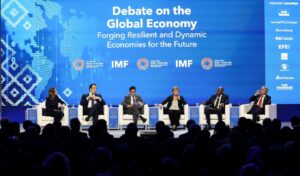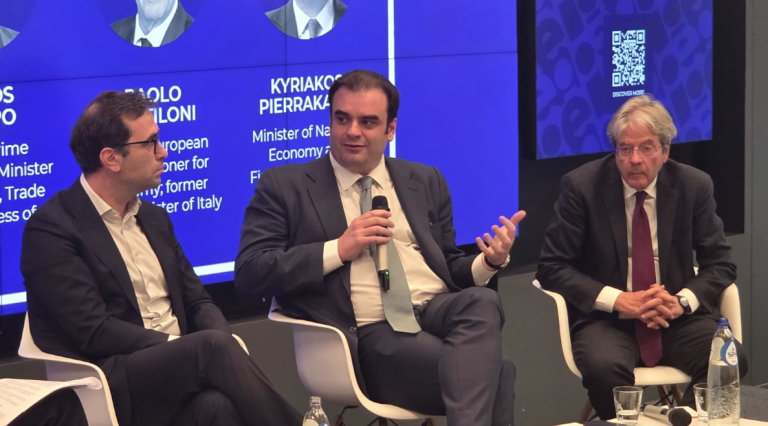
The Savings and Investment Union (SIU) and its role in mobilizing European citizens’ savings, digital finance and the digital euro, as well as the broader agenda for simplifying and deepening the single market, were at the center of a panel within the IE Competitiveness Hub, focusing on the challenges and prospects of European competitiveness. The panel featured Finance Minister and Eurogroup President Kyriakos Pierrakakis, while the discussion, moderated by Financial Times journalist Paola Tamma, also included former Italian Prime Minister and former Economy Commissioner Paolo Gentiloni and Spain’s Deputy Prime Minister and Economy Minister Carlos Cuerpo.
When asked about creating unity through E6 initiatives, the minister said: “Any initiative that moves us forward is positive. We know what we need to do. Enrico’s report and Mario’s report are our north star. Yes, both are from Italy, and I would say one is the Pope and the other is the Patriarch, but now we have two Popes. So we know what we need to do. The implementation challenge lies with the finance ministers.”
He added: “The Commission is doing excellent work. Maria Luisa Albuquerque’s work is absolutely targeted, with concrete content. Right now we’re discussing all aspects of the Savings and Investment Union. The challenge is on our side to implement it. So we need the right mechanisms within the group to be able to implement all elements of the Savings and Investment Union.”
As Pierrakakis noted, “First of all, we need to be able to ‘unfold’ it communicatively to citizens, because Roberta Metsola mentioned this earlier. When I have to explain, I assume the same applies to Carlos, what the Savings and Investment Union is and what it means for citizens, we need to be able to present it concretely.
“The Eurogroup president’s job is to build consensus”
People understand the Erasmus program, they understand free roaming. But what is the SIU for them? For example, yesterday we discussed the Kukies and Noyer report. I take a startup and turn it into a scale-up. Should it become a Delaware company and find American intermediate financing, or should it be able to develop in Europe? This is very specific for this category.
So we need to be able to unfold all these elements and then our job is to find consensus, I suppose. This is, to a very large extent, also the job of the Eurogroup president, to be able, in this informal institutional framework, to shape consensus.
Is it good that larger countries have an informal forum to shape this consensus? Well, to the extent that this works as a facilitator, I think it’s positive. Everything will depend on whether, at the end of the day, strategy becomes synonymous with implementation. It depends on us. But honestly, for this to happen, national reservations that exist must not prevail – we all say we agree with the Savings and Investment Union or with any other initiative in principle.
There’s a ‘but’ that follows after the initiative. And we all have these national parameters, depending on the portfolio, depending on the issue. The question is how well we’ll understand that the opportunity cost is equally tangible as the real cost. And right now we understand this, and we also understand it because of the exogenous nature of events around us.
Russia invaded Ukraine, so we realized we need to strengthen our defense capabilities, but also, honestly, the era of geopolitical innocence is over. And we understand that we need to become not just a single market, but possibly something more than that. And to achieve this, we need to strengthen defense and also have a doctrine in technology, in technology strategy.
According to Pierrakakis, “Anthropic-Mythos was the topic of the day, along with what’s happening in Washington. Anthropic-Mythos is one issue. How you manage a specific LLM and access to it is another. But there’s much more that needs to be discussed.
We overdramatize what we have in front of us, we overdramatize the present and underestimate the future. And when it comes to technological innovation, honestly, the future isn’t years away – it’s weeks away. What you see today with Anthropic, you can easily see in a few weeks with more companies developing similar algorithms and equally powerful models. And these will only be the ones we know about.
So the question is: what kind of governance arrangements will we develop and what kind of common understanding can we cultivate among ourselves regarding technological sovereignty.
When we talk about technological sovereignty at the finance minister level, do we all mean the same thing? Do we use the same vocabulary? Do we have the same strategy as Europeans? Are we trying to create European champions, as Enrico’s report envisions? Or do we remain in small national logics, whether in banking or technology? If we don’t understand that we must do the latter, I think we’ll lose a great opportunity.”
“The Fed hasn’t chosen to proceed with a digital dollar, citing mainly privacy concerns”
Pierrakakis then answered a question about the digital euro and whether it could play a role in strengthening European financing, saying: “Digital Finance is an area where we hope to have a common statement in the Eurogroup in July. Generally speaking, this is a huge opportunity for Europe. If we look at it overall: what are the Americans doing? They have the institutional and regulatory framework, but they don’t have a digital dollar. They allow dollar-based stablecoins and this will be their basic strategy: private innovation around their currency, in digital form. China does exactly the opposite: it wants a fully digital currency, without allowing stablecoins. In our case, we have MiCA. However, if we look at the world today, 95% of stablecoins are tied to the dollar and less than 1% to the euro. So the basic strategy is implementing the digital euro. We hope that, from the European Parliament’s side, this will be voted on this year, quite soon.”
As he said, “The Fed hasn’t chosen to proceed with a digital dollar. It mainly cites privacy issues, but I suppose this is partly a cultural issue too. In our case, creating a public infrastructure for payments and clearing, with the secondary benefits this can bring, is a very positive development. 2029 as a time horizon is acceptable, but generally, when we talk about technological innovation, whether in finance or elsewhere, innovation happens now, in weeks, not months or years.
We lose opportunities every week, every month and every year that passes. So these opportunity costs are tangible. I believe European legislators understand this. And I believe the project will be implemented. And honestly, it will be among the first to be fully implemented, on a large scale. And the impact will be quite positive. It’s good to have a strong public infrastructure that will serve the business system.”