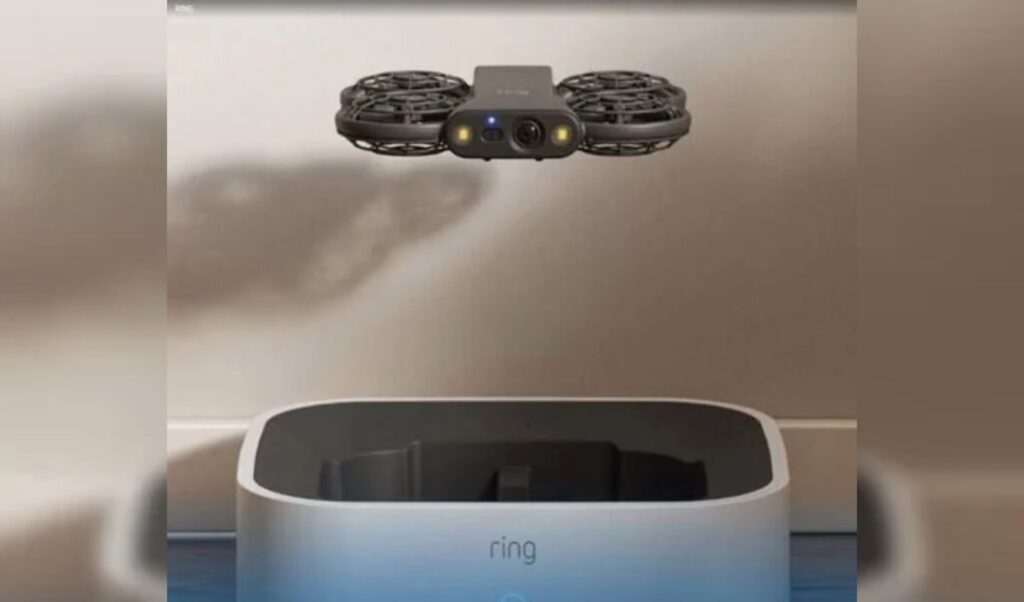
Ring doorbells from Amazon have always stayed put — fixed to your wall, watching the same spot. But Ring Robotics, operating deep within the company that made Jeff Bezos a multi-billionaire, is changing the game. The real question surrounding the Ring Drone Cam and the Ring Rover home robot is whether the people they’re meant to protect will still feel like their home is truly their own. Traditional Ring devices had their blind spots — and to some extent, that was fine; they didn’t need to see everything. But these two new devices are full-on surveillance units, capable of peering into spaces where, as the saying goes, even kings go alone. Amazon is already widely regarded as a company with a complicated relationship with privacy, and that raises serious ethical questions — though as has almost always been the case throughout history, technological progress seems poised to outrun them.
What is the Ring Drone Cam?
According to available details, the Ring Drone Cam is an indoor flying camera that takes off from a docking base, follows pre-programmed routes, and navigates to specific locations whenever a camera, sensor, or alarm detects something suspicious. It runs on artificial intelligence — specifically a system called AI Pilot. According to Amazon, this system combines the device’s onboard cameras, integrated sensors, and cloud processing to map out a space, identify rooms, and suggest optimal surveillance points: side doors, windows, hallways, or — in a retail setting — the cash register.
Amazon pitches it as a convenient way to check whether windows are closed before a trip, or to investigate an alert without having to install cameras in every single room. That said, anyone living in a home running this security system might find it feels less like a smart home device and more like having an uninvited housemate.
Battery life is a real concern
Reports indicate that the Ring Drone Cam — Amazon’s indoor flying camera — features a 148-degree field of view. This is not an outdoor drone or a continuous monitoring device. It offers 360-degree rotation, 2K recording, and two LED lights for low-light conditions. However, battery life is a significant limitation. Amazon claims the drone delivers up to eight minutes of flight time on a full charge, measured under controlled conditions — meaning real-world performance will likely fall short of that. For a quick check-in, that may be sufficient, but for patrolling a home for any meaningful period of time, it doesn’t appear to be nearly enough.
There are also navigational constraints to consider. Amazon warns that performance may degrade in environments with reflective surfaces — such as polished marble or wet floors — featureless matte walls, or unframed glass and mirrors. In other words, the drone may work well in some modern homes, but certainly not in all of them.
The Ring Rover robot
The Ring Rover camera is the other half of this strategy — and it’s not designed for the home. Instead, it targets stores, warehouses, offices, and small businesses. Amazon describes it as an autonomous security robot capable of patrolling set routes, investigating alerts, and streaming video at up to 4K while in motion. It features an adjustable mast that lets it see over counters, shelving, and other obstacles. It also comes equipped with a siren, a light bar, and two-way audio, so a business owner can communicate directly with anyone near the robot. Amazon says it can cover up to 465 square meters.
However, its physical limitations are considerable. The Rover is designed exclusively for single-floor indoor use — it cannot climb stairs and is incompatible with curved edges, recessed areas, floor level changes greater than 3.5 centimeters, or glossy black flooring. This is not a versatile home robot: it is a specialized security guard built for a very specific type of space.
Amazon speaks of “uncompromising privacy and security” and highlights several mechanisms to back that up: the drone disables its camera when docked, the Rover can activate a sleep mode that retracts the mast and disables the microphone, and both devices display indicator lights when recording.
A troubled track record
The problem is that Ring’s recent history does not exactly inspire confidence. In 2023, the U.S. Federal Trade Commission (FTC) charged Ring with allowing employees and contractors to access recordings from customers’ private spaces, while also flagging security vulnerabilities that allegedly enabled hackers to access approximately 55,000 accounts across the United States.
New video footage will be protected by the Throw Away the Key Encryption (TAKE) system, which Ring introduced in September 2026. The Electronic Frontier Foundation (EFF) considers it an improvement over Ring’s previous setup, but maintains that it falls well short of true end-to-end encryption. In other words, the company is improving its protections — but it has not eliminated users’ dependence on Amazon and its infrastructure.
It does not appear that the Ring Drone or Ring Rover will incorporate facial recognition. However, Ring already allows doorbell camera owners to enable “Family Faces” — a facial recognition feature for visitors — and that functionality is currently the subject of a class-action lawsuit. That history matters, because once surveillance becomes mobile, autonomous, and integrated with a broader platform, the limits of what the system can actually do become much harder to control.
The Ring Drone also marks the return of an idea Amazon first tried to sell back in 2021 with the Ring Always Home Cam. That product launched on an invite-only basis through the “Day 1 Edition” program, with a starting price of $250. Five years later, the company is back with a more ambitious version, integrated with Alexa and wrapped in artificial intelligence.
The context, however, is very different now. Generative AI and computer vision systems have advanced significantly — but so have public expectations around privacy, data control, and the boundaries of corporate surveillance. A drone patrolling your home isn’t just an impressive gadget: it’s a decision about how much observation we’re willing to accept within our own four walls.
How much does it cost?
Both the drone and the robot will initially be available exclusively in the United States. The Ring Drone Cam is set to launch on January 27, 2027, priced at $249.99 — approximately €224. The Ring Rover Cam, meanwhile, will hit the market from December 16, 2026, at $999 — roughly €900 at the current dollar-to-euro exchange rate.