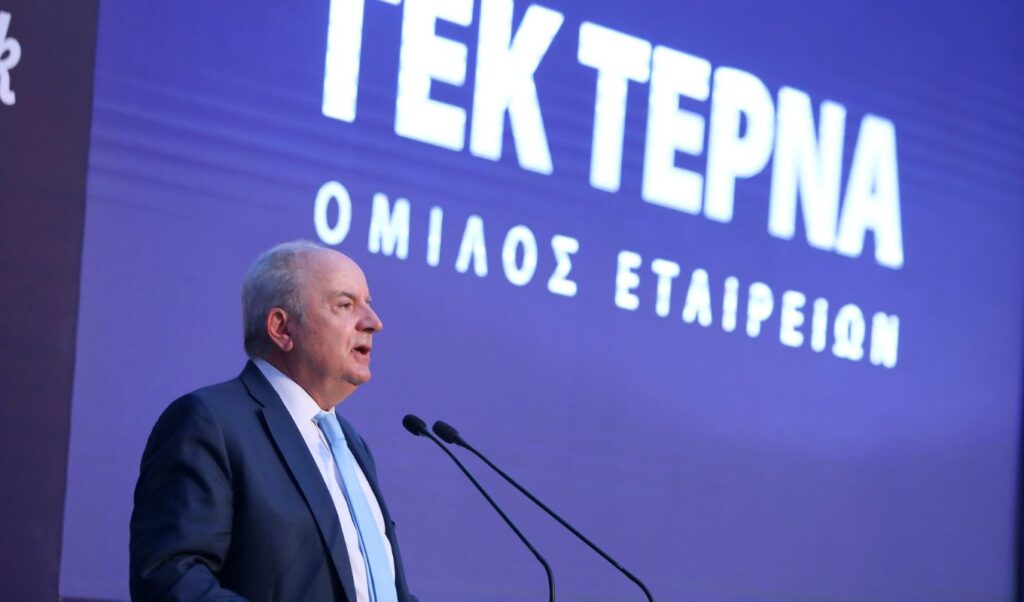
GEK Terna is taking another step toward broadening its business activities, this time entering the specialized field of aviation services. According to reports, the group has acquired a majority stake in Greek company Greek Air — a move that marks its entry into the aircraft and helicopter maintenance, repair, and technical support market, while opening up prospects for further growth in areas connected to civil aviation and the defense industry.
Read also: Petros Souretis: The role of GEK Terna in the future of construction
GEK Terna’s new move into the aviation industry with the acquisition of Greek Air
This investment is part of a broader portfolio diversification strategy for GEK Terna, as the group looks to leverage its expertise and investment capacity in highly specialized sectors. It is no coincidence that this latest business move follows recent partnerships with international players such as Airbus and U.S.-based Shield AI, underscoring the group’s growing interest in aerospace technology and its defense applications.
Gaining control of Greek Air gives the group an immediate foothold in a market with demanding technical requirements, where specialized know-how, certifications, and partnerships with international manufacturers are essential prerequisites for operation.
The investment gains additional significance when viewed alongside GEK Terna’s already strong presence in aviation infrastructure. A prime example is the new international airport at Kastelli in Heraklion — one of the largest infrastructure projects currently underway in Greece — in which the group is involved both in construction and in the concession scheme.
With this new acquisition, GEK Terna’s presence in the broader aviation sector is no longer limited to infrastructure development and management, but now extends to services directly related to the technical support of aircraft themselves.
Greek Air and its presence in the Greek aviation market
Greek Air is one of the longest-standing companies in the domestic aviation sector, with a history dating back to 1977. Over nearly five decades of operation, it has built up expertise in maintenance, repair, and technical support services for both fixed-wing aircraft and helicopters, serving the needs of both civil and military aviation.
The company operates facilities in Koropi, Attica, and at Pachi Megaron Airport — two locations that support its operational and technical activities. Its presence at these sites enables it to provide technical inspection, maintenance, and support services in an industry where operational availability and flight safety are critical factors.
Particularly noteworthy is the network of partnerships Greek Air has established with major international aircraft and helicopter manufacturers. These include Italy’s Leonardo Helicopters, U.S.-based Textron Aviation, Austria’s Diamond Aircraft, and Cirrus Aircraft — all companies with a significant presence in the global aviation market.
These partnerships give Greek Air a specialized business profile that sets it apart from traditional construction and energy groups. Aircraft technical support is an activity that does not depend solely on the sale of new aircraft, as it generates ongoing maintenance and repair needs throughout the entire operational lifespan of a fleet.
Prospects in defense and the aerospace industry
GEK Terna’s entry into Greek Air takes on added significance in the context of developments across the European defense industry, where there is growing interest in building domestic technical support capabilities, upgrading existing systems, and ensuring the operational readiness of aviation assets.
In this environment, aircraft and helicopter maintenance and repair represents a sector with strong prospects, as it is tied to the needs of both private operators and government agencies.
For GEK Terna, the acquisition of Greek Air could serve as a foundation for gradually developing new partnerships and strengthening its position in high-value-added specialized services. The fact that the Greek company already has established infrastructure, technical expertise, and relationships with international manufacturers creates the conditions to build on existing capabilities — without the need to develop a comparable operation from scratch.
Ultimately, this latest investment reflects GEK Terna’s gradual shift toward a more diversified business model, in which construction, concessions, and infrastructure are complemented by technology-intensive activities. In the months ahead, it will be worth watching for clarification on the transaction value, the exact stake acquired, and the investment plans for the further development of Greek Air.
Facilities and international operations
Beyond its experience, Greek Air’s physical infrastructure is equally noteworthy. According to information the company has made publicly available, its Koropi facilities span a total area of 27,000 square meters, including 1,200 square meters of covered helicopter parking and an additional 1,400 square meters dedicated to engine workshops, offices, staff training, and spare parts storage.
The complex is located a short distance from Athens International Airport “Eleftherios Venizelos,” offering easy access to both the Greek market and international clients.
The company’s operations extend beyond Greece, with technical support stations in Istanbul and Montenegro. It also holds EASA Part-145 maintenance certification and approval for continuing airworthiness management services — credentials that strengthen its ability to operate within a strictly regulated European framework.
In the past, Greek Air had also announced a partnership with EFA Ventures, aimed at developing maintenance, repair, and overhaul services with a geographic focus on Europe, the Middle East, and North Africa. The scope of that collaboration also included technical support for aircraft operated by the Greek Armed Forces and Security Services.
This particular area of activity highlights one of the most significant dimensions of the investment: GEK Terna is gaining access not only to technical facilities and specialized personnel, but also to an existing network of partnerships — one that could serve as a springboard for expanding its presence in both the aviation and defense markets.
Source: powergame.gr