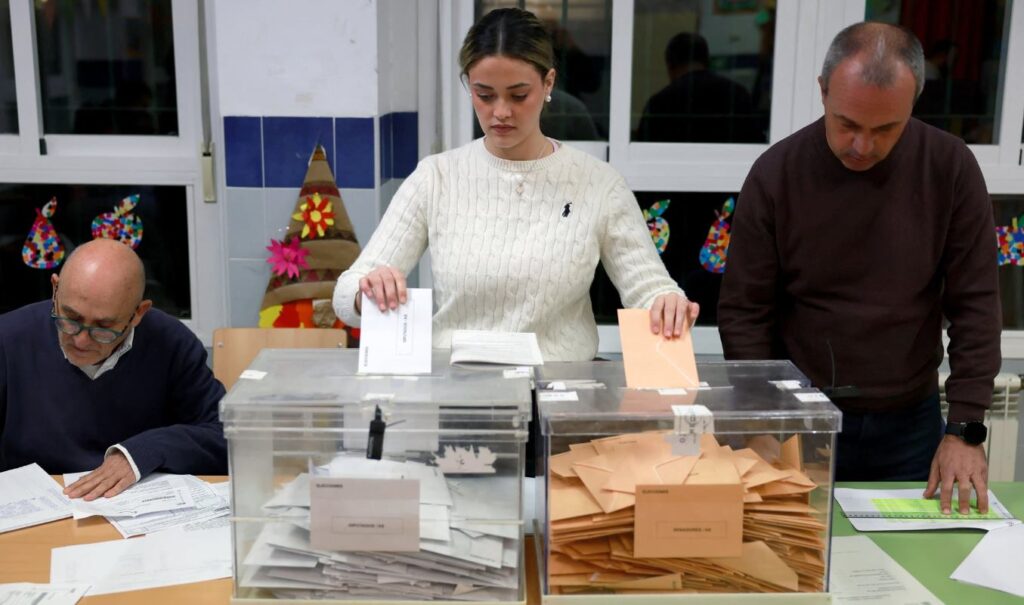
The first exit poll for the Spanish general election, held on Sunday, July 23, shows Alberto Núñez Feijóo’s conservative People’s Party (PP) in the lead, with Pedro Sánchez’s Socialists in second place and Santiago Abascal’s far-right Vox party in third. According to the survey conducted by Sigma Dos for public broadcaster RTVE and the FORTA network, the People’s Party is polling at 32.2%, compared to 28.8% for the Socialist Party and 16.2% for Vox. Attention is now turning to the seat distribution, as the People’s Party and Vox are estimated to collectively win between 173 and 182 seats — with 176 seats representing the absolute majority threshold.
Read more: Spain elections: When are the first results expected — What Sánchez, Feijóo and Abascal said
Spain election exit poll: vote share and projected seats
The initial exit poll shows a 3.4 percentage point gap between the People’s Party (PP) and the Socialist Party (PSOE), while Vox appears to have captured more than 16% of the vote. A key factor in shaping the post-election political landscape will be the number of seats awarded to each party, as the final composition of the lower house of parliament — the Congress of Deputies — will determine the possibilities for coalition-building.
According to Sigma Dos’s exit poll, the projected vote shares and seat ranges for the main political forces are as follows:
– People’s Party (PP): 32.2%, projected 129–134 seats.
– Socialist Party (PSOE): 28.8%, projected 119–124 seats.
– Vox: 16.2%, projected 44–48 seats.
– Frente Amplio: 5.7%, projected 10–11 seats.
The 176-seat threshold and the possibility of a PP-Vox coalition
Combined, the People’s Party and Vox are polling at 48.4%, with their projected parliamentary representation estimated at between 173 and 182 seats. Since Spain’s Congress of Deputies has 350 members, at least 176 seats are required to secure an absolute majority. At the lower end of the exit poll estimate, the two parties fall three seats short of that threshold; at the upper end, they would exceed it by six.
A potential governing coalition between the People’s Party and Vox carries significant political and historical weight: if it materializes, the far right would enter Spain’s central government for the first time since the restoration of democracy. However, the exit poll projections neither guarantee a parliamentary majority nor indicate that an agreement between the two parties has been reached.
Pedro Sánchez’s options in parliament
Socialist Prime Minister Pedro Sánchez faces the prospect of losing power after eight years in office. To retain the premiership, he would need to once again secure the support of the political forces that helped him form a government in 2023. Among them is the Catalan party Junts, whose decision to withdraw its support from his government triggered the early election call. The new parliamentary arithmetic also includes Adelante Andalucía, which, according to the first exit poll estimate, is expected to enter the Congress of Deputies for the first time, winning four to five seats. The presence of smaller parties becomes particularly significant if neither of the two main political blocs manages to secure enough seats for an absolute majority.
Losses for the parties to the left of the Socialists
The exit poll points to a significant drop in parliamentary representation for the parties to the left of the PSOE. Frente Amplio appears to be on course for 5.7% of the vote, translating to between 10 and 11 seats — compared to the 31 seats won in 2023 by the broader alternative left alliance. The comparison is not entirely like-for-like, however, as the composition of the left-wing parties participating in this election has changed.
At the same time, Podemos — which chose to run independently in this election — appears set to fall below the parliamentary threshold entirely. This would mark a dramatic fall from grace for a party that burst onto the Spanish political scene 11 years ago, winning 69 seats at its peak. In any case, exit poll figures do not constitute official election results, and the final vote count will ultimately determine the seat distribution and the prospects for forming the next government.