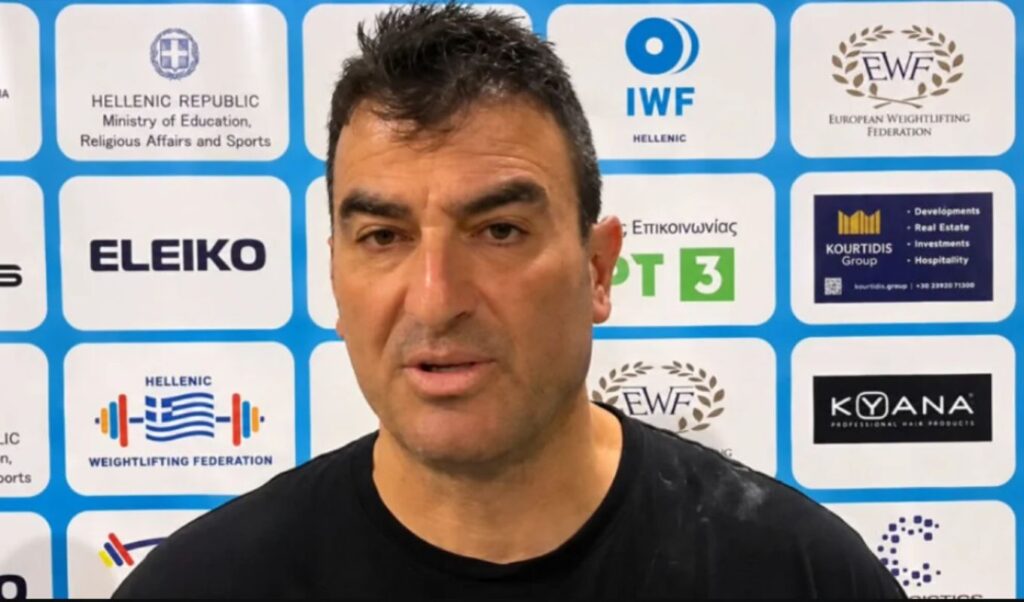
A mobile phone belonging to Odysseas Dimas is expected to play a pivotal role in the ongoing investigation into the alleged supply of banned substances to athletes.
The mobile phone of Pyrros Dimas’s brother has been sent to forensic laboratories, with police authorities searching for evidence that could help identify potential suppliers and recipients of the banned substances found at the 58-year-old’s residence.
According to initial assessments, a Balkan country is being investigated as a possible source of the substances, though this has not yet been confirmed.
The handwritten notes seized from the suspect’s home are also considered critically important to the investigation’s progress, as is the testimony of a National Organization for Medicines (EOF) employee, which has been included in the case file.
Across three pages of handwritten notes, names of individuals — listed by their initials — appear alongside a price list for pharmaceutical preparations and substances. Prices are reported to have ranged from €80 to €700.
According to information obtained by SKAI, among the findings are also handwritten notes by athletes, in which they reportedly wrote the word “Received,” followed by a monetary amount and their signature. It was clarified that these entries relate to the receipt of a pharmaceutical preparation.
Odysseas Dimas: EOF employee testimony on the seized substances
A television broadcast also aired an excerpt from the testimony of an EOF (National Organization for Medicines) employee.
According to the official, the pharmaceutical products that were seized are not approved for the Greek market, and some of them fall into the category of anabolic drugs.
“In their entirety, they fall under pharmaceutical products that have not been approved by the EOF for the Greek market. Based on their labeling and the active substances listed, some are anabolic drugs included on the World Anti-Doping Agency (WADA) prohibited list, and they have not been evaluated for safety or efficacy — consequently, they are harmful to the health of users,” the EOF employee stated.
Findings at the residence and sports club
On Thursday morning, police officers arrested the 58-year-old and conducted searches both at his home and at a sports club in the Glyfada area.
During the searches, according to reports, 871 pills and ampoules containing substances allegedly linked to doping were discovered and seized, along with 17 athlete registration cards and handwritten notes.
The registration cards belonging to the 17 athletes were reportedly registered under the name of the Glyfada sports club. This particular finding is under close scrutiny by authorities, as it is believed that the 58-year-old continued to coach young athletes despite having been expelled from the Federation.
What his associates say about the €15,000
Regarding the €15,000 in cash seized from his home, sources close to Odysseas Dimas claim the money was intended for the construction of a prefabricated house measuring between 50 and 60 square meters in Lagonissi. Meanwhile, police had received information that the 58-year-old was trafficking banned substances, which he allegedly stored in a space at the training facility within the Athens Olympic Sports Complex (OAKA). That location was searched, but no evidence was found.
In his statement, a gym instructor noted that the 58-year-old’s last visit to the training facility had taken place approximately one year ago.
What the defense says
For his part, attorney Michalis Dimitrakopoulos, speaking on Friday (13/11), stated that the seized substances are not anabolic steroids and that his client was not trafficking banned substances. According to the lawyer, Odysseas Dimas was using dietary supplements and pharmaceutical preparations to manage a health condition that, he claims, dates back to his athletic career. “He never trafficked drugs or anabolic substances,” he maintained, adding that in his view, should the case go to trial, the felony charge would not be substantiated.
Mr. Dimitrakopoulos also referenced Pyrros Dimas, with whom he said he has maintained a friendly relationship since 2004, calling on the public not to associate the Olympic champion with the allegations against his brother. “His brother’s mistake is not a family one — it is not a family responsibility,” he stressed, urging respect for the name of Pyrros Dimas.
Timeline of the investigation
The investigation began in late 2024, when the National Anti-Doping Organization forwarded complaints against Odysseas Dimas to the sports prosecutor, following a prior doping incident involving his son. In early 2025, the prosecutor ordered a preliminary inquiry, which was assigned to the Financial Police. This was followed by the collection of evidence and complaints, with the Financial Police compiling an initial case file that was forwarded to the sports prosecutor in late 2025. After reviewing and assessing the material as significant, the prosecutor ordered the continuation of the investigation in March 2026, which ultimately led to the raid on the 58-year-old’s home on Thursday, November 12.
As part of the investigation, Odysseas Dimas was also placed under physical surveillance. This revealed that he had been visiting the OAKA training facility until May 2025, when a 12-year ban was imposed on him in connection with his son’s doping case. Around the same time, due to the doping incidents, Deputy Minister of Sports Giannis Vroutsis imposed a €50,000 fine on the Greek Weightlifting Federation. The investigation culminated in the arrest of the 58-year-old, who now faces criminal prosecution for: the illegal procurement, storage and trafficking of banned substances capable of positively altering athletic performance or concealing such alterations, in the context of participation in competitions, carried out professionally and with the intent of financial gain (felony); and violation of pharmaceutical legislation (misdemeanor).