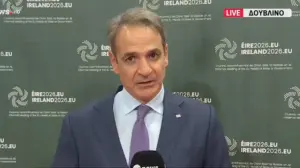
The European Commissioner for Internal Affairs and Migration, Magnus Brunner, has issued a positive assessment of Greece’s migration policy, effectively endorsing the strategy being implemented by the Ministry of Migration and Asylum under Minister Thanos Plevris. The commissioner’s remarks came in response to a question about the progress of the new EU Pact on Migration and Asylum in Greece.
Turkish-Libyan pressure and the risk of a new crisis in Crete
The statement from the senior EU official carries particular weight, coming at a time when Ankara is using every tool at its disposal to expand its influence across the southeastern Mediterranean — drawing Libya into the equation by weaponizing migration flows as a means of pressuring Greece. The geopolitical instrumentalization of migration routes from Libya represents one of the most critical pressure points facing Greece. Migration Minister Thanos Plevris warned on Thursday that the country is bracing for a migration crisis in Crete, linking the rising numbers of arrivals to the Turkey-Libya memorandum and Libya’s lack of cooperation. He also announced the activation of reception facilities in Athanatos and Agia, noting that returns had exceeded 6,000 during the first ten months of the year.
Brunner’s praise and Greece’s pivotal role
Almost simultaneously, Magnus Brunner stated that “Greece is doing a very good job,” publicly recognizing Greek performance in border procedures, returns, and the assumption of its responsibilities under the new European system.
Responding to a question from Kathimerini journalist Alexandra Voudouri, the EU official emphasized that “Greece is, of course, incredibly important for managing migration in Europe and plays a significant role in our efforts to curb irregular migration,” adding that this also has a positive impact across the European Union as a whole.
Greece “critically important” in managing migration flows
Regarding arrivals, Brunner pointed to an overall decline along the Eastern Mediterranean route, while acknowledging that “Greece continues to face challenges, particularly due to arrivals from Libya.” He added: “That is why we are working with our partner countries along the eastern corridor to prevent these dangerous journeys. And there, Greece is certainly extremely important.”
The new Pact, European solidarity, and returns
On the rules of the new Pact, Brunner explained that Greece will continue to have access to the solidarity pool, as it did last year, and that it is “making effective use of the new border procedure.” “These are very good news. Greece is doing a very good job and is also increasing returns, by the way. And that sends a very clear message from Greece to the rest of the world. Very good news,” he concluded.
*Originally published in Apogevmatini on Saturday