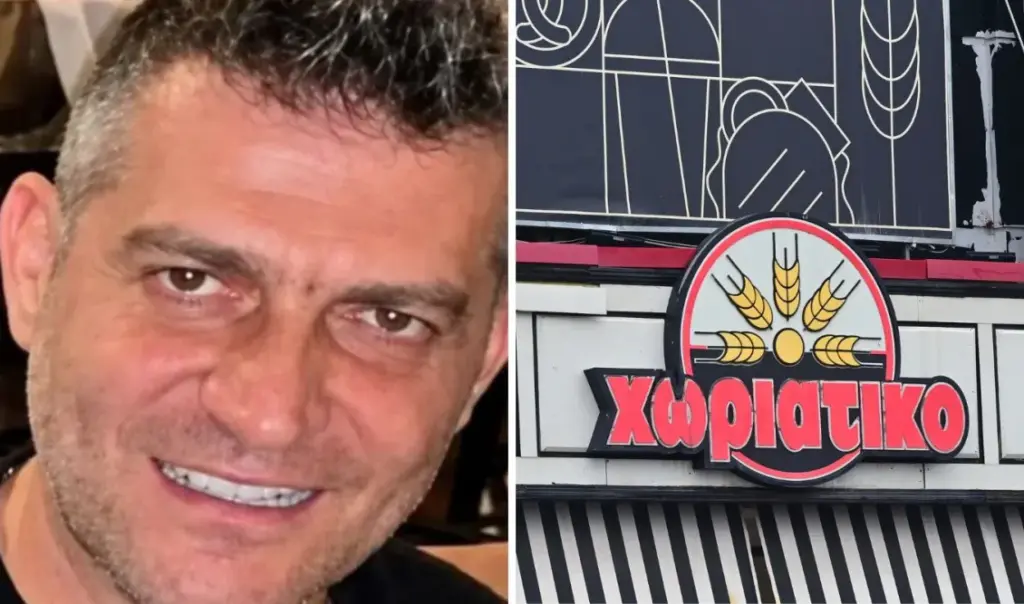
The owner of the Angelos Giannakopoulos, the bakery and restaurant chain “To Horiatiko,” appears to have been convinced he would successfully flee Greece, having allegedly been tipped off about the impending police operation in advance. According to information currently under investigation by authorities, he left behind a note containing contemptuous remarks directed at the officers hunting him, fully expecting to escape abroad.
Read also: “To Horiatiko”: Angelos Giannakopoulos’s business dealings in Rhodes — what his business associate on the island claims
Meanwhile, the investigation is taking on new dimensions. As reported by Greek public broadcaster ERT, authorities are now examining the potential involvement of six police officers, as well as employees from the Social Security Authority (EFKA), the Labor Inspectorate, and the Independent Authority for Public Revenue (AADE). Regarding the possible participation of AADE staff, the authority’s governor, Giorgos Pitsilis, has already ordered an internal investigation.
Also at the center of the case is information suggesting that the 57-year-old had been traveling abroad despite having a court-ordered travel ban in place. Among other trips, he is alleged to have visited the United Arab Emirates, and according to evidence currently being examined, he was in Dubai between October 5 and 7, where he also posted related content on social media.
Angelos Giannakopoulos is now in pretrial detention, along with other individuals accused of participation in the criminal organization. Authorities estimate that the network’s illegal revenues may exceed 70 million euros across an extensive web of business activities.
“To Horiatiko”: The note left for police and the attempted escape
The operation to arrest the 57-year-old unfolded as a cat-and-mouse affair, marked by a series of movements and deliberate attempts to throw authorities off the trail. According to information that has emerged, the chain’s owner had allegedly been forewarned about the police operation and attempted to buy enough time to flee the country.
He is reported to have initially moved between various locations across the Attica region before making his way to the Corinthia area. Officers ultimately tracked him down in Ioannina, just as he was preparing to cross into Albania by road. From there, according to the plan authorities are investigating, he intended to continue by air to Dubai.
According to the same sources, the 57-year-old had in his possession a credit card allegedly belonging to a person whose identity has yet to be confirmed. The find is being examined as part of the broader investigation into his escape plan.
His confidence that he would get away appeared to be captured in the note he left behind for police. According to its contents, it read: “You’ve been chasing me for three years, but in the end, when Chrysochoidis is gone, you’ll be shining my shoes.”
Investigative and police authorities are now examining whether the suspect had access to insider information about Greek Police (ELAS) operations, and whether any officers were aware of his travel ban yet nonetheless allowed or facilitated his movements.
The six officers and allegations of bribery and intimidation
One of the core strands of the investigation concerns the possible existence of a network of six police officers who allegedly provided information and assistance to Angelos Giannakopoulos. According to information being examined, as reported by ERT, some of them may have received payments, while others allegedly served the group’s interests following threats made against them.
In the case of one officer, investigators are looking into whether he was tipping off the owner about scheduled inspections at businesses linked to the network, giving him advance notice to prepare before inspection teams arrived.
A second officer is also under scrutiny, with information suggesting he may have been bribed by one of the accused. The precise reason for the alleged transaction has not yet been clarified.
Greek Police, working in coordination with judicial authorities, are investigating whether any uniformed officers were aware of the travel restrictions placed on the 57-year-old and yet facilitated his departures from Greece.
Dimoglidou: “Anyone involved […] will face justice”
Greek Police spokesperson Constantia Dimoglidou addressed the possibility of police involvement in the case during an interview on ERT News’s weekend program “Weekend from 5.” She stated that the months-long investigation into the “Horiatiko” criminal organization has included in its case file every piece of evidence that emerged pointing to the potential participation of public officials.
Specifically regarding the officers, she explained that when relevant evidence was identified, the appropriate procedures were activated. In some cases, individuals were removed from their posts, while in others the Internal Affairs division intervened — all handled in a manner designed not to compromise the confidentiality of the investigation. “Anyone involved in any way in this network, in whatever way they provided assistance or protection, will face justice,” she emphasized.
Code names, gifts for inspectors, and intercepted conversations
The investigation extends well beyond police officers, with employees from other public sector agencies also now under scrutiny. These are individuals connected, according to case evidence, to EFKA, the Labor Inspectorate, and AADE, who are alleged to have provided favors to the organization’s businesses.
The case file includes intercepted conversations between suspects in which references are made to gifts for inspectors and other individuals who could help ensure the uninterrupted operation of the businesses.
To describe the intended recipients, those conversing allegedly used code names such as “godchildren,” “auntie,” and “cousin.” The communications also suggest that the value of the gifts was calibrated according to the specific recipient and the favor being sought.
In one of the intercepted dialogues included in the investigation’s evidence, two individuals discuss their choice of perfumes and cosmetics as gifts:
— “Tell me, if I get a few things, what should I get? All perfumes? Would it be a problem if I also got some lipsticks?”
— “No, no, get whatever you want. Just make sure they’re not too cheap.”
— “They’re not cheap — they’re 40 euros. Should I get ones that cost 100?”
— “Oh, well done! No, that’s fine.”
In a separate conversation, reference is made to at least ten people who absolutely needed to receive gifts:
— “For about ten that we definitely need to cover.”
— “Yes, I’ll get them. But I’ll also pick up some lipsticks for the more low-key ones.”
Authorities are examining the full body of communications in order to identify the gift recipients, determine whether those gifts were tied to specific favors, and establish what services or facilitations the relevant public officials are alleged to have provided.
Internal investigation at AADE ordered by Giorgos Pitsilis
The governor of AADE, Giorgos Pitsilis, has ordered an internal review to investigate the possible involvement of the authority’s employees in the “Horiatiko” case.
As part of this process, AADE is expected to formally request the transfer of all evidence relating to the potential participation of its staff. The goal is to determine whether any employees collaborated with the network or provided any form of support to its operations.
The review will be conducted by AADE’s Internal Affairs Directorate, in coordination with Greek Police and investigative authorities.
The case file has also been referred to the Internal Affairs Service of the Hellenic Police. The investigation also covers the role of employees from tax offices, EFKA, and the Labor Inspectorate, who are alleged to have accepted bribes in exchange for turning a blind eye to inspections of the organization’s businesses.
Ten suspects remanded in custody — case file exceeds 800 pages
Ten individuals accused of participation in the criminal organization have so far been remanded in pretrial custody, including the 57-year-old alleged ringleader, as well as his son and daughter.
The case file runs to more than 800 pages, and investigations are ongoing to identify any additional individuals who may be involved.
Authorities estimate the organization’s total illegal revenues at more than 70 million euros. Evidence gathered during searches of suspects’ homes, offices, and businesses suggests that a significant portion of the money was channeled into luxury spending.
At the location believed to have served as the organization’s headquarters — above a large bakery on Kifissos Avenue — officers discovered gold bars, gold sovereign coins, expensive watches, designer handbags, and large amounts of cash.
Some of the cash had been concealed in purpose-built hidden compartments within the premises. Among the seized items were also 12 luxury vehicles and six motorcycles.
According to authorities, these findings are consistent with the way the group’s members are alleged to have utilized proceeds from their criminal activities.
430 businesses, 28 beach concessions in Rhodes, and a company in Dubai
The scale of the activity attributed to the network is reflected in the sheer number of businesses allegedly operating under its umbrella. Police estimate the total at approximately 430, concentrated primarily in the food and beverage, nightlife, bakery, and pastry sectors.
A separate strand of the investigation focuses on the island of Rhodes. According to evidence under examination, the network had allegedly established a strong presence on the island, with affiliated businesses estimated to have secured control over the concessions for 28 prime beach locations.
The investigation has also extended beyond Greek borders. The 57-year-old is alleged to have developed business activities internationally, with a company identified in Dubai that, according to findings currently being examined, is suspected of issuing fictitious invoices. The money is then reported to have been returned to Greece in cash.
Finally, the investigation is examining potential connections and activities in Balkan countries, including Albania. Authorities believe the network may have expanded its reach well beyond Greece’s borders.