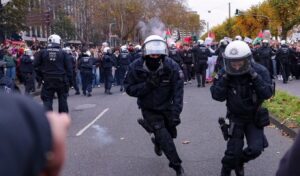
Poland is facing one of its most severe institutional crises in recent years, as a long-running dispute over the legitimacy of appointments to the Constitutional Tribunal has escalated into an open confrontation with far-reaching political, judicial, and diplomatic consequences. Protests outside the court building and a police cordon remain in place following the announcement that the tribunal’s president, Bogdan Święczkowski, and his deputy, Bartłomiej Sochański, have been suspended from their duties.
Read also: Political crisis in Poland: Police cordon around the Constitutional Tribunal — President Nawrocki makes urgent return (Video)
The decision triggered a fresh wave of outrage, with the confrontation reaching all the way to the country’s president, Karol Nawrocki, who cut short his trip to Senegal to return to Poland. There, he was involved in a heated incident with Judge Anna Korwin-Piotrowska, who had assumed control of the Constitutional Tribunal.
Behind these latest developments lies a dispute that has been simmering for 11 years. The conflict over judicial appointments has cast a deep shadow over the legitimacy of the country’s highest court and has effectively brought its operations to a standstill.
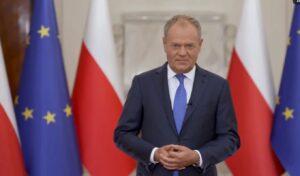
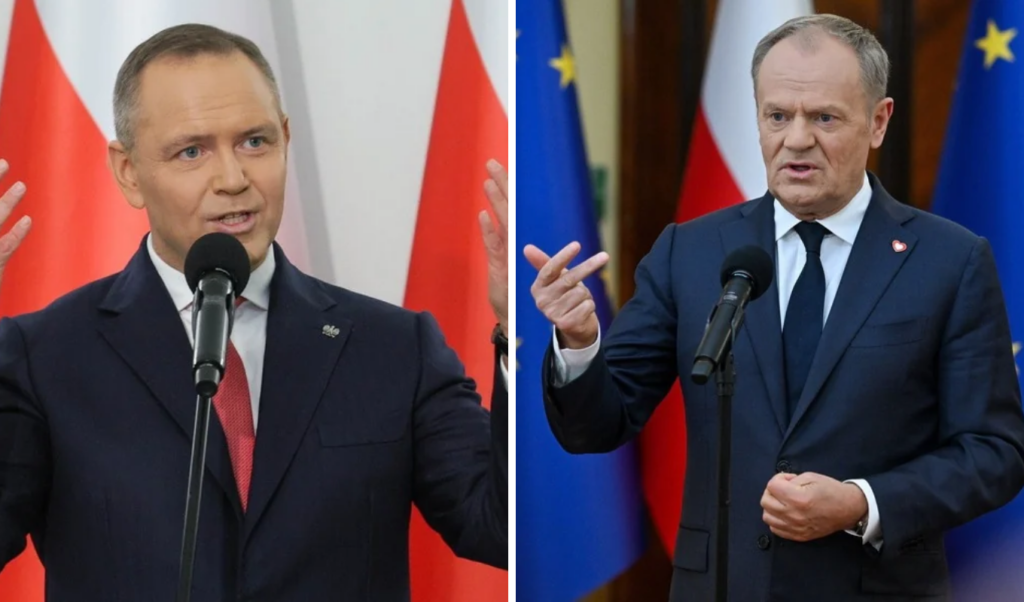
The government of Prime Minister Donald Tusk insists that its actions are aimed at restoring the rule of law. The opposition, backed by President Nawrocki, has denounced the moves as a “coup,” accusing the government of attempting to seize control of the judiciary.
Poland: How the Constitutional Tribunal crisis began in 2015
The roots of this institutional conflict stretch back to October 2015. At that time, the outgoing Polish parliament (Sejm) elected five judges to the Constitutional Tribunal. Three were designated to replace judges whose terms were expiring in November, while the remaining two were to fill seats with mandates ending in early December. The then-President of the Republic, Andrzej Duda, refused to administer their oath of office. The Law and Justice party (PiS), which had just won the elections, then proceeded to elect its own judges to seats it considered already filled.
On December 3, 2015, the Constitutional Tribunal ruled that the provision under which two of the five judges had been elected by the outgoing parliament was unconstitutional. In the years that followed, as sitting judges’ terms expired one by one, PiS filled every vacancy with individuals aligned with the party.
By the end of this process, Julia Przyłębska — who had been elected a judge during the PiS era — was appointed president of the Constitutional Tribunal by the President of the Republic.
European court rulings that deepened the divide
The dispute did not remain confined within Poland’s borders. On May 7, 2021, the European Court of Human Rights, ruling on the Xero Flor case, found that the election of judges in 2015 had not followed the legally prescribed procedure. It also determined that the applicant’s right to a fair hearing before a “tribunal established by law” had been violated. The Polish Constitutional Tribunal fired back in November of that same year, claiming that the ECHR’s interpretation conflicted with the Polish Constitution.
In 2022, Poland’s Supreme Administrative Court similarly ruled that the Constitutional Tribunal included judges who had been appointed in breach of the Constitution, replacing individuals who had been lawfully elected.
Then, in December 2025, the Court of Justice of the European Union (CJEU) issued a ruling finding that serious irregularities in the appointment of three judges and the tribunal’s president had compromised the institution’s impartiality.
Tusk’s pledge to reform the judiciary — and Nawrocki’s veto wall
Donald Tusk’s pro-European government came to power in 2023 on a clear promise to restore judicial independence. That effort, however, ran into formidable resistance following the election of Karol Nawrocki to the presidency in 2025. The new president, closely aligned with PiS, moved to block the government’s reform agenda.
Legislative measures proposed by the government to restructure the Constitutional Tribunal were vetoed by two PiS-linked presidents — one of whom was Nawrocki himself.
Meanwhile, Bogdan Święczkowski had been elected a judge of the Constitutional Tribunal in February 2022, during the PiS administration. On December 9, 2024, then-President Andrzej Duda appointed him as the tribunal’s president. Prior to this, Święczkowski had served as Deputy Minister of Justice in a PiS government, according to Haberler.
March 2026: Six new judges and the battle over the oath of office
A new cycle of tensions erupted on March 13, 2026, when the current parliament elected six judges to the 15-member Constitutional Tribunal: Krystian Markiewicz, Anna Korwin-Piotrowska, Maciej Taborowski, Magdalena Bętkowska, Marcin Dziurda, and Dariusz Sońta.
Under a 2016 law, newly elected judges are required to take their oath before the President of the Republic. The governing coalition, however, argues that the oath is a purely ceremonial formality and that the parliamentary vote electing the judges is legally binding.
Nawrocki refused to administer the oath, citing alleged procedural irregularities in the selection process. Among those turned away was Korwin-Piotrowska. Święczkowski took the same stance, barring all six judges from entering the tribunal building on the grounds that they could not assume office without first being sworn in before the president.
The judges then took their oaths before a notary and submitted the relevant documents to the presidential palace. When they attempted to enter the Constitutional Tribunal, they were met with heightened security measures and protesters.
The Constitutional Tribunal itself ruled that the President of the Republic is under no legal obligation to swear in judges elected by parliament. The ECHR, however, issued an interim order in May calling for four of the judges to be allowed to take up their posts.
The appointment of Tusk’s close ally reignites controversy
Tensions escalated further in September when parliament elected Maciej Berek — a close associate of Prime Minister Donald Tusk — to the Constitutional Tribunal.
The appointment drew immediate criticism, with government opponents arguing that it directly contradicted the administration’s stated goal of restoring institutional balance and judicial independence.
Nawrocki reacted sharply, stating that the last thing the Constitutional Tribunal needed was a politician — and in particular, the prime minister’s closest ally.
Having received no invitation from the president, Berek was sworn in on October 14 at a ceremony held in parliament. In the meantime, prosecutors pressed charges against two officials for obstructing the newly elected judges from taking office. Święczkowski, for his part, initiated disciplinary proceedings against three of the judges.
November 3 looms — the Constitutional Tribunal at an impasse
The appointments dispute has brought the Constitutional Tribunal to a virtual standstill. The government and the president each contest the legitimacy of the other side’s nominees, leaving the institution without a commonly accepted composition.
According to Polish media reports, the judges elected by the current parliament are planning to convene the tribunal’s General Assembly on November 3. The primary item on the agenda is expected to be the approval of the court’s budget.
The suspension of Święczkowski and Sochański — and the police presence
The latest phase of the crisis unfolded when, at around 6:00 p.m. local time, a notice appeared on the Constitutional Tribunal’s website announcing that President Bogdan Święczkowski and Deputy President Bartłomiej Sochański had been suspended from their duties for one month.
The decision was signed by Anna Korwin-Piotrowska — one of the judges elected by the current parliament — who assumed control of the tribunal.
On the same day, Justice Minister and Prosecutor General Waldemar Żurek announced that he had filed five requests to lift the immunity of the two men — four targeting Święczkowski and one targeting Sochański. Żurek argued that the two officials had violated their duties by preventing lawfully elected judges from carrying out their functions.
Rallies outside the tribunal and arrests in Warsaw
The announcements triggered an immediate response. According to Polish media, large crowds gathered outside the Constitutional Tribunal building. Among those present were PiS leader Jarosław Kaczyński, former Prime Minister Mateusz Morawiecki, and former tribunal president Julia Przyłębska.
The building was placed under police cordon. Police stated that officers had been deployed at the request of Korwin-Piotrowska, who cited a potential threat to the safety of the judges and court staff.
Warsaw police, however, pushed back against reports of an “intrusion,” clarifying that officers had not entered the building itself.
During the disturbances, three individuals who attempted to climb the railings were detained and arrested, and objects were thrown at police officers.
Święczkowski’s camp cries “coup”
Święczkowski’s administration rejected the suspension order outright. It claimed that the tribunal’s website had been illegally seized and that Korwin-Piotrowska did not hold valid judicial status.
In a post on the Constitutional Tribunal’s official account on X, the events were labeled a “coup,” with the allegation that those involved had committed criminal offenses.
Senior PiS figures, led by Jarosław Kaczyński, accused the Tusk government of staging a coup against the judiciary.
Former Prime Minister Mateusz Morawiecki argued that a judge whose oath the President of the Republic had refused to accept had declared herself head of the tribunal, dismissed its leadership, and summoned police to secure the building.
Nawrocki cuts Senegal trip short to return to Poland
The crisis deepened further when President Karol Nawrocki announced via X that he was cutting his trip short and returning home immediately. “At a moment like this, the president must be in Poland. I am interrupting my visit to Senegal and returning,” he wrote.
The presidential aircraft changed course over Spain, and according to Flightradar24, more than one million users tracked the return flight in real time.
Upon his return, Nawrocki met at the Presidential Palace with Święczkowski and Zbigniew Kapiński, the First President of the Supreme Court.
He then proceeded to the Constitutional Tribunal, accompanied by Kapiński. At the entrance, Korwin-Piotrowska was waiting for him and attempted to block his entry.
Television footage captured the president telling her to “please step aside,” while the judge, physically holding him back, insisted he had no right to enter the building.
A brief physical altercation ensued, after which Nawrocki ultimately entered the tribunal alongside Kapiński and suspended Deputy President Sochański. Both sides later traded accusations over the physical contact that had taken place.
The president left shortly afterward. It subsequently emerged that Korwin-Piotrowska had offered to allow him entry — on the condition that he enter alone, without the two officials who had been removed from their positions.
“There is no other way,” Tusk insists — reactions from the US and abroad
Prime Minister Donald Tusk vigorously defended his government’s actions, reiterating that the goal is to restore the rule of law. “Restoring the rule of law is our duty. After years of lawlessness under the PiS government, this process is difficult, sometimes painful, and requires decisive steps. There is no other way,” he wrote on X.
Deputy Prime Minister and Foreign Minister Radosław Sikorski, who was in Atlanta for the G20 summit, also defended the police intervention. He argued that the police presence was necessary to allow the lawfully elected judges to restore the tribunal to full operation.
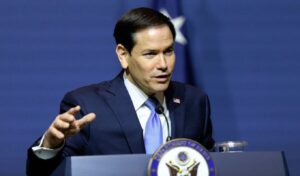
US Ambassador to Warsaw Tom Rose expressed deep concern over the situation, urging all political parties to prevent the dispute from turning violent and to exercise restraint. He emphasized that the United States has a direct interest in Poland’s stability, security, and democratic future.
The developments also had diplomatic repercussions. Poland’s ambassador to Beijing, Jakub Kumoch, and the ambassador to Bucharest, Paweł Soloch, both submitted their resignations.
In the United Kingdom, Reform UK leader Nigel Farage described the situation as extremely serious, claiming that the arrests and police intervention at the tribunal amounted to an attempt to defend the interests of the European Union.