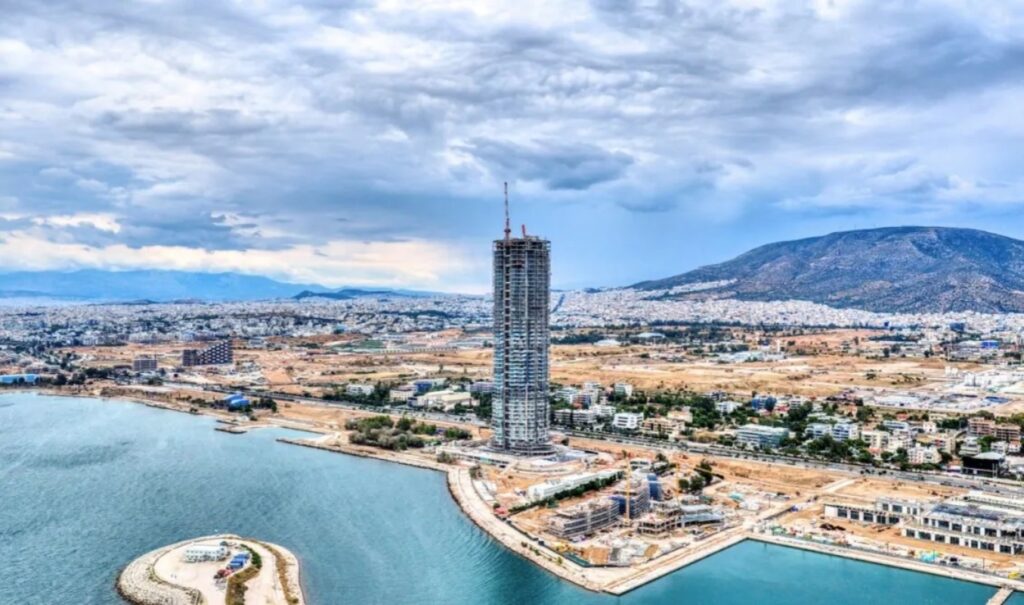
Athens is rapidly emerging as a premier destination for billionaires, hedge fund managers, and affluent international families, according to an extensive report by the Financial Times that documents the transformation of the Athenian Riviera and surging demand for luxury properties. Greece’s capital is no longer seen merely as a holiday destination — a growing number of international investors are choosing to relocate their residences, families, and even their business operations here. A prominent example is billionaire hedge fund manager Chris Rokos, who decided to leave London and establish an office in Athens. His move caused considerable stir in the UK, as he reportedly paid around £330 million in taxes the previous year. At the same time, rising international demand is reshaping the southern suburbs, where old single-family homes are being replaced by modern luxury complexes, with some high-end properties reaching prices of €30,000 per square metre.
Read also: Greek Ministry of Finance: What changes for debtors under the new bill — New rights, housing protection and stricter rules for servicers
The tax incentives attracting the ultra-wealthy
Greece’s special tax regimes, introduced in 2020, are playing a pivotal role in attracting high-net-worth residents. The non-dom programme offers a flat annual tax of €100,000 on foreign-sourced income, subject to specific conditions including a minimum investment of €500,000. Foreign retirees, meanwhile, can benefit from a flat 7% tax rate on foreign-sourced income for up to 15 years. Professionals and entrepreneurs who relocate their activities to Greece are eligible for a 50% exemption on qualifying income. In addition, the carried interest tax rate for qualifying fund managers was reduced this past summer from 15% to just 5%, provided certain conditions are met — including annual expenditure of at least €3 million in Greece.
According to data from the Ministry of Finance, approximately 500 applications have been submitted under the non-dom scheme, while around 1,500 retirees and nearly 10,000 professionals have applied to take advantage of other incentive programmes. Vasilis Karatzas, adviser to the Finance Minister, explains: “This isn’t about ten people spending a lot of money.” He adds: “Their real impact lies in their potential to help build an ecosystem and a business environment that simply didn’t exist in this country before.”
The Athenian Riviera: how Glyfada, Voula and Vouliagmeni are changing
The most visible transformation is taking place in the southern suburbs, where low-rise homes with gardens are gradually giving way to luxury apartment complexes featuring swimming pools, sea views, and security services. Real estate agent Paulina Billiri, a 30-year resident of Voula, describes the shift: “I’ve lived in Voula for 30 years. The gardens, the low-rise houses… The urban landscape is changing very rapidly. Each new apartment block is taller than the last.” Meanwhile, Eleni Papadopoulou has been documenting the area’s architectural heritage through her @Vintage.Glyfada account, having compiled nearly 700 photographs of old residences.
This transformation has been accompanied by a dramatic rise in property prices. According to the Bank of Greece, after falling by more than 40% between 2008 and 2017, apartment prices have since recovered by approximately 85% from their 2017 lows, with the second quarter of 2026 seeing a further year-on-year increase of 5.5%.
Multi-million euro luxury homes and the landmark Ellinikon development
According to market professionals, luxury property prices on the Athenian Riviera typically range from €6,000 to €10,000 per square metre, rising to €15,000–€20,000 in new developments and reaching as high as €30,000 per square metre in select cases. In Glyfada, a two-storey penthouse of 276 square metres is listed at €3.4 million, while a 500-square-metre property in Vouliagmeni is on the market for €6.75 million.
The Ellinikon mega-development is expected to play a defining role in shaping this new market. Of the project’s approximately 1,300 residential units, between 850 and 900 have already been sold, with 55% of buyers being Greek nationals and a further 20–25% coming from the Greek diaspora. An international school is also planned, with an expected opening date of September 2028. The key challenge, as the Financial Times report notes, is for Greece to retain the interest of its new residents by offering not only luxury housing, but also schools, professional infrastructure, and services that enable long-term settlement.