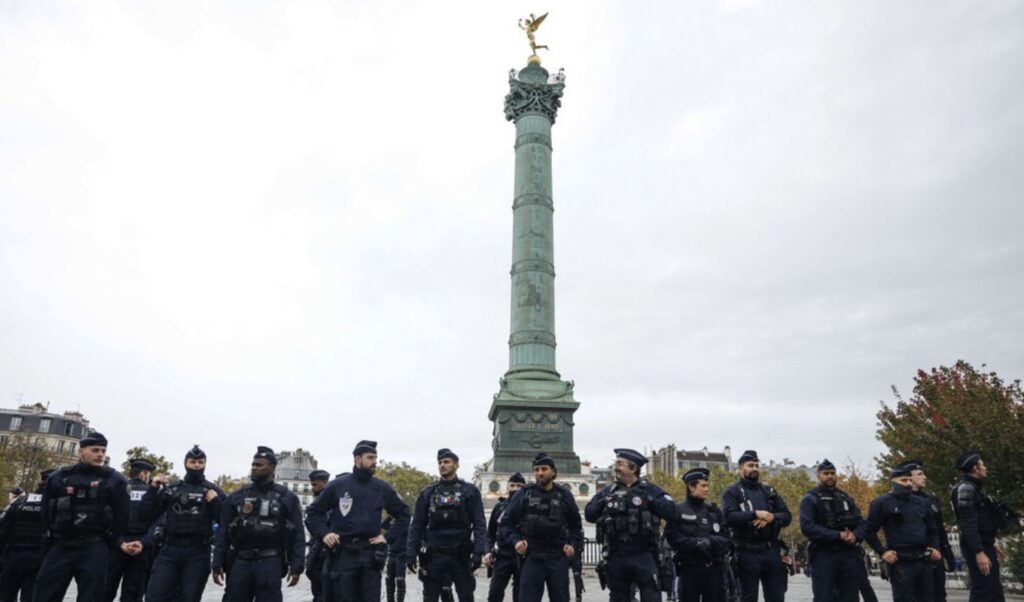
France finds itself in a tense yet calm atmosphere ahead of major demonstrations scheduled for Saturday afternoon across numerous cities, with students, university attendees, and trade unions all taking part in the mobilizations.
The rerouting of the Paris march
In Paris, where protests are already underway, police authorities decided at the last minute to change the route demonstrators would follow. As announced, the originally agreed march was set to begin at Place de la Bastille and end at Place de la Nation. However, an alternative route was imposed, running from Porte d’Italie to Porte de Vincennes, with adjusted timing announced accordingly.
According to French media, the decision was announced on Friday, just hours before Saturday’s demonstration, sparking backlash from trade unions and organizers. Police maintained that the change was linked to a threat assessment and the need to adapt security measures, keeping the focal point of the protests away from the city’s commercial center. The authorities’ decision was upheld by the administrative court just hours before the demonstrations were set to begin, with participants stating that they would…
Paris on lockdown — army and reinforced police forces deployed across the capital
Tensions remain high, one week after the clashes, looting, and widespread unrest that swept the country. Nevertheless, calm has prevailed so far, while police forces remain on heightened alert.
Throughout the day, police units were deployed at various points across Paris. Among those deployed are the Brav-M units — specialized motorcycle police squads created in 2019 in the wake of the Yellow Vest protests.
Earlier, Place de la Bastille was completely cleared following repeated police announcements calling on those gathered to disperse. The evacuation was carried out without incident, with dozens of officers remaining on site.
Interior Minister Laurent Nuñez today called on police to demonstrate “exceptional readiness” in the face of potential troublemakers. The statement came as soldiers reinforced police officers patrolling the French capital. Authorities appear determined to handle unrest more effectively this weekend, after last Saturday’s violence, looting, and riots appeared to catch them at least somewhat off guard, as Sky News noted.
Among the locations where patrols were deployed was the Champs-Élysées, with police vehicles also circling the Arc de Triomphe. Nuñez has mobilized 10,000 more police officers compared to last weekend.
Speaking to officers in Paris, Nuñez warned that they would face attempted attacks on shops, public institutions, and security forces. He specifically stated: “We must be extremely, extremely vigilant. We are seeing significant calls for unrest from political groups and, simply, from criminals. It is going to be a long day.”
Nuñez: 135 arrests across France
During a press conference, Interior Minister Laurent Nuñez announced that 135 arrests had been made since the start of the day. He added that 136 incidents had been recorded up to that point, compared to 264 at the same time last Saturday. “We have counted 35,000 people on the streets, compared to 60,000 on October 17,” he noted.
More than 600 security checks carried out
The Paris police prefecture announced that it had conducted 635 checks “to prevent those who might wish to come to the capital with bad intentions.”
Among the items seized were a knife, a grinder wheel, and protective equipment such as filtered masks and diving goggles.
Yellow Vests call for another mobilization next Saturday
The Yellow Vest movement announced that more than 700 demonstrations were planned for Saturday across the entire country.
At the same time, the movement is calling for a new day of action next Saturday, October 31, centered around the defense of civil liberties. As part of this, rallies and sit-in protests are planned in front of the National Assembly and town halls throughout France.
In a statement, the Yellow Vests denounced what they called the government’s “authoritarian drift,” arguing that there is widespread anger in society that is not being heard. They spoke of “contempt, refusal to listen, lies, and repression,” and claimed that citizens’ freedoms are under attack due to the banning of numerous demonstrations across the country.
Rally in Orléans as the National Rally party holds its congress
Meanwhile, in Orléans, gatherings of protesters opposing racism, fascism, and imperialism were recorded, coinciding with the congress of the far-right Rassemblement National (National Rally) party, where Marine Le Pen is expected to receive the party’s presidential nomination. According to authorities, 11,000 protesters were present, while organizers put the figure at 20,000.
First tear gas fired in Clermont-Ferrand
Despite a ban on gatherings issued by the Puy-de-Dôme prefecture, protesters in Clermont-Ferrand assembled at Place Jaude in response to the Yellow Vests’ call.
Authorities had issued a series of administrative orders aimed at preventing public order disturbances.
However, according to France 3, part of the march attempted to move toward the train station, where approximately 30 police officers were stationed. The first tear gas canisters were fired near the 92nd Infantry Regiment, while CRS riot control units surrounded the crowd.
According to journalists present at the scene, union representatives stated that they had lost control of the march.
Tear gas and tensions in Pau, southern France
Similar scenes unfolded in the city of Pau in southern France. According to reports from sudouest.fr, approximately 5,000 demonstrators took to the streets despite the rain.
However, despite the largely peaceful atmosphere, some protesters clashed with police, casting a shadow over the demonstration.
Videos circulating online show students running through an arcade, while the accompanying caption states that police deployed flash-bang grenades.