The decision by Greece and Egypt to resume negotiations over the delimitation of their maritime zones marks a significant new development in the Eastern Mediterranean, following Libya’s ratification of the Turkey-Libya maritime memorandum. Athens and Cairo have agreed to continue consultations on the basis of the Law of the Sea, reopening the question of extending the partial Exclusive Economic Zone (EEZ) agreement signed in 2020. Attention is now focused on the maritime areas east of the 28th meridian, where previous delimitation efforts had stalled due to Egypt’s reluctance to engage in negotiations over zones where Turkey asserts competing claims. Cairo’s new approach carries particular significance, as it comes in direct response to the memorandum’s ratification and strengthens cooperation between the two countries on one of the region’s most complex geopolitical issues.
Read also: Marinakis on the Turkey-Libya memorandum: Geography and international Law of the Sea cannot be changed by unilateral, legally unfounded decisions (Video)
Turkey-Libya memorandum: The Gerapetritis – Abdelatty agreement on new talks
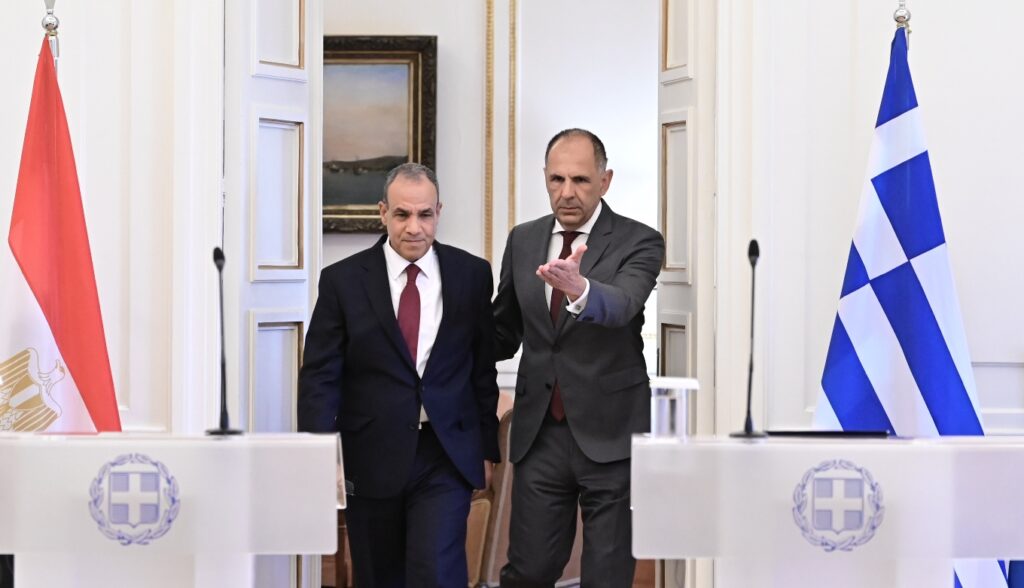
The decision to restart the negotiation process was reached during a phone call between Greek Foreign Minister Giorgos Gerapetritis and his Egyptian counterpart, Badr Abdelatty. The two ministers reiterated their joint opposition to the memorandum’s ratification, underscored the importance of respecting the Law of the Sea, and agreed to resume maritime delimitation talks between Greece and Egypt. This development follows the wave of reactions triggered by Libya’s decision among regional states and the European Union, and revives a negotiation process that had effectively been frozen since the 2020 agreement. The next phase is expected to involve the formation of technical committees to address the outstanding delimitation issues. Egypt’s willingness to return to the table is considered a significant diplomatic win for Athens, even if the process does not immediately yield a new formal agreement.
Why delimitation stalled at the 28th meridian
The partial EEZ agreement signed by Greece and Egypt in 2020 was not extended east of the 28th meridian, as Cairo was reluctant to negotiate over maritime zones subject to Turkish territorial claims. Ankara maintains positions that significantly diminish — or entirely negate — the maritime entitlements of the island of Kastellorizo in any delimitation, making this one of the central points of contention with Greece. While the 2020 agreement served as an effective challenge to the Turkey-Libya memorandum, it was reached with certain concessions from the Greek side regarding the principle of full island entitlements. The prospect of extending the agreement now brings back to the table the zones that were left outside the original delimitation — zones directly tied to the fundamentally different approaches of Athens and Ankara on maritime rights.
Turkey’s attempts to court Egypt
Relations between Cairo and Ankara have gone through several phases, though their underlying rivalries have never fully disappeared. During the Mubarak era, Egypt left open the possibility of maritime discussions with Turkey — talks that could have encroached on areas of the Greek continental shelf. After President Abdel Fattah el-Sisi came to power, such negotiations never materialized, despite reported pressure from both Turkey and elements within Egypt’s own diplomatic establishment. Even during the process of normalizing bilateral relations, Ankara attempted to attract Cairo by arguing that embracing the “Blue Homeland” doctrine would secure Egypt a larger maritime area. However, this approach was built on a delimitation framework that would have directly undermined Greek sovereign rights.
Libya and the Cairo-Ankara rivalry
Egypt’s reaction to the memorandum’s ratification goes beyond disagreements over maritime delimitation. Cairo views the memorandum as a direct threat to its own maritime rights, and regards Turkey’s expanding presence and influence in Libya with deep concern. Of particular significance is Ankara’s ambition to gain a stronger foothold in eastern Libya — a region where Egypt has traditionally wielded considerable influence. Turkey’s assertive moves coincide with a critical juncture in Libya’s political process and bring the rivalry between the two regional powers back into sharp focus. Despite recent steps toward normalizing their bilateral ties, disagreements over Libya and the broader Eastern Mediterranean persist. In this context, the resumption of Greek-Egyptian talks adds another pillar to the strategic partnership between Athens and Cairo, while simultaneously narrowing the window for any Turkish-Egyptian understanding that could come at the expense of Greek maritime rights.