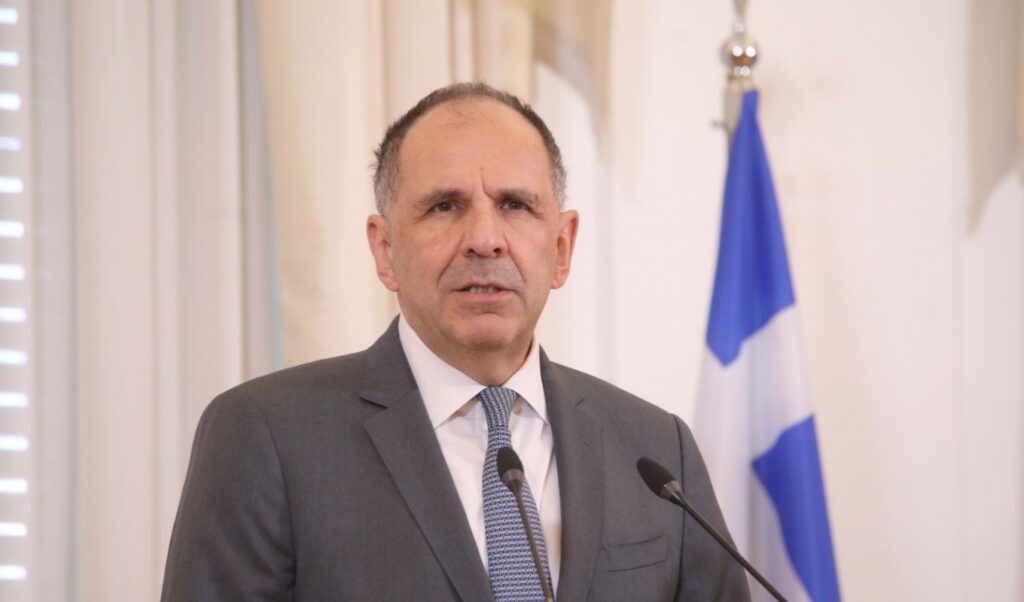
Athens has embarked on a full-scale diplomatic marathon to brief its partners and allies while taking every necessary step to safeguard its sovereign rights. European Commission President Ursula von der Leyen stood firmly by Greece’s side from the outset, condemning the ratification of the Turkey-Libya maritime memorandum by the Libyan Parliament, and reminding all parties that the EU has maintained since 2019 that this agreement “violates the sovereign rights of third states.”
In an official statement, von der Leyen declared that “the Turkey-Libya agreement does not comply with the Law of the Sea and is null and void.” She simultaneously reaffirmed the European Commission’s solidarity with both Greece and Cyprus.
Turkey-Libya memorandum: Gerapetritis leads Greece’s diplomatic marathon
Greek Foreign Minister Giorgos Gerapetritis, who has been coordinating closely with his Cypriot counterpart Constantinos Kombos, held a telephone conversation yesterday with Egyptian Foreign Minister Badr Abdelatty to discuss developments surrounding the Turkey-Libya maritime memorandum and its potential impact on security and stability across the Eastern Mediterranean.
It is worth noting that Greece and Egypt concluded a partial maritime zone delimitation agreement in 2020, partly in response to the Turkey-Libya memorandum. Egypt, like Greece, had rejected the Turkey-Libya agreement from the very beginning, as it encroached upon the sovereign rights of both nations. However, Cairo now maintains strong diplomatic ties with Khalifa Haftar’s Eastern Libya government and has more recently opened channels of communication with Turkey as well.
Liakuras: Greece must expand its territorial waters immediately
Professor of International Law Petros Liakuras spoke exclusively to parapolitika.gr about the steps Greece must take to defend its sovereign rights, stressing that Athens must “absolutely” and without delay extend its territorial waters to 12 nautical miles south and west of Crete — and most critically, south of Kastelorizo. As he argued: “We did it with the Egypt agreement, and even with the Turkey-Libya memorandum in place, did you see Turkey react beyond verbal statements? No. So why shouldn’t we do the same south of Kastelorizo? Kastelorizo now faces a grave threat of being completely encircled by the Marine Park announced by Turkey. Don’t view that Marine Park simply as a marine park — it does not represent sovereignty yet. But it will be absorbed once Turkey’s ‘Blue Homeland’ legislation passes into law. It will then become an Exclusive Economic Zone. Greece must act before that happens. All of this needs to happen now. There is no time to wait.”
Regarding the Libyan Parliament’s decision, Liakuras pointed out that in practical terms nothing has fundamentally changed for third states that do not recognize the Turkey-Libya agreement, since the memorandum is binding only between its two signatories. “The Turkey-Libya memorandum was already in force, because it applies between Turkey and Libya — not beyond them. What this ratification does, first and foremost, is to silence those who argued that ‘the memorandum isn’t legitimate because it hasn’t been ratified by parliament.’ Well, now it has been.” As for the potential consequences, the professor warned: “I’m very concerned that, having now secured this ratification, Erdoğan may conclude that ‘fine, we’ve moved past the threshold of plausible challenge and can now proceed with surveys and so on.’ That would be very bad for us. Because if they launch surveys in that area — which is also covered by the Greek-Egyptian agreement — we will have a serious problem.”
For Athens, this decision came as a bolt from the blue. Just last August, a Greek delegation had been in Benghazi for talks on migration, reporting a positive atmosphere between the two sides. A month earlier, on July 27th, Athens hosted the third round of technical talks focused on the delimitation of the Exclusive Economic Zones between Greece and Libya. According to well-informed sources, negotiations had reached an advanced stage, with the Libyan side having delivered maps to the Hellenic Navy’s Hydrographic Service upon which the technical discussions were to be based. Greece had consequently been preparing to host a fourth round of technical talks in the near future.
Yet clouds of uncertainty had never fully dissipated from the Athens-Benghazi relationship. On the contrary, Ankara’s cultivation of Saddam Haftar — son of Field Marshal Khalifa Haftar and commander of the Libyan National Army — had periodically raised tensions with Greece. Saddam Haftar’s visit to Athens last June and his meetings with Prime Minister Kyriakos Mitsotakis and Foreign Minister Giorgos Gerapetritis had registered as a positive signal and laid the groundwork for a mutually beneficial cooperation, with discussions centered on EEZ delimitation between the two countries. Libya’s verbal note of August 24th, in which Tripoli protested Greek survey activities south of Crete, was treated by Greek diplomacy as a routine tactical maneuver on the part of its neighbor and was promptly addressed through diplomatic channels.
Warning signs had also emerged following the removal of Aguila Saleh from the presidency of the Tobruk Parliament — a figure who had been rejecting the Turkey-Libya memorandum as illegal since 2019 and had consistently refused to ratify it. His replacement by a figure close to Saddam Haftar delivered exactly the outcome Turkey had been seeking.
Karaïtidis: “Turkey may well move to provoke an incident”
Honorary Ambassador Dimitris Karaïtidis described this development as “unpleasant, negative and extremely damaging for us,” explaining that “although it is entirely irregular and illegal from the standpoint of International Law, it nevertheless constitutes a reality. An illegitimate situation, but a real one — which Turkey exploits, having notified the United Nations of this agreement and presenting it internationally, in its contacts and negotiations, as a lawful act. What had given us hope and expectation that this memorandum might be weakened was the fact that Libya’s second government, which controlled the parliament, had not approved it. We had hoped that, partly through the contacts we had maintained over the years with the well-known Haftar, we might manage to prolong that refusal and, if possible, convert it into an outright rejection of the memorandum. All of that — all those expectations — have now been overturned and dashed by yesterday’s decision.”
Many analysts are linking Libya’s move to the timing of the resumption of surveys related to the laying of the GSI cable, which is set to pass through a maritime area covered by the Turkey-Libya memorandum. As International Law Professor Petros Liakuras argued: “Whether the cable passed through the area previously defined as Turkey-Libya, as it did before, or through the current designated area, Turkey’s reaction would be identical. The cable is irrelevant. And references to the continental shelf are misplaced — the continental shelf regime is one thing, and the continental shelf as a seabed is another matter entirely.”
Honorary Ambassador Dimitris Karaïtidis, however, takes a harder line, arguing that “on the ground, this means that if we attempt to ignore this reality and operate in that area, Turkey will very likely — almost certainly — accuse us of violating what it considers a valid agreement. It will level those accusations and may well proceed to provoke an incident. Whichever way you look at it, this situation has nothing but negative implications for us.”