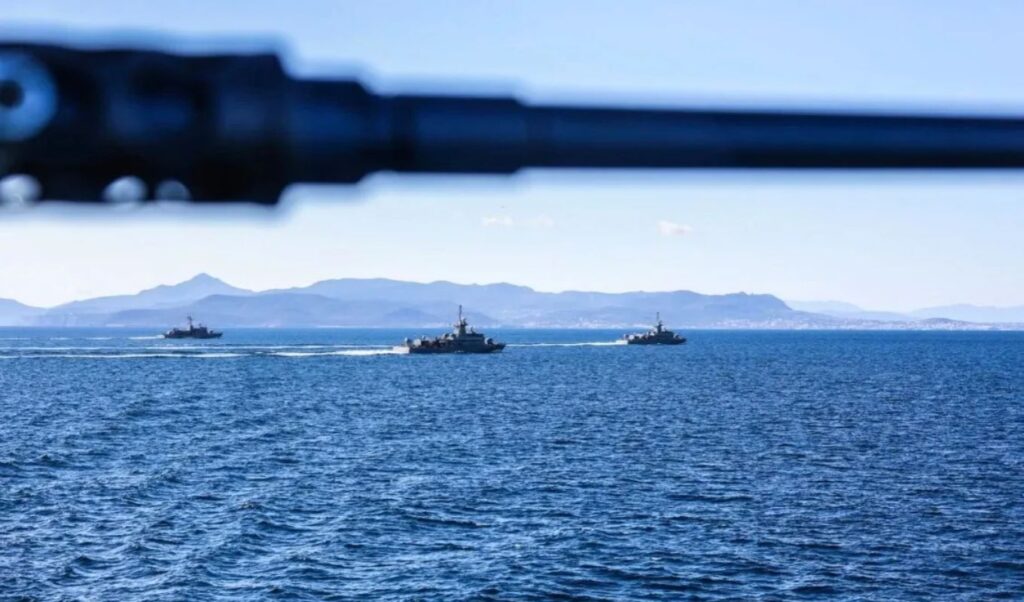
Turkey has reasserted its claims in the Eastern Mediterranean by reissuing a Navtex notice through its Antalya station for the multinational exercise “EUNOMIA,” to be conducted in waters south of Kastellorizo. The Heraklion station had already issued its own authorization for the same exercise one day earlier.
Through this move, Turkey is attempting to send a clear message to Athens that “the specific maritime area falls within its jurisdiction.”
By contesting Greece’s authority to issue Navtex notices in the area through which the GSI cable is set to pass — the same zone designated for the “EUNOMIA” exercise — Athens finds itself facing serious concern. Meanwhile, the pro-government Turkish press (Hürriyet) is speaking of “Ankara’s warning to Athens,” recalling that Turkish vessels had previously halted cable-laying operations in the same maritime zone (near Kasos and Kastellorizo, in 2024).
Turkey provokes again with its own Navtex south of Kastellorizo
Under these circumstances, the Greek Ministry of Foreign Affairs is expected to instruct the Heraklion Naval Hydrographic Service to issue a Navtex in order to commence seabed survey operations in the area where the undersea electricity cable connecting Cyprus to Greece will be laid.
These developments come ten days after U.S. Secretary of State Marco Rubio departed Athens, having offered assurances regarding the connectivity projects in which Greece is involved or leading. However, the prospect of a Greek-Turkish crisis brings to the fore a critical question: what position would the United States take in the event of a military confrontation?
As former Greek Ambassador to Washington Alexandros Mallias points out to parapolitika.gr, during the prolonged 2020 crisis in the Aegean, the United States under President Donald Trump failed to intervene in a timely manner to prevent escalation. Active deterrence through air and naval forces was undertaken at the time by France and the United Arab Emirates, while the U.S. only stepped in toward the end of the crisis through a visit by then-Secretary of State Mike Pompeo.
As Ambassador Mallias recalls, “since the restoration of democracy — that is, from 1975 onwards — the issue of Turkey’s threats of war against Greece (because that is the correct terminology: ‘threats to declare war against Greece’), threats to Greek sovereignty and challenges to our territorial integrity — meaning everything that has been granted to us through international multilateral treaties and belongs to us, constituting national sovereignty — all of this has been contested by Turkey. This issue has, therefore, been the subject of discussions, often between Greece and the United States. I have before me the minutes of the conversations between President Ford and Prime Minister Konstantinos Karamanlis in May 1975 in Brussels, on the occasion of the NATO Summit, during which Ford himself told the then-Prime Minister: ‘We are ready to discuss a letter of assurance to you regarding what we will do to prevent a military confrontation with Turkey.’ This is what we are talking about, because the words ‘tension’ and ‘escalation’ sometimes fail to capture the full picture. One year later, on April 10, 1976, with Henry Kissinger as Secretary of State and acting on President Ford’s instructions, the United States sent a letter to Greece’s Foreign Minister Dimitrios Bitsios — the content of which had been the subject of months of negotiations — stating, among other things, that ‘disputes must be resolved through peaceful processes,’ as the UN Charter requires, and ‘that each party must avoid provocative actions. We have already expressed our conviction that neither side should seek a military resolution of these disputes. This remains the policy of the United States. Accordingly, the United States will actively and unreservedly oppose any attempt by either party to seek a military solution to these disputes, and will make every major effort to prevent such a development.’ Given that only Turkey continuously threatens Greece with war (and casus belli means precisely that — a declaration of war), it is clear that the United States was assuring Greece that if it perceived Turkey was about to use military force, to declare war, it would intervene.
Moving from 1976, fifty years forward, to Secretary of State Marco Rubio’s remarks during his recent visit to Greece: when asked about the possibility of a Greek-Turkish conflict, he said ‘for me it would be unthinkable for something like that to happen. These are two NATO allies and partners, so it simply cannot happen.’ So we have almost the same formulation from 1976 to 2026. Is that enough? My answer is no. Because we saw during the 2020 crisis — the longest in duration and the most intense in terms of military deployments, primarily air and naval assets in the Aegean — that we had a confrontation between two fleets in the Aegean for over three months, preceded by Turkey’s attempted violation of our land borders on the Evros River. So we saw then, for the first time since 1976, under President Trump in 2020, that the United States did not intervene. It was France that actively intervened by deploying air and naval forces, and the UAE also sent a squadron of aircraft to Crete. But primarily France. Toward the end of the crisis — which did not ultimately escalate into a military engagement — the United States intervened by sending Secretary of State Mike Pompeo. Consequently, we cannot rely on someone else to deter Turkey. However, I would say, taking into account how President Trump generally operates today, it was a positive message in the right direction — and, to be completely honest, it was a position that serves the interests of the United States. Through Rubio’s words, they were signaling that they would not wish to see a military confrontation between two NATO allies.”
Uncertainty
Within this context, uncertainty is mounting ahead of the U.S. midterm elections. A potential Republican defeat could render Trump even more unpredictable, effectively putting an end to scenarios involving a forceful American intervention in Greek-Turkish affairs. As Ambassador Mallias states, “I am not at all certain — and I would wish you could find someone who is — what the situation at the White House will be, or what Mr. Trump’s state of mind will be, after the November 3rd midterm elections. Consequently, U.S. policy in the region, as in the rest of the world at this stage, has many faces.”
Let us not forget that Athens is also navigating a transitional period following the departure of Ambassador Kimberly Guilfoyle, with experienced Chargé d’Affaires Josh Huck managing bilateral relations in the interim.