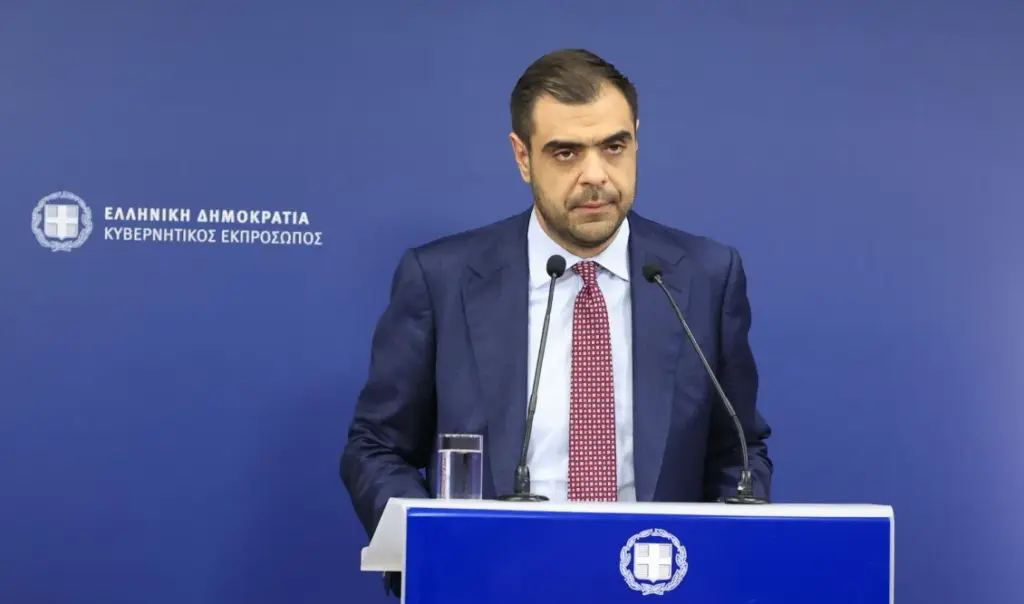
Government spokesperson Pavlos Marinakis addressed the energy crisis affecting Greece, Europe, and the rest of the world, while also outlining the government’s economic policy and the measures taken to combat the crisis’s impact.
Speaking on Open TV, Marinakis stressed that Europe needs greater fiscal flexibility, enabling member states to implement additional measures when circumstances demand it. He also touched on the heating allowance and the possibility of fast-tracking the relevant application platform, criticized the opposition’s proposals and political conduct, and weighed in on the Greece–Cyprus electricity interconnection project and the Turkey–Libya maritime memorandum.
Marinakis: “The biggest energy crisis in history”
Marinakis cited statements by the Executive Director of the International Energy Agency, noting that the current energy crisis adds to a string of wars and international upheavals in recent years. “We are facing the biggest energy crisis in history,” he said, while criticizing the opposition for attributing rising costs of living solely to government decisions.
He made particular reference to Prime Minister Kyriakos Mitsotakis’s initiative to secure greater fiscal flexibility within the European Union, commenting on the criticism leveled by PASOK leader Nikos Androulakis against the Prime Minister’s letter on the matter. “A few weeks ago, the leader of the main opposition mocked the Prime Minister for taking an initiative to raise an issue at the European level,” he noted, adding that the debate that followed demonstrated, in his view, the national and European significance of the issue. He explained that the inclusion of fiscal flexibility in the Council conclusions represents a first step, but does not mean Greece’s request has already been accepted. “The fact that it was included in the conclusions is a good first step. But that is not what needs to happen. What needs to happen is for the request to be approved,” he emphasized.
The government spokesperson also referred to previous Greek initiatives at the European level, including the Recovery Fund during the pandemic and decisions on defense spending. He further argued that Greece had successfully placed the issue of Turkey’s casus belli formally on the table as a condition for third-country participation in the EU’s SAFE defense program.
Heating oil: Pump subsidies and who qualifies for the heating allowance
Turning to heating oil, Marinakis argued that without government intervention, the price could have reached approximately €1.95 per liter, compared to the subsidized levels currently in place. He explained that the government has activated two lines of support. The first is a pump subsidy, applied without any income criteria and available to all consumers. “The weighted average price of €1.95 — which varies by region — will drop to just above €1.50,” he noted.
The government spokesperson pointed out that prices cannot be compared without taking international conditions into account, referencing developments in the Middle East and their impact on energy markets. “Greece, as the Prime Minister said, is unfortunately not a ‘galactic village’ that could be shielded from an unprecedented global crisis,” he stressed.
The second line of support is the heating allowance, for which Marinakis said there are approximately 1.2 million eligible beneficiaries. He also highlighted the expansion of income thresholds compared to 2019, explaining that a couple with two children could previously qualify with an income of up to €24,000, whereas the threshold has now been raised to €34,000. He added that the maximum benefit amount, which previously stood at €350, can now reach up to €1,560 depending on eligibility criteria.
“The major increases to the heating allowance did not happen just this year or last year,” he clarified, adding that an additional 30% increase is planned for the current period. He also reminded viewers that electricity is included among the forms of heating subsidized by the state.
Early platform launch remains on the table
When asked about the possibility of opening the heating allowance application platform ahead of schedule, the government spokesperson stopped short of making any announcement. “This is an important technical matter. I will pass this request on to those responsible. I cannot tell you something that has not yet been decided. I understand what people need,” he said. He added that if an early launch can be supported technically, logistically, and fiscally, the request can be considered.
Tax revenues and the €850 million in emergency measures
On the cost of interventions, Marinakis stated that the government has already allocated €850 million for emergency support measures. He also referenced approximately €800 million in additional VAT revenues projected for 2026, which he said have been channeled into permanent measures.
He attributed the increase in tax revenues to economic growth, crackdowns on tax evasion, and VAT receipts boosted in part by higher prices. “All of this is not enough for citizens — we must give more, but as much as we possibly can,” he underlined.
He also insisted that any additional measures must take into account the country’s fiscal constraints and applicable spending ceilings, arguing that further support would require either greater European fiscal flexibility or a clear identification of funding sources.
His take on excise duty cuts and the cost-of-living crisis
Marinakis addressed the possibility of cutting excise duty on fuels, noting that measures vary from country to country. He said that in some states, VAT was reduced but the measure was reversed after two months, while in others the benefit to consumers was smaller than what can be achieved through a pump subsidy.
Specifically regarding diesel, he argued that reducing excise duty to the lowest permitted level would produce a smaller impact than the existing intervention.
He also emphasized that the government supports tax cuts, provided they are fiscally viable and that the benefit reaches the end consumer. “The cost-of-living problem is real. There are no magic solutions, and no sorcerer’s apprentices,” he said.
Acknowledging that many households continue to face difficulties, the spokesperson argued that the government has had to manage successive crises. In this context, he criticized the previous administration of Alexis Tsipras, citing the state of the National Health System, the public power corporation DEI, Civil Protection, and the broader economy.
“I tell people that we are doing the best we can. But a government cannot be judged in a vacuum. A government is judged in comparison to what is happening in the world around us. I wish we could press a button and do even more for people, especially the middle class and lower-income households,” he said.
He added: “The dilemmas of elections, when you are facing crises, are not about whether you can press a button and make the crises disappear. It’s about who can manage a problem better. The problem exists. The cost-of-living crisis is real. There are no magic solutions, and no sorcerer’s apprentices.”
The PASOK–Tsipras feud and the bid for an outright majority
Marinakis was sharp in his comments on the clash between PASOK and Alexis Tsipras, remarking that political forces that once presented themselves as a unified progressive front are now openly at war with each other. “All these parties at various times presented themselves as a progressive front, when politically it appears they are actually a war front,” he said.
According to the government spokesperson, the state of the opposition strengthens the case for New Democracy winning an outright parliamentary majority. “We have one and only one political goal — due in part to the situation in the opposition — and that is an outright majority,” he stressed.
Marinakis drew a distinction between PASOK’s current leadership and previous figures from the party’s history, referencing Fofi Gennimata and Evangelos Venizelos. He also accused Nikos Androulakis’s party of politically exploiting a tragic accident and of failing to rule out all possible post-election coalition arrangements.
He further criticized PASOK’s economic proposals, arguing they lack adequate costing. He made particular reference to proposals on private debt and installment schemes, contending they fail to sufficiently consider citizens who are meeting their financial obligations on time. On the government’s record, he cited the enrollment of approximately 70,000 citizens in the out-of-court debt settlement mechanism and a €20 billion reduction in non-performing loans.
A potential new party by Antonis Samaras
When asked about the possibility of former Prime Minister Antonis Samaras forming a new political party, Marinakis declined to comment on a hypothetical scenario. “Let’s first wait for Mr. Samaras to actually form a party. When and if he does, we will talk about that party,” he said.
Greece–Cyprus cable: “We have not ceded any jurisdiction”
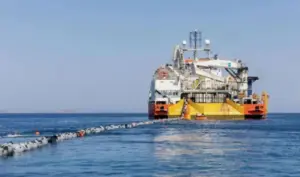
On the Greece–Cyprus electricity interconnection project, the government spokesperson made clear that no jurisdiction has been transferred to the French side. He explained that two parallel licensing processes are currently underway by Greek authorities, given that the vessel to be used for the works is French-registered. “We have not ceded any jurisdiction whatsoever,” he stated.
He added that no permit or approval from any other country is required for the works to proceed. “The only permits needed are from the Greek authorities — no permits from anywhere else — and the project will move forward in accordance with what international law provides for in such cases,” he emphasized. According to Marinakis, the licensing procedures are progressing and the project is advancing on schedule.
Turkey–Libya maritime deal: “Greece moves forward with respect for international law”
In closing, Marinakis addressed the Turkey–Libya maritime memorandum and Greece’s actions to safeguard its sovereign rights. He characterized the memorandum as illegal and void, arguing that Greece has taken concrete steps that reinforce its positions.
As examples, he cited Greece’s Maritime Spatial Planning framework, the EEZ delimitation agreements with Italy and Egypt, and the extension of Greek territorial waters to 12 nautical miles in the Ionian Sea. “We do not move forward with fireworks — we move forward with respect for international law and with actions that leave a real mark,” he concluded.