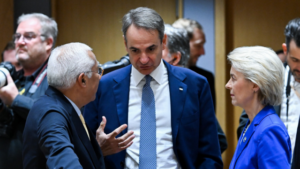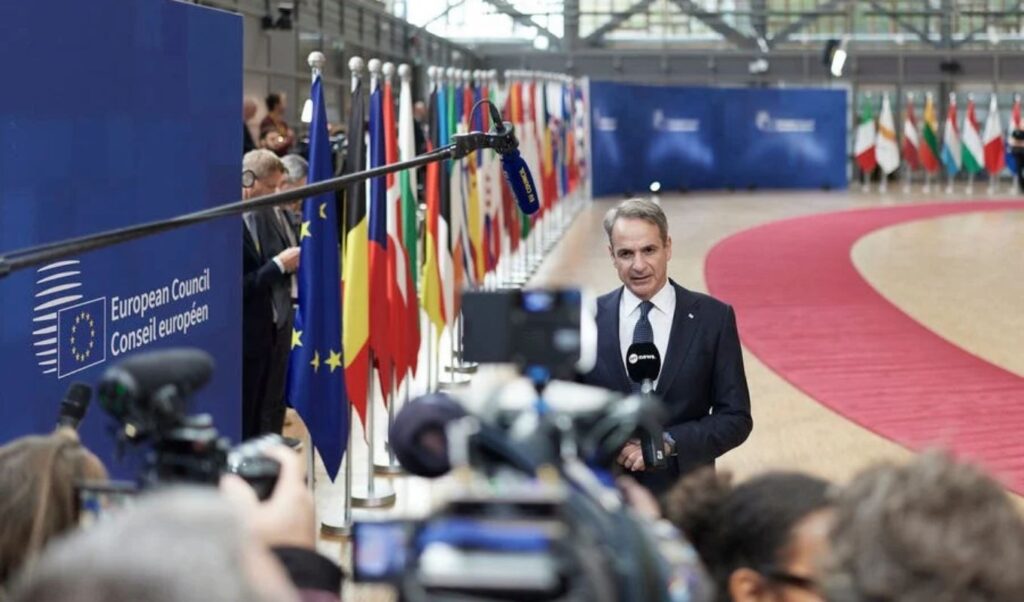
The first day of the European Council concluded yesterday without an agreement on the conclusions regarding the critical issue of energy.
Read also: EU Summit: Top-level clash over money, energy, China and Ukraine — Mitsotakis’ red lines
On the Multiannual Financial Framework (MFF), EU leaders discussed the key elements needed to reach a balanced compromise, based on the updated negotiating proposal put forward by the Irish Presidency. They also called on European Council President António Costa to advance the negotiations, with the goal of reaching an agreement by the end of 2026, allowing the necessary legislative process to be completed within 2027 and ensuring uninterrupted funding for beneficiaries from January 2028.
In a post on X, António Costa reflected on the conclusion of the Summit’s first day, noting that the final discussion focused on the EU’s enlargement strategy and internal reforms. He highlighted that intergovernmental conferences were held this week with Montenegro, Ukraine, Moldova and Albania, stressing that the accession process is moving forward with reforms as the driving force.
The EU’s 27 member states remain deeply divided over the size of the next budget, and a deal appears to be far off — despite repeated calls from EU officials urging a resolution before year’s end, specifically to settle the matter ahead of the 2027 electoral cycle.
French President Emmanuel Macron warned his European counterparts that reaching an agreement on the future EU multiannual budget would be even more difficult in 2027, given the elections scheduled in multiple countries — including the French presidential election — according to diplomatic sources cited by Agence France-Presse.
Two opposing camps are taking shape in the negotiations. On one side, 17 countries — including France, Poland, Italy, Spain and Greece — are pushing for an ambitious budget with adequate funding for agriculture and social and regional cohesion. “We are looking at a clearly insufficient proposal,” said Spanish Prime Minister Pedro Sánchez, while Lithuanian President Gitanas Nausėda stressed that securing a well-funded budget is crucial for achieving European objectives. On the other side, Germany, Sweden, Austria and the Netherlands are demanding stricter fiscal discipline, citing mounting pressure on national budgets. Dutch Prime Minister Rob Jetten warned that “the numbers simply don’t add up,” advocating for a reallocation of resources toward EU modernization and competitiveness — even at the expense of agricultural spending. The Irish Presidency’s proposed cuts — affecting areas including competitiveness and development aid — appear to satisfy neither camp. France is also pushing for the introduction of new European revenue streams through the taxation of digital services, cryptocurrencies and gambling.
Greek Prime Minister Kyriakos Mitsotakis used the Brussels Summit to call for additional European measures and greater fiscal flexibility to cushion the impact of high energy costs on households and businesses. He spoke during a lengthy session marked by deep divisions within the European Council, spanning issues from energy policy all the way to the new EU budget. Ahead of the proceedings, the Greek Prime Minister warned of the risk of a fresh inflation surge, urging the European Commission to put forward new solutions, while making clear that Athens is drawing “red lines” against any potential cuts to EU funds earmarked for farmers and cohesion policy.
In the European Council’s conclusions, the energy issue — framed within the competitiveness agenda — is identified as a key priority. Specifically, the conclusions emphasize the need to address energy costs through short-term interventions, taking into account the differing circumstances of member states, while maintaining the course toward the energy transition and strengthening the competitiveness of the European economy.
As the European Council conclusions explicitly state: “The European Council calls on the Commission to examine and, where necessary, propose further measures to address the surge in energy prices in the short term, taking into account the specific circumstances of member states, including differences in electricity prices.”
Furthermore, “the European Council welcomes the Commission’s presentation of the proposal to postpone certain obligations arising from the methane regulation.” It also welcomes the Commission’s intention “to extend the temporary State aid framework for the most affected industrial sectors, to develop a short-term framework to optimize the capacity and efficiency of EU refineries, and to take initiatives for the voluntary aggregation of energy demand.”
Finally, the European Council underlines the need to reduce administrative and regulatory burdens — particularly for small and medium-sized enterprises — through the simplification and acceleration of permitting procedures and the elimination of unnecessary bureaucratic obligations.