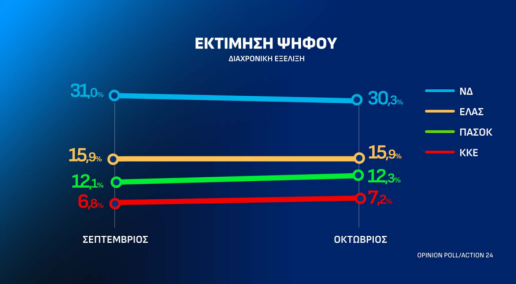
A significant and stable lead of 14.4 percentage points is maintained by New Democracy in voting intentions ahead of the June European elections, according to findings from the Opinion Poll survey conducted for Action24. Specifically, New Democracy records 30.3%, a figure slightly higher than its performance in the previous European elections. In second place comes ELAS with 15.9%, putting the gap between the two parties at 14.4 points — a clear reflection of the ruling party’s strong electoral standing. The survey also examines the political and social climate that has taken shape following the visit of Marco Rubio, as well as the impressions his visit left on public opinion.
Opinion Poll: New Democracy leads ELAS by 14.4 points
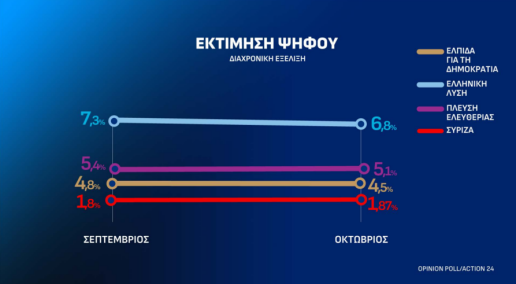
In more detail, on voting intention estimates, New Democracy is recorded at 30.3% — down 0.7% compared to the September survey — while ELAS follows at 15.9%, unchanged from the previous measurement. This puts the gap at 14.4%. PASOK sits in third place at 12.3% (up from 12.1% in September), trailing ELAS by 3.5 points (compared to 3.8 points in September). Further down the rankings: KKE at 7.2% (previously 6.8%), Greek Solution at 6.8% (previously 7.3%), Course of Freedom at 5.1% (previously 5.4%), ELPIDA at 4.5% (previously 4.8%), Voice of Reason at 3.5% (previously 3.3%), and the newly entered Greeks’ Alliance also at 3.5%.

MeRA25 is recorded at 2.7%, SYRIZA at 1.7%, and NIKI at 1.1%, while “Other parties” account for 5.6%. SPARTANS, DIMOKRATES, and NEW LEFT do not appear separately due to polling below the 1% threshold (their figures are absorbed into the “Other” category).

In terms of voting intention among valid votes, the figures are as follows: New Democracy at 25.5%, ELAS at 13.3%, and PASOK at 10.4%. These are followed by KKE at 6.1%, Greek Solution at 5.8%, Course of Freedom at 4.3%, ELPIDA at 3.8%, Voice of Reason at 2.9%, Greeks’ Alliance at 2.9%, and MeRA25 at 2.2%. SYRIZA is recorded at 1.5% and NIKI at 0.9%, while “Other” accounts for 4.7%. Undecided voters stand at 15.7%.


A nine-party parliament
Based on these voting intention estimates, Greece would see a nine-party parliament, with seats distributed as follows: New Democracy: 122, ELAS: 48, PASOK: 37, KKE: 21, Greek Solution: 20, Course of Freedom: 16, ELPIDA: 14, Voice of Reason and Greeks’ Alliance: 11 seats each.


Who is the most suitable prime minister?
In evaluating the current government’s performance to date, 31.7% express positive or somewhat positive views, while 66.3% hold negative or somewhat negative opinions. In September, the figures were identical — 31.7% positive and 66.3% negative — indicating a marginal 1% decline in positive sentiment.
On the question of the most suitable prime minister, Kyriakos Mitsotakis leads with 27.4%, while 26.5% answer “none of the above.” Alexis Tsipras is recorded at 13.1% and Nikos Androulakis at 7.1%. Compared to September, Mitsotakis slips from 27.9% to 27.4%, Tsipras from 13.9% to 13.1%, and Androulakis from 7.4% to 7.1%. Meanwhile, the “none of the above” response rises from 24.9% to 26.5%. Among other party leaders considered most suitable for prime minister: K. Velopoulos at 3.7%, Zoe Konstantopoulou at 3%, Maria Karystianou at 2.6%, Afroditi Latinopoulou at 2.3%, and D. Koutsoumbas at 2.2%, among others.
On the hypothetical vote for a Samaras-led party, 3.6% say they would very likely vote for it and 8.2% say they would quite likely do so, bringing the combined total to 11.8%. This represents a virtual stagnation, as the combined figure was 11.5% in September (with 3.6% saying “very likely”) and 11.7% in June (with 3.8% saying “very likely”).


Positive assessment of Rubio’s visit to Athens
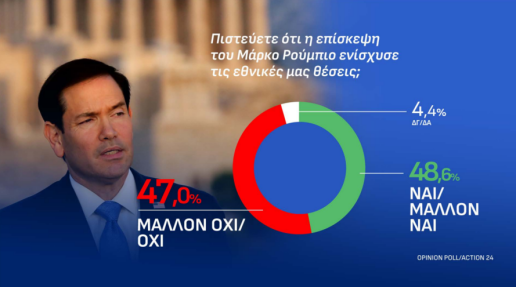
Regarding Marco Rubio’s visit to Greece, 48.6% believe it strengthened or somewhat strengthened Greece’s national positions, while 47% hold the opposite view. The most positive partisan audiences are New Democracy voters at 77.7% and PASOK voters at 63.6%.

On the question of an energy alliance with the United States — with references to the vertical energy corridor and drilling activities — 55.9% believe such a partnership strengthens national security, compared to 40.8% who disagree. The data therefore shows greater public acceptance of energy cooperation with the US when framed in terms of national security.


Energy crisis & cost of living
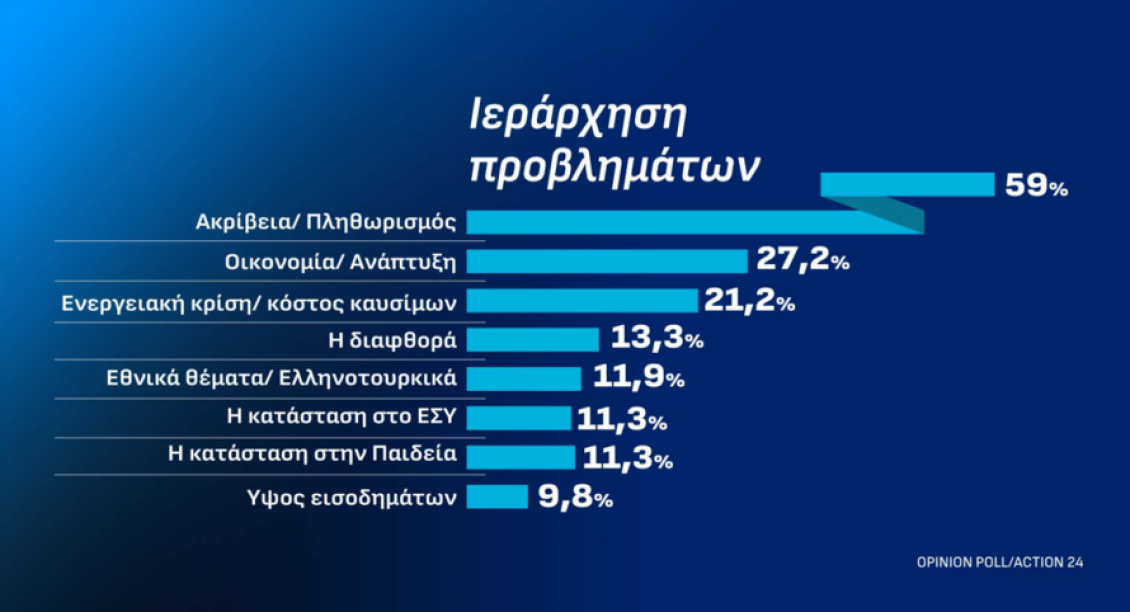
Inflation and the rising cost of living emerge by a wide margin as the most pressing issue for citizens, cited by 59% of respondents. This is followed by the economy and growth at 27.2%, and the energy crisis — including rising fuel, heating, and electricity costs — at 21.2%. This ranking underscores the weight of economic concerns in the everyday lives of households. The cost-of-living crisis is not perceived as an isolated issue, but as part of a broader framework of anxiety encompassing income, living costs, and economic prospects.
Particularly telling is the fact that 58.5% of respondents say their standard of living has deteriorated over the past year, while 32.9% report it has remained the same. Only 8% say it has improved.
At the same time, the energy crisis and rising fuel prices are causing intense concern about household finances: 42% believe they will be very negatively affected and 41.3% quite negatively affected. In total, more than eight in ten citizens anticipate a significant financial burden.
These findings highlight the core challenge for economic policy: the impact of rising prices and energy costs on disposable income and the daily lives of citizens.
- On the question of what is driving the ongoing and worsening