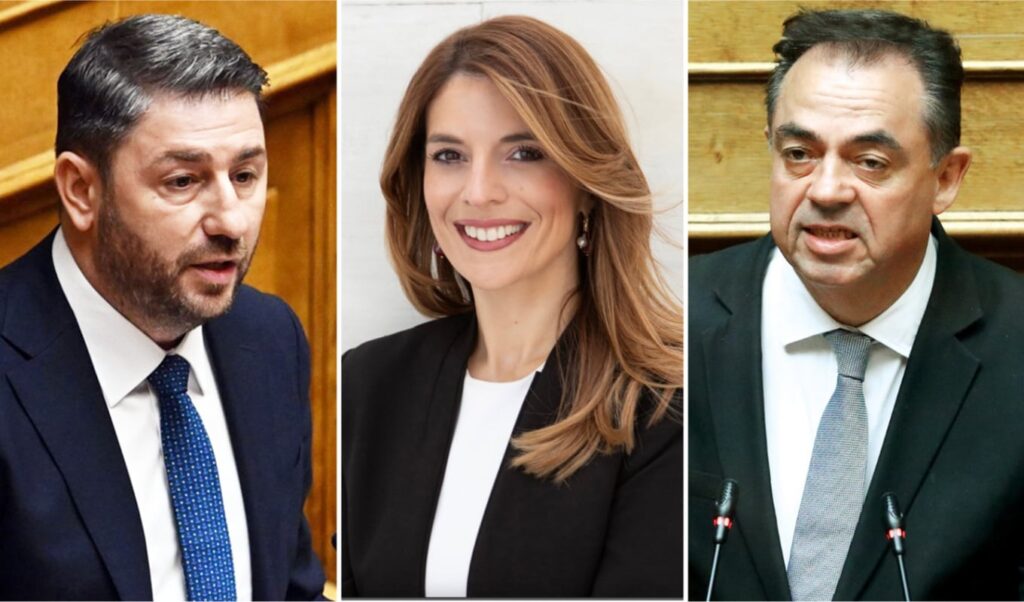
Questions and internal party debates have been sparked by the stance of PASOK headquarters toward former party MP Dimitris Konstantopoulos, following his heated on-air confrontation with Anna Papadopoulou of the Greek Police (ELAS) and her allegations that she was subjected to insulting and intimidating behavior.
Tsoukalas on Parapolitika 90.1: “His explanations were sufficient”
A new wave of internal debate was triggered by a statement from PASOK spokesperson Kostas Tsoukalas, who, speaking on Parapolitika 90.1’s program “Apenanti Mikrofona” with Vasilis Skouris and Sotiris Xenakis, chose to fully back the former MP, framing the incident as a personal dispute.
“I heard the complaint filed by Ms. Papadopoulou, and when she says ‘I will take this to court,’ it’s as if she herself is acknowledging that this is a personal, private matter to be resolved there,” he stated.
“I believe everyone has the right, if they feel wronged, to do whatever they see fit to defend themselves. Mr. Konstantopoulos has provided explanations, and we consider them sufficient in relation to the video we watched — which showed a heated exchange — and anything beyond that falls within the scope of a private dispute,” Tsoukalas added.
This statement has been interpreted by leadership critics as an attempt to politically defuse an affair involving a figure with a specific party role and strong ties to the inner circle of PASOK leader Nikos Androulakis.
The internal party pushback
Against this backdrop, particular significance attaches to the support expressed for Anna Papadopoulou by PASOK’s Deputy Secretary for Equality, Vasia Madesi. Her public distancing from Dimitris Konstantopoulos amounts to a political rebuke of the party official, highlighting the awkward position the affair has created within the party.
In a social media post, Ms. Madesi condemned the behaviors described in the complaint, stressing that political disagreement cannot serve as justification for insults, threats, or intimidation. She also criticized those who are approaching the incident through the lens of party loyalty rather than taking a clear stand against such conduct.
“Insults, threats and intimidation have no place in political debate. They are not justified by the intensity of an argument, by any disagreement, or by the fact that someone considers their interlocutor ‘provocative.’ What Anna is reporting is serious and cannot simply be brushed aside,” Ms. Madesi emphasized.
Batzelis raises the stakes and sends a message
Even more forceful was the intervention of Katerina Batzelis, who chose to publicly stand alongside Anna Papadopoulou.
The former minister and PASOK MP did not limit her comments to the incident involving Dimitris Konstantopoulos. She also weighed in on the conduct of Michalis Katrinis during a televised discussion with Papadopoulou on SKAI, noting that a lower tone of voice does not change the substance when, in her assessment, the same “punitive, papal logic” is being reproduced.
Batzelis’ statement carried clear political content. She condemned verbal intimidation, contemptuous behavior, and a paternalistic approach to debate, underscoring that such conduct has no place in democratic dialogue — and even less so within a progressive political space.
But the phrase that carried the greatest political weight was this: “Silence is not neutrality.” A remark that, regardless of the former minister’s intentions, can readily be read as a direct message to the PASOK leadership.
Batzelis also spoke about the need to take responsibility and draw clear boundaries, rejecting party tribalism, personal friendships, and political score-settling as factors in how such cases are handled.
And so the public debate shifts from what happened between two individuals to how a political organization responds as a whole when confronted with allegations of this kind.
Margaritis: Konstantopoulos’ explanations didn’t convince me
Following the interventions of PASOK’s Deputy Secretary for Equality and of Katerina Batzelis — both interpreted as implicit rebukes of Dimitris Konstantopoulos — Theodoros Margaritis added his voice, openly expressing reservations about the explanations offered regarding the incident.
In a social media post, Margaritis recalled that PASOK has experienced intense forms of verbal and other violence in the past — particularly during 2011 — arguing that this experience should have cultivated a heightened sensitivity among party members toward similar incidents.
Referring directly to Dimitris Konstantopoulos, he wrote pointedly: “D. Konstantopoulos did not convince me regarding the incident with Anna Papadopoulou. Not at all!”
The indirect rebuke from Androulakis loyalists
On the other side, Thanasis Glavinas and Christos Kaklamanis chose, in their television appearances, to stick to broader, more general statements.
They condemned all forms of violence and defended the need for political dialogue free from personal attacks, while carefully stopping short of specifically evaluating the conduct attributed to Konstantopoulos. They noted that they do not know exactly what took place off-air.
Konstantopoulos’ role and his political closeness to Androulakis
This is precisely where the most politically interesting backstory begins.
Dimitris Konstantopoulos is not considered a peripheral or insignificant party figure. On the contrary, he is counted among those who are politically close to PASOK leader Nikos Androulakis, having actively supported his bid for re-election to the party leadership.
His appointment as head of the party’s Self-Organization division had already raised eyebrows among members familiar with the internal balance of power. This is a division with substantial responsibilities over the formation and functioning of regional and prefectural party organizations — in other words, a critical mechanism of party influence.
Seen in this light, the political handling of the Konstantopoulos affair takes on added significance, as it does not concern merely a former MP but rather a figure with an active role in the party machinery and a clear political alignment with the leadership.
Double standards at PASOK headquarters?
What appears to be causing the greatest irritation among PASOK members and MPs is not only Tsoukalas’ specific statement, but above all the contrast with how party headquarters has handled other cases in the past.
According to the criticism being voiced behind the scenes, the leadership has at times been notably strict when it comes to the statements, conduct, or public interventions of party members — even in matters of lesser political significance.
In comparable cases, critics argue, the party has not been shy about publicly distancing itself, issuing warnings, making announcements, or leaking expressions of displeasure from the party apparatus.
In the Konstantopoulos case, however, the public line expressed by the party spokesperson was markedly different, they point out. The affair was presented as a personal dispute, without any corresponding public political condemnation.
It is precisely this inconsistency that fuels the questions about whether the leadership’s strictness is applied according to uniform criteria — or whether it shifts depending on how politically close any given member is to the party leader’s inner circle.
The presumption of innocence and political accountability
As the same party members point out, there is a meaningful distinction between respecting the presumption of innocence and allowing judicial proceedings to run their course on the one hand, and making a political assessment of the public conduct of a person holding a position of party responsibility on the other.
“A dispute being resolved in a courtroom does not automatically relieve a party of its obligation to clarify what standards of public conduct it considers acceptable for its members. Nor, of course, does the mere filing of a complaint establish that the allegations are proven,” these members told parapolitika.gr.
This distinction lies, according to the leadership’s critics, at the heart of the matter. Because regardless of how a complaint is ultimately resolved in court, the question remains: whether and on what criteria does a party evaluate the public behavior of its members — particularly when those members hold positions of responsibility.
The question putting the leadership on the spot
The political issue therefore remains unresolved for those members who are critical of how PASOK headquarters has handled this affair: Would the leadership’s response have been the same if, instead of Dimitris Konstantopoulos, the figure at the center of the controversy had been a member who does not belong to Nikos Androulakis’ close circle of political influence?
That is the question driving the conversations inside PASOK. And the longer the criteria for handling such cases remain unclear, the more it reinforces, among those critical of the leadership, the impression that in practice the same rules do not apply to everyone.
Because, ultimately, the credibility of a party leadership is judged not only by the strictness it shows toward those who are politically distant from it, but above all by the consistency with which it applies the same principles when those at the center of controversy are its own people.