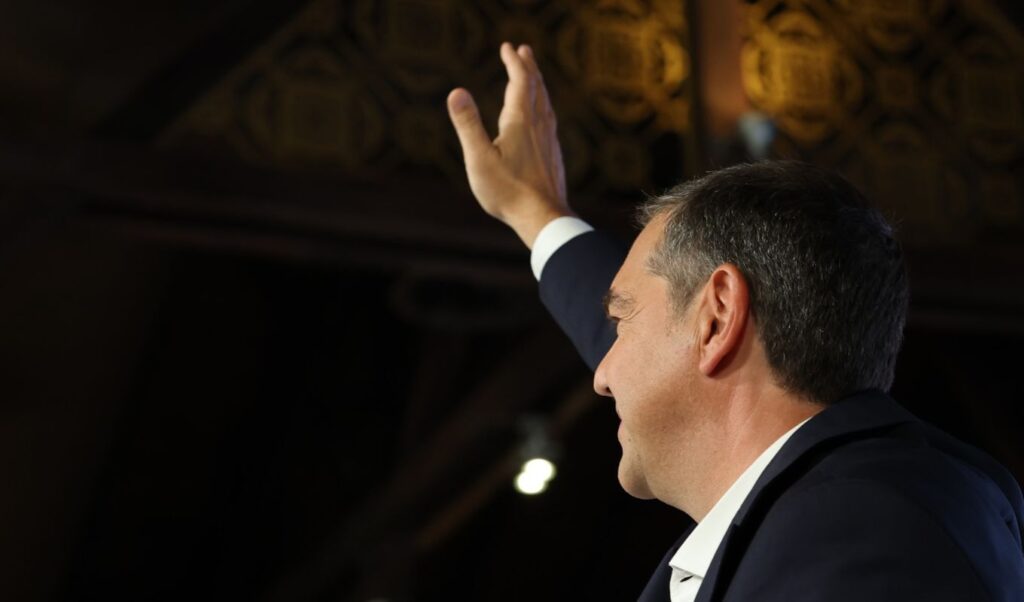
The clash between SYRIZA and the government over the cost of living crisis — particularly rising fuel prices — is expected to intensify today, as Alexis Tsipras takes his fight to the regions. Speaking at the Olympic Forum in Ancient Olympia, the opposition leader is set to double down on his criticism that the government has taken no meaningful action on the issue, while repeating his party’s concrete proposals. Ahead of his speech, Tsipras will meet with local farmers to hear their concerns firsthand, and will tour surrounding villages to speak directly with residents about the challenges of everyday life.
Cost of living and energy prices take center stage
Meanwhile, senior SYRIZA figures have been vocal on the energy crisis, arguing: “Italy implemented a price cap. In Greece, nothing has been done… Other countries, including Poland and Croatia, have also set price caps, while Germany is already subsidizing fuel by €2.5 billion at the pump. How can we call this an ‘imported’ inflation problem, when Greek gasoline is the 11th most expensive in the world and the 7th most expensive across 43 European countries — with France, Italy, and even Monaco offering cheaper prices?
And how credible is the argument that the government is ‘waiting for EU approval,’ when countries like Hungary, Italy, Portugal, Spain, Ireland, Croatia, and Poland have been implementing effective emergency measures since March — while the Greek government has achieved nothing? Europe is acting. Mr. Mitsotakis is waiting until mid-October for the problem to show up in household bills. We will not tire of saying it: the government has four tools at its disposal. It’s time to choose one and use it. In any case, there is no justification for heating oil to exceed €1.40 per liter — or for diesel to exceed €1.80.”
Speaking yesterday at the Athens Chamber of Trades and Commerce, the former prime minister highlighted that soaring energy costs are “burning” every small and medium-sized business in Greece today, and stressed the urgent need for household relief measures that would deliver an immediate improvement in disposable income.
He outlined a series of targeted relief measures for households, all fully costed and within the available fiscal space:
- Reduction of VAT to 6% on basic food and hygiene products.
- An average 30% reduction in electricity bills.
- Elimination of out-of-pocket costs for private tutoring support.
- Pay increases for teachers, doctors, and nurses.
- Tax credits for families with children.
- Full coverage of medication costs for all insured individuals.
Tsipras also called for a crackdown on cartels and greater market transparency, stating: “We need to open all markets and public procurement processes with full transparency, and effectively combat cartels. This means we don’t pick favorite businessmen — we choose the productive capabilities this country actually needs.”
The new clash over bailouts and economic legacy
The confrontation between SYRIZA and the government erupted yesterday morning after Tsipras, in an interview with the French magazine Marianne, declared: “The average Greek has to work two jobs or twelve hours a day just to get by. In short, we have Bulgarian wages, French prices, and Chinese working conditions. It’s as if the Kyriakos Mitsotakis government is imposing a new bailout on the Greek people.” The government spokesperson hit back swiftly: “Mr. Tsipras is arguably the last person in this country who should be talking about a new bailout. This is the politician who promised to tear up the bailouts, to abolish them — and then saddled Greece with the third and largest unnecessary bailout of €120 billion, loaded onto the backs of Greek taxpayers. Clearly, this rebranding effort — in plain terms — means ‘trying to rewrite history, hoping people forget.'”
SYRIZA’s spokesperson Theoni Koufonikola fired back: “The party that fiscally derailed the country, concealed data, and fled in the night. The party that was part of a failed government which not only set unachievable fiscal targets and left empty coffers, but also undermined Greece’s negotiating position — that party has the nerve to wag its finger at Alexis Tsipras, who led Greece out of the bailouts, reduced the poverty rate, boosted purchasing power for 8 out of 10 income groups, and left a cash reserve to shield the country against future risks. And to put an end to the joke about the ‘worst bailout’ once and for all — Mr. Marinakis, please memorize two numbers: 41 and 7. €41 billion was the adjustment under the first two bailouts (€33 billion in spending cuts, €8 billion in revenue increases), implemented while New Democracy was in power — a government that didn’t pull Greece out of the deep crisis, but drove it deeper. €7 billion was the adjustment under the third bailout (€1.9 billion in spending cuts, €5.4 billion in revenue increases).”