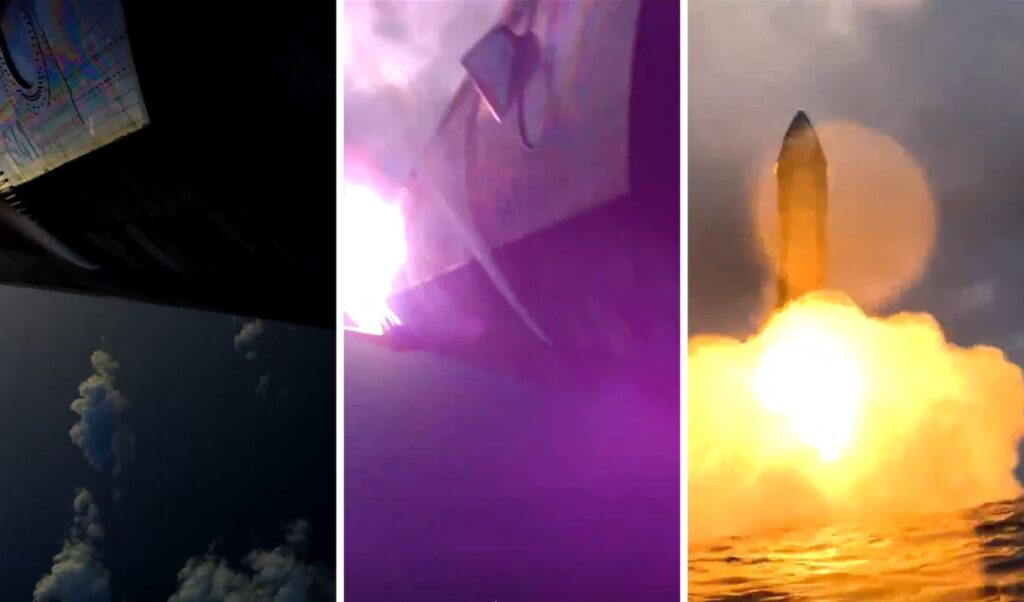
Starship‘s endurance in space proved short-lived, as SpaceX‘s spacecraft splashed down in the North Pacific Ocean approximately three hours after launch. Nevertheless, after 13 test flights, the vehicle successfully achieved Earth orbit for the very first time — a landmark milestone for the program. The splashdown produced a spectacular fireball that left eyewitnesses in awe. Observers noted, however, that this particular splashdown was significantly more violent compared to Elon Musk’s spacecraft splashdown last July. “This time we did not have a soft landing. Even so, it made it,” a SpaceX official stated. The rocket broke apart into two pieces, both of which remain in the ocean — at least for now.
Read more: SpaceX: Starship completes first orbital flight — six orbits around Earth and 26 satellites deployed
Starship: The malfunction
SpaceX had originally targeted a 10-hour mission, but the flight lasted only three. A failure was reported in one of the three engines. Initially, engineers decided to press ahead with the mission, but the malfunction posed increasing risks. During the flight, the spacecraft successfully deployed 26 next-generation Starlink V3 satellites, which have been integrated into the Starlink network providing broadband internet access across the globe.
SpaceX describes Starship as “the most powerful launch vehicle ever developed” and states that it hopes to one day carry crews and cargo into orbit around Earth, to the Moon, to Mars, and beyond.
Splashdown confirmed. Congratulations to the entire SpaceX team on the first orbital flight of Starship! pic.twitter.com/urjmiwnvNl
— SpaceX (@SpaceX) September 28, 2026