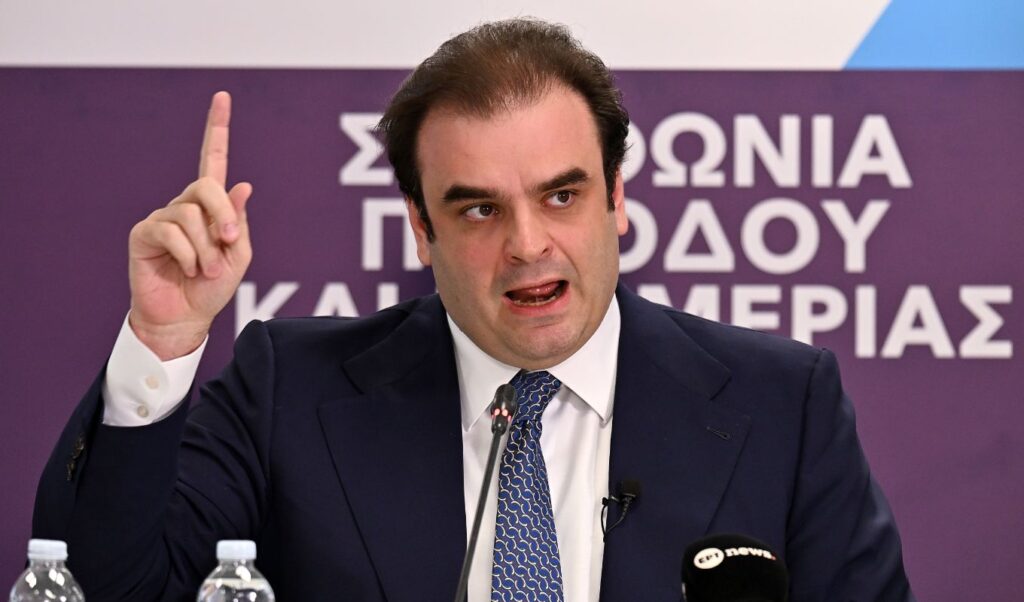
Kyriakos Pierrakakis participated on Wednesday (16/09) in the Board of Directors meeting of the Athens Chamber of Commerce and Industry, stressing that the government has committed to exhausting all possible means of supporting businesses within the limits of the Greek economy’s capacity. “Policy has value when it can withstand the criticism of those who produce. Today, through my role, I must underline and demonstrate that what we are doing is exhausting every possible means of supporting businesses — as many options as economic reality allows,” Pierrakakis stated.
Read also: Energy costs at Eurogroup: Pierrakakis’s €130-150M package for new measures — Diesel, Fuel Pass and heating allowance on the table at Maximos Mansion
Pierrakakis also noted that “a business owner understands the limits of reality better than most,” emphasizing that the government “does not make empty promises.” He also referenced the support provided to businesses by the Greek state during the difficult period of the pandemic. Pierrakakis further endorsed the proposal that all political parties submit their programs to the Fiscal Council, so that, as he put it, “we can truly see what fiscal space is available and have a fact-based discussion.”
What Kyriakos Pierrakakis said at the Athens Chamber board meeting
As he emphasized, entrepreneurship has been a core government priority since 2019 and sits “at the heart of our program.” “We have implemented 23 specific interventions for businesses, investments and competitiveness,” he said pointedly.
Athens Chamber president Yannis Bratacos’s remarks
Athens Chamber of Commerce and Industry President Yannis Bratacos, addressing the minister, stated: “Minister, you are a man of the market. Highly experienced, politically, and you can recognize the difficulties and concerns of the business community. For us, it is a fortunate thing that you hold the position of Minister of National Economy and Finance.”
Mr. Bratacos characterized the abolition of the business license fee and the reduction of the tax advance payment as positive steps, while noting, however, that the proposed timeline does not meet the current needs of the market. Specifically regarding the advance tax payment, he stressed that maintaining it at high levels ties up valuable liquidity that could otherwise be directed toward investments, hiring and working capital, and called for faster implementation of the reduction.
He placed particular emphasis on access to financing for small and medium-sized enterprises. Referring to new financing and guarantee instruments through the Hellenic Development Bank, he noted that their success would depend on whether funding actually reaches small businesses — not just those that are already creditworthy in the eyes of banks.
“Financing must reach the real economy,” he said emphatically. The Athens Chamber president also revived the Chamber’s proposal for an operational settlement of up to 120 installments for tax and insurance debts, the ability to re-enroll businesses that had lost previous settlement arrangements, a reduction in surcharges, and improvements to the out-of-court settlement mechanism.
As he pointed out, it is impossible to have a meaningful conversation about new financing when a significant portion of the market remains excluded from it due to old debts.
Finally, Mr. Bratacos identified the transformation of the country’s productive model as a fundamental challenge, calling for more productive investments, a stronger industrial base, greater exports and businesses of larger scale.
He called for stable incentives for investment, mergers and partnerships, simpler licensing procedures, faster delivery of justice and a clear plan for financing the economy once the Recovery Fund has run its course.
Closing his remarks, the Athens Chamber president stressed: “The critical question of the period ahead is not who will promise the most. It is who has the most credible and workable plan to make this country produce more. Before we decide how to distribute wealth, we must honestly explain how we are going to create it.”
Kyriakos Pierrakakis’s full address
Mr. President of the Athens Chamber, dear Mr. Bratacos, my friend Yannis, esteemed members of the Board, ladies and gentlemen,
The Athens Chamber of Commerce and Industry is a steadfast institutional interlocutor of the State. But it is also something more: it is a space where we can measure the real strength and real potential of the Greek economy. Among us, in this room, are people who do business, invest, create jobs and translate economic progress into prospects for the country — what you mentioned earlier, Mr. President, and what I also referenced in my interview with Kathimerini — the protagonists of the shift in our productive model.
My presence here is aimed at exploring how the State and businesses can — and must — convert stability into productive power.
Let me begin with the obvious, offering a brief assessment, if you will permit me, given that yesterday I was in Berlin, in my capacity as President of the Eurogroup, for a series of meetings. And while there, a feeling I will share with you became all the more vivid.
A few years ago, the word “Greece” in many European halls was accompanied by a cluster of words — with “crisis” being the first.
Today, that conversation has changed.
Not because our problems are over — you rightly mentioned some of them — but because our country gained something it had lacked for a decade: the word “credibility.”
Life and the economy are shaped by our expectations. They give back exactly as much as we ask of them and as much as we invest in them. Nothing more, nothing less.
That is why it matters to set the bar high.
Not to be satisfied only with what we have achieved, but to demand more for our country, because we are genuinely capable of more. For example, a 2% growth rate — double the European average — is not our ceiling. We deserve better. We must achieve better, and that is a task we are committed to.
I believe the Athens Chamber has a very important role to play here.
The economic picture has changed significantly.
Unemployment fell to 7.9% in July. We will very soon approach a historic low in unemployment.
Public debt is declining at the fastest pace in the world. This year it will stand at 136.8%. We will no longer be the most indebted country in Europe — debt will fall below 120% by 2029 — if everything continues on its current trajectory.
One of the most telling indicators of the shift in our productive model is investment. From 11% of GDP when we took office — compared to the European average of 21% — investment will reach 17.7% of GDP this year.
Three figures that, for me, describe an economy with more jobs, greater credibility and a stronger productive base.
Now, I know very well what a business owner thinks when they hear macroeconomic data.
They think about energy costs, about a competitor abroad moving faster and accessing capital more easily — and they are right. Macroeconomics matters only when it genuinely serves — and is served by — microeconomics. Both directions hold true.
Mr. President, the Athens Chamber and you, just moments ago, have publicly set a bar that I respect.
I will not disagree with the demand for greater ambition.
Policy has value when it can withstand the criticism of those who produce.
Today, through my role, I must underline and demonstrate that what we are doing is exhausting every possible means of supporting businesses — as many options as economic reality allows. And I fully agree with what you said earlier: that all political parties should submit their programs to the Fiscal Council, so that we can truly see what fiscal space is available and have a fact-based discussion.
I believe a business owner understands the limits of reality better than most. And we, as a political movement and as a government, do not make empty promises. Let me also remind you how decisively and generously our businesses were supported by the Greek state during the difficult period of the pandemic.
I also want to say that making entrepreneurship a priority — which is clear and sits at the heart of our program — is not something that started today. It has been a consistent choice since 2019.
It is reflected in concrete decisions.
We have implemented 23 specific interventions for businesses, investments and competitiveness.
We reduced the corporate income tax rate from 28% to 22%, the dividend tax to 5%, and the advance tax payment from 100% to 80%.
We reduced social insurance contributions by 5.4 percentage points and the capital concentration tax from 1% to 0.2%.
We cut the stock exchange transaction tax by 50%, reduced the tax on interest from listed corporate bonds from 15% to 5%, and suspended VAT on new residential construction.
We reduced VAT on transport, tourism and a range of goods and services, and cut stamp duty on a series of business transactions.
At the same time, we created stronger incentives for investment, growth and innovation — starting with an increased super-deduction for research and development. We introduced super-deductions for green investments and strategic investments, tax incentives for mergers and corporate transformations with a 30% income tax reduction, incentives for angel investors, a favorable framework for stock options, and special tax regimes to attract investors, businesses and human capital from abroad — something we are experiencing very intensely in recent weeks, days and hours at the Ministry of Finance, with significantly increased interest.
In other words, we did not simply reduce taxes on businesses.
What was the goal? To fiscally reward businesses that invest, innovate, grow and create jobs — and alongside those actions, to inject far more capital into the economy.
From the Recovery Fund alone: €1.66 billion in grants have been approved; 15,700 small and medium-sized enterprises received loans totaling €3.29 billion through InvestEU guarantees.
Through the ESPA structural funds, 17,661 investment projects totaling €3.95 billion have been financed.
Through the Hellenic Development Bank, 60,696 loans to SMEs totaling €10.49 billion have been approved, primarily targeting small and micro-enterprises. And now, with €1.5 billion from the Recovery Fund, we are mobilizing — through leverage — €5 billion in new financing exclusively for small and medium-sized businesses.
In essence, our policy has had two pillars: a lighter burden on businesses and more capital for investment.
That is precisely the direction we continue to follow today.
And that is precisely the plan we have before us for the next four years as well.
The catalogue of measures and reforms presented at the Thessaloniki International Fair by Prime Minister Kyriakos Mitsotakis does not, I believe, merely push against the ceiling of our current fiscal capacity. It also offers a perspective for the future.
I see that from today it must begin creating the conditions for sustained growth going forward.
So, to turn to the next steps, allow me to be somewhat more specific.
First: stability.
A stable regulatory framework is, in itself, a business incentive — anyone who speaks with a business owner or investor understands this.
We chose to phase out the business license fee gradually, in line with available fiscal space, beginning with the regions. But in any case, the business license fee will be abolished within the coming years, within a defined and declared fiscal envelope.
The advance corporate tax payment will be reduced by five percentage points per year — from 80% down to 50% — starting, as you mentioned, from 28%.
Allow me to address the obvious here.
This is a measure I believe will ease the burden on businesses.
We would have liked it to go further, of course, but it is an extraordinarily costly measure.
I want you to bear in mind that this 5% translates into €400 million under fiscal accounting rules. You might say it is an advance payment against the following year — yes, but in that one year, that 5% consumes €400 million of fiscal space. Consider what 10% would mean… There are years ahead of us — because we want to be fiscally responsible — where fiscal space is limited. Imagine a single measure consuming almost all of that space. That was not something we could responsibly do. What we did, however, was embed it in our planning: to reduce it, starting from 28%, by 5% per year, with the target of reaching 50%.
Now, regarding these measures — you also referenced accelerated depreciation for productive equipment, which is the third of the three key measures announced — I will say this: these measures, which Prime Minister Mitsotakis announced, are calibrated to our current fiscal space.
Specifically, to what we have negotiated with Brussels, with the Commission — we have concrete parameters before us for the country.
At a Thessaloniki International Fair that inevitably looks four years ahead — that outlines a governmental program for the coming term — every citizen must be able to see themselves in it, and within that fiscal envelope you must bring together and balance a range of social priorities.
Because it goes without saying — and you all understand this very well — that the cost-of-living crisis is knocking on every Greek household’s door, and the macroeconomic indicator I mentioned earlier translates, at the business level, into the microeconomics of households — into the supermarket checkout, into the cost of rent. These are issues we understand very well.
Because fundamentally, there is an obvious question that anyone can raise: Greece, they say — correctly — is growing at twice the rate of the rest of Europe.
And everyone asks: how does that translate for me?
How does it come back to the pensioner? How does it reach the civil servant? The teacher who educates our children, the professor, the firefighter, the police officer. How does it reach each and every person?
When you design a government program while society is also under pressure from rising costs, you have a duty to address society as a whole and to balance competing social priorities.
This program carries that character of balance.
But if one places these measures in the context of everything else that has been done, and with the understanding that every euro of fiscal space created in the years ahead — as we have demonstrated — generates additional measures and additional revenue and continuously creates room, then every euro that will be generated in the coming years, if we are entrusted by the Greek people to govern again, will be returned to society.
And that, of course, applies to businesses as well.
Every opportunity that arises will, by definition, be seized.
I hope to be here with you, to discuss what further steps we can take — but certainly today, to remain credible, we had to position ourselves based on the resources we have, not on some imaginary sum we do not have.