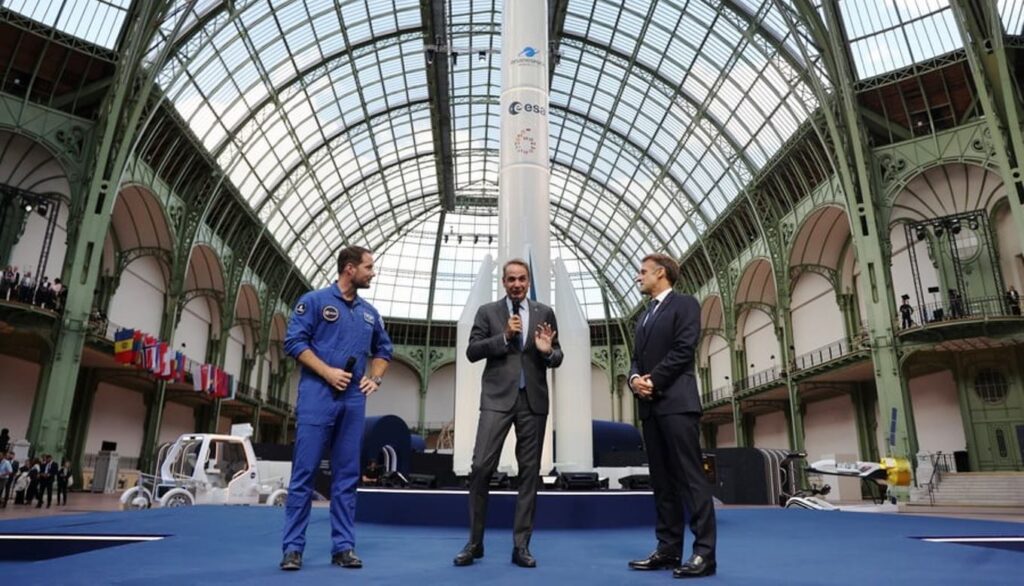
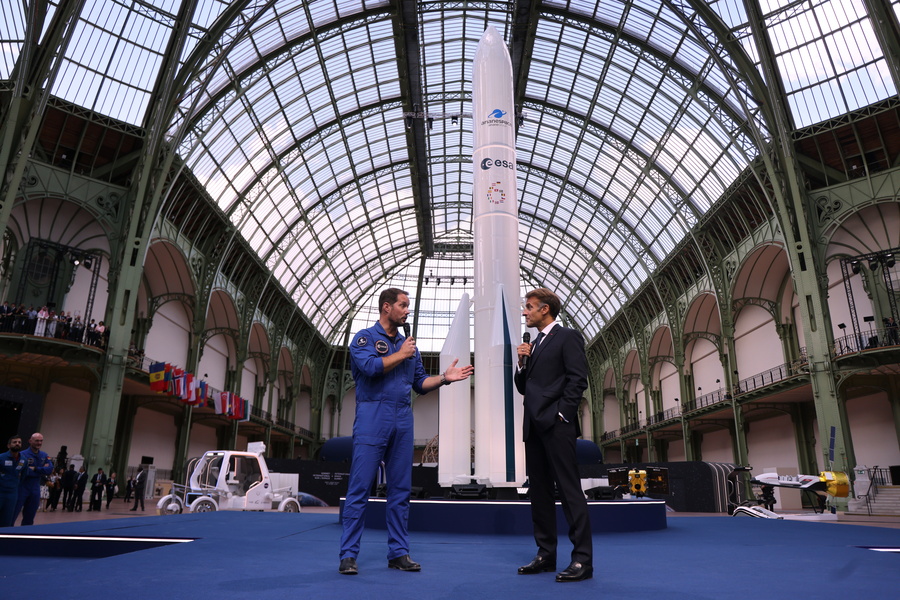
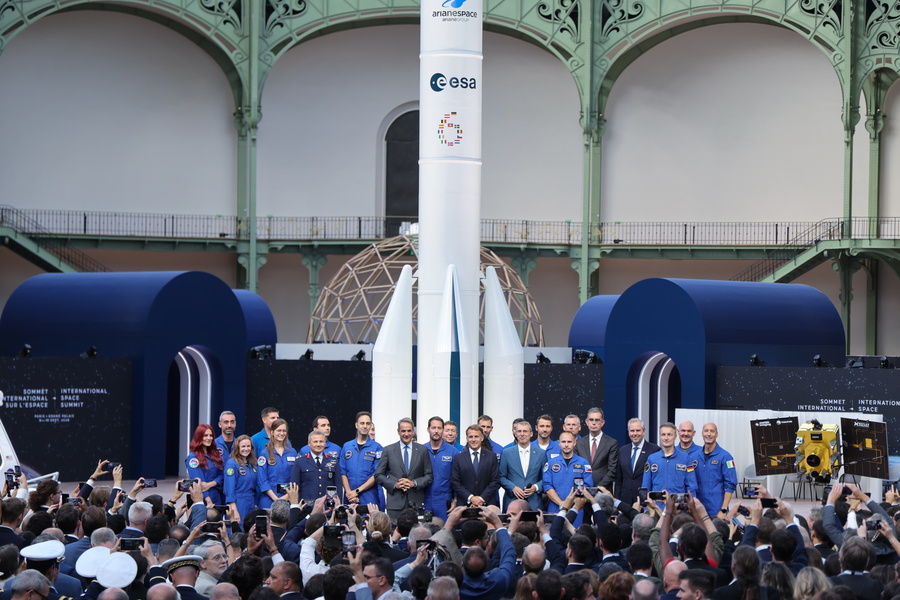
In a highly symbolic gesture, Emmanuel Macron put Greece front and center at the opening of the International Space Summit in Paris, inviting Prime Minister Kyriakos Mitsotakis to be the first among the assembled heads of state and government to take the floor. The French president then asked the Greek prime minister to introduce Adrianos Golemis — Greece’s astronaut and the face of the country’s emergence in the new era of space exploration — to an audience of approximately 2,000 guests and representatives from nearly 90 nations.
Read more: Who is Adrianos Golemis, the Greek training to travel to space — an impressive journey through space medicine (Photos)
The introduction by Kyriakos Mitsotakis
Macron’s choice was no coincidence. By placing Greece at the very heart of the opening of a premier international space conference, the French president sent a clear message: the new space age does not belong exclusively to the traditional superpowers that dominated the field throughout the 20th century. Smaller nations like Greece are now claiming an increasingly active role in the global space ecosystem, investing in technology, scientific research, and skilled human capital.
The presence of Adrianos Golemis alongside Kyriakos Mitsotakis, before representatives of nearly 90 countries, added a remarkable dimension to Greece’s participation. From a country that, just a few years ago, had virtually no footprint in space management, Greece is now staking its claim on the new international space map.
Kyriakos Mitsotakis highlighted Greece’s growing presence in the space sector during the presentation of the PAM-6 mission to the International Space Station. Scheduled for the second half of 2027, the mission will be carried out by Vast in collaboration with ESA and NASA, and is expected to include Adrianos Golemis — who is set to become the first Greek astronaut ever to travel to space.
“We now have 18 satellites in orbit”
The prime minister reflected on the remarkable progress Greece has made in the space sector in recent years. “A few years ago, Greece had no presence in space whatsoever. We had no space program, no space strategy. Now we have 18 satellites in orbit. We are developing our own satellite manufacturing ecosystem. We are bringing young Greeks with space expertise back to our country,” he said.
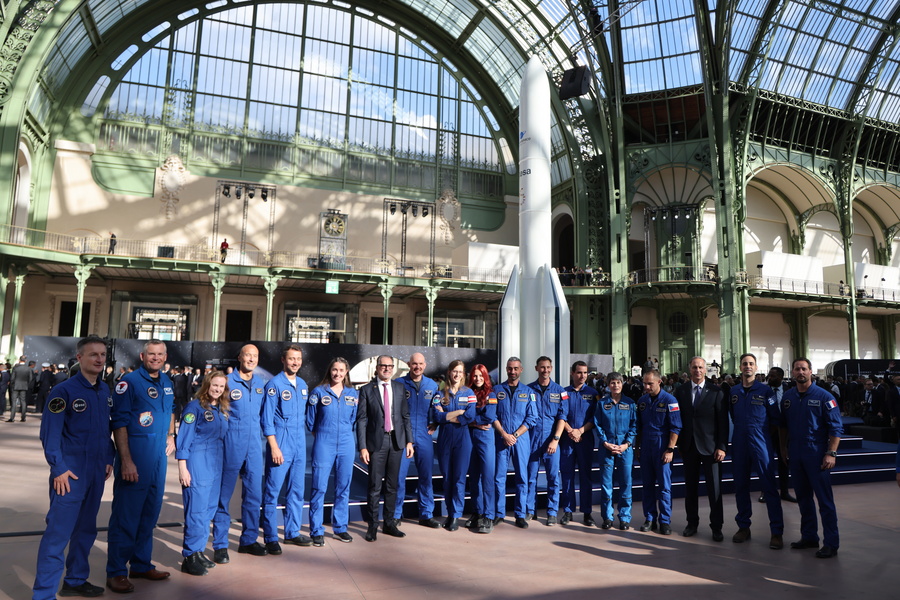
The presentation took place as part of the International Space Summit in Paris. According to current plans, the PAM-6 crew will also include a French astronaut as mission commander, an astronaut from the Czech Republic, and a representative from one additional European country.
“The first Greek astronaut will be sent to space”
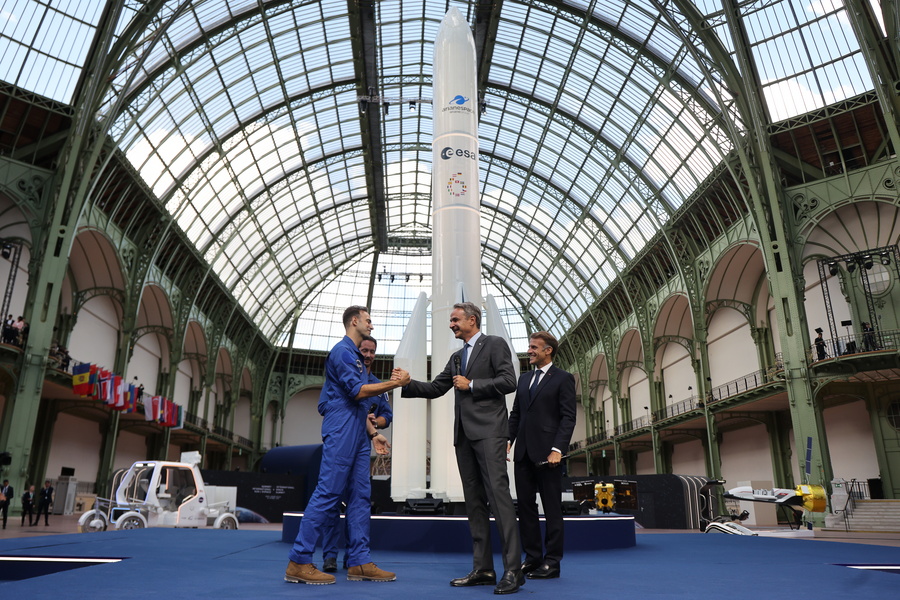
The prime minister paid special tribute to Adrianos Golemis. “Today we are very proud to announce that the first Greek astronaut will be sent to space as part of the Vast mission. His name is Adrianos Golemis. Adrianos, please come to the stage,” he said.
Kyriakos Mitsotakis called the moment truly historic for Greece, stressing that the mission’s significance goes far beyond simply having a Greek astronaut aboard the ISS. “This is a very special moment for Greece. And I believe that Adrianos, beyond the very interesting experiments he will conduct on the International Space Station, will also serve as a source of inspiration for young Greek children — to turn towards science, technology, engineering and mathematics, to dream again and to look up from their screens.”
A message to the next generation — and a nod to social media algorithms
The prime minister connected the mission to the broader need to steer children toward science and away from excessive social media use. “We share a common interest with the French President in ensuring that our children are not overly addicted to social media algorithms. It is far better for them to dream about space, to build microsatellites — as they are already doing in schools.”
Closing his remarks, he expressed full confidence that Adrianos Golemis would make Greece proud, adding: “I am delighted to see the Greek flag on the International Space Station.” He also drew attention to NASA’s longstanding tradition of naming missions after ancient Greek deities — from Apollo to Artemis — and concluded with a touch of ambition: “Who knows what will come next, when we decide to go to Mars.”

The prime minister’s full statement
Prime Minister Kyriakos Mitsotakis delivered the following remarks in full: “Thank you very much. It is a genuine pleasure and honor to be here with you today, sharing the stage with the President of France, who is so deeply committed to strengthening the European space ecosystem.
A few years ago, Greece had no presence in space. We had no space program, no space strategy. Now we have 18 satellites in orbit. We are developing our own satellite manufacturing ecosystem. We are bringing young Greeks with space expertise back to our country.
Today we are very proud to announce that the first Greek astronaut will be sent to space as part of the Vast mission. His name is Adrianos Golemis. Adrianos, please come to the stage.
This is a very special moment for Greece. And I believe that Adrianos, beyond the very interesting experiments he will conduct on the International Space Station, will also serve as a source of inspiration for young Greek children — to turn towards science, technology, engineering and mathematics, to dream again and to look up from their screens.
We share a common interest with the French President in ensuring that our children are not overly addicted to social media algorithms. It is far better for them to dream about space, to build microsatellites — as they are already doing in schools.
I am certain that Adrianos will make us proud. I am delighted to see the Greek flag on the International Space Station. And it is no coincidence that NASA continues to choose gods from ancient Greece for its space missions. After Apollo, it is now Artemis. Who knows what will come next, when we decide to go to Mars.
Thank you so much, Adrianos. We wish you all the best.”