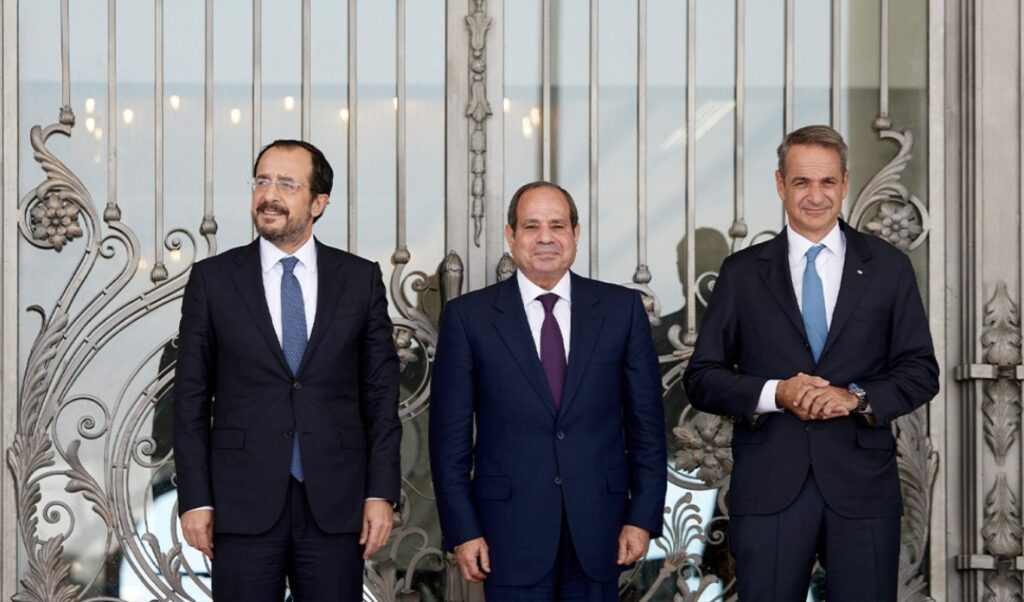
Greece, Cyprus, and Egypt sent a powerful message to Turkey regarding the electricity interconnection project included in the trilateral cooperation’s energy agenda. This came through the Joint Declaration of the Trilateral Summit held in El-Alamein.
The joint declaration of the Trilateral Summit
“We, the President of the Arab Republic of Egypt, the President of the Republic of Cyprus, and the Prime Minister of the Hellenic Republic, having met in El-Alamein on the occasion of the Trilateral Summit between our countries, reaffirm our pride in the historic relations and unbreakable bonds that unite our peoples, and our commitment to continuing our joint efforts to promote peace, security, stability, and prosperity in the Eastern Mediterranean and the Middle East, in a manner that advances the interests of our peoples and strengthens efforts to address common, regional, and international challenges.
Recognizing the growing strategic importance of the Eastern Mediterranean region in an era of intense geopolitical challenges, we emphasize the importance of continued consultation and coordination among our three countries. Building on the achievements of the Trilateral Cooperation Mechanism since its establishment in Cairo in November 2014 — which has proven to be a successful model for regional cooperation — we remain committed to its further development, grounded in the principles of trust, respect, and collaboration. We reaffirm our collective will to uphold security and stability in the region, as well as to resolve disputes and crises through political and diplomatic means, and we reject any actions that would escalate tensions, undermine regional stability, or threaten the peace and security of the region. We underline the importance of respecting the national sovereignty, independence, and territorial integrity of States, refraining from the threat or use of force, and fully adhering to the rules of international law and the principles of the United Nations Charter.
We reiterate the importance of full respect for international law and the commitment of all States to upholding its principles, in a manner that ensures the rights of all States concerned and contributes to peace, security, and stability in the Eastern Mediterranean. We reaffirm that any agreements or memoranda of understanding relating to the delimitation of maritime jurisdiction must be concluded on the basis of international law, including the United Nations Convention on the Law of the Sea (UNCLOS).
We welcome the efforts of the United Nations Secretary-General and his Personal Envoy on the Cyprus issue and express our support for the ongoing efforts to achieve a comprehensive settlement of the Cyprus problem within the UN framework, based on the relevant Security Council resolutions. We emphasize that achieving a lasting resolution of the Cyprus problem would significantly contribute to enhancing peace and stability in the region.
We reaffirm our unwavering support for the legitimate rights of the Palestinian people and the need to achieve a just, lasting, and comprehensive peace based on the Two-State Solution. We reiterate our support for the establishment of an independent and sovereign Palestinian state within the borders of June 4, 1967, with East Jerusalem as its capital, in accordance with United Nations resolutions. We emphasize the importance of advancing the implementation of the second phase of President Donald Trump’s Comprehensive Plan for Ending the Conflict in Gaza, as endorsed by UN Security Council Resolution 2803. This would ensure the launch of reconstruction and early recovery in Gaza, as well as the preservation of the unity of Palestinian territories. We remain deeply concerned about the humanitarian situation in Gaza and stress that it is essential for humanitarian aid to reach the population safely, swiftly, and at scale. We also affirm the geographic, political, and legal contiguity between the West Bank and the Gaza Strip and reject any attempts to separate them, including policies aimed at the forcible displacement of the Palestinian population.
We reiterate our steadfast support for the stability, sovereignty, and territorial integrity of Lebanon and the importance of the full implementation of UN Security Council Resolution 1701. We note the necessity of halting all attacks on Lebanon and the withdrawal of Israeli forces from Lebanese territory. We call for the strengthening of Lebanese state institutions — foremost among them the Lebanese Armed Forces — so that they are able to assume their responsibilities and extend the full authority and sovereignty of the state throughout its entire territory.
We reaffirm our support for the sovereignty, territorial integrity, and national unity of Libya, as well as for an inclusive political process led and owned by Libyans themselves, free from foreign interference. We also call for the withdrawal of all foreign forces and mercenaries from Libya, and we express our support for United Nations efforts to hold simultaneous presidential and parliamentary elections as soon as possible, within a framework of Libyan ownership.
We affirm that energy security is a shared interest and a fundamental pillar of trilateral cooperation. We express our commitment to continuing the development of electricity interconnection projects, including the GREGY interconnection project, so as to strengthen energy security and enhance the Eastern Mediterranean’s connectivity with European energy markets.
We also note the importance of strengthening cooperation in the field of natural gas, thereby supporting regional and European energy security. In this context, we attach particular importance to recent developments regarding the connection of Cypriot natural gas reserves to Egyptian natural gas infrastructure and facilities, and we call for their completion as soon as possible.
We emphasize the importance of enhancing cooperation in the areas of water security and sustainable water resource management, in light of the growing challenges facing the region, including water scarcity and climate change. In this context, we recognize Egypt’s significant dependence on the Nile River and reaffirm our support for its water security. We reiterate the importance of full compliance with international law in the Nile Basin, including with respect to the Ethiopian Dam. Furthermore, we underline that transboundary water resources, including the Nile River, should serve as a means of cooperation and regional integration rather than a source of conflict. To this end, we affirm the need to uphold the principle of “do no harm” and the obligation to cooperate, including through prior notification, consultation, and consent, as well as to refrain from unilateral measures that could adversely affect Egypt’s water uses and needs, in a manner that safeguards the interests of all States concerned.
We attach particular importance to strengthening economic, trade, and investment cooperation among our countries, and to translating our exceptional political relations into tangible economic opportunities for our peoples. The effective leveraging of our geographic position and the comparative advantages of our three countries will create new horizons for the private sector and promote synergies among our economies. We encourage the intensification of engagement between our business communities and the development of partnerships in priority sectors, thereby contributing to sustainable development and job creation.
We note that addressing irregular migration requires a holistic and balanced approach that combines security and development dimensions, as well as economic and social aspects. We emphasize the importance of expanding cooperation in the area of legal migration and of promoting structured employment opportunities for Egyptian workers in both Cyprus and Greece, in accordance with relevant legislation and bilateral agreements.
We emphasize the importance of continuing to strengthen the Comprehensive Strategic Partnership between Egypt and the European Union, which contributes to supporting stability, development, and prosperity in Egypt and the region. We welcome the progress made in implementing the six pillars that form the framework of this partnership, and we reaffirm our determination to continue close coordination within this framework to advance our shared interests and contribute to strengthening connectivity between the two shores of the Mediterranean.
We reaffirm our commitment to the further strengthening and development of the Trilateral Cooperation Mechanism and to enhancing its effectiveness through the regular monitoring of the implementation of agreements and intensified coordination among the governments of the three countries, their institutions, and the private sector. This will ensure that the existing political consensus is translated into concrete projects and programs for the benefit of the peoples of the three countries.
We recall the commitment made at the 10th Trilateral Summit to the practical establishment of a Permanent Secretariat within the framework of the Egypt–Cyprus–Greece Trilateral Mechanism, to be based in Nicosia.
As we conclude our Summit, we reaffirm our unwavering commitment to the strategic relationship among Egypt, Cyprus, and Greece, as well as our determination to continue our joint efforts toward a more secure, stable, and prosperous region. We underline our intention to build on the achievements of previous years and to further consolidate this partnership in a manner that reflects the aspirations of the peoples of our three countries and strengthens peace, progress, and cooperation in our region.
We, the President of the Republic of Cyprus and the Prime Minister of the Hellenic Republic, express our deepest appreciation to the President, Government, and people of the Arab Republic of Egypt for hosting today’s Trilateral Summit. We look forward to the next, 11th Trilateral Summit in Cyprus, where we will continue our joint efforts toward a safer, more peaceful, and prosperous future.”