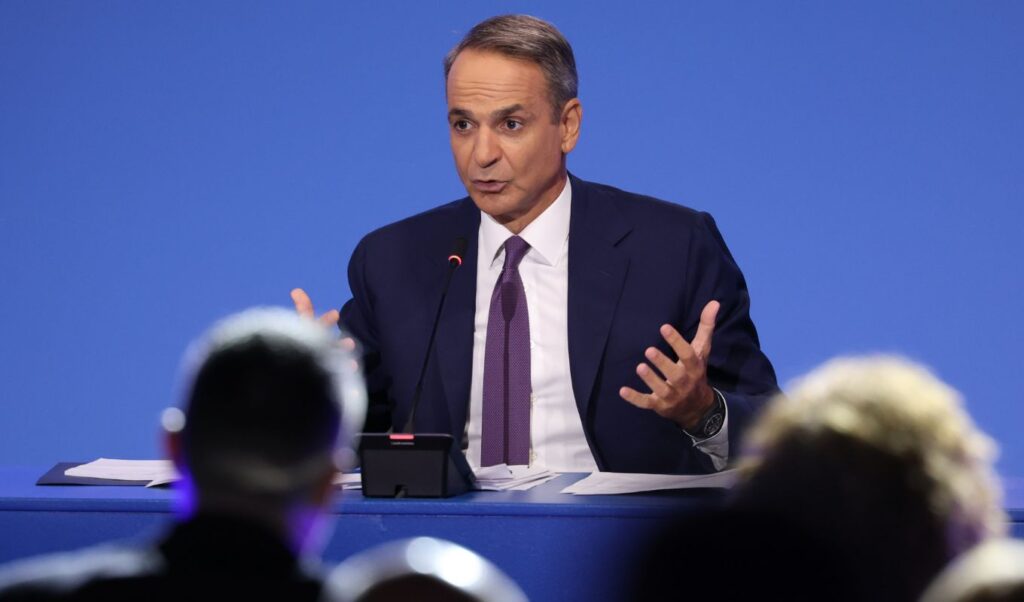
With his gaze fixed on Greece in 2030, outlining relief measures and key policy interventions, Prime Minister Kyriakos Mitsotakis fielded questions from political journalists during a press conference held at the “I. Vellidis” conference centre, as part of the 90th Thessaloniki International Fair (TIF). He spoke about the need for a parliamentary majority, while simultaneously framing the dilemma ahead of the next elections — with his Saturday statement about “hope or adventure” resurfacing, in a different guise, on the table. The Prime Minister stressed the need for political stability, linking it directly to economic stability, while also emphasising the necessity of bolstering the country’s defences, defending the “Achilles’ Shield” programme.
Leaving no room for coalition deals with other parties, and speaking of New Democracy as a centre-right political force, he showed no concern about the far right as a threat. He took aim at Alexis Tsipras and his party, the Hellenic Left Alliance, dismissing it as “rebranding for free.” He also criticised Nikos Androulakis, focusing on PASOK’s stance on the constitutional revision. Meanwhile, responding to criticism over school textbooks, he chose to back Education Minister Sofia Zacharaki, emphatically stating that a woke agenda “does not exist in Greece.” Notably, in response to a question from Parapolitika and Kostas Papachlimintzo about self-criticism and government mistakes, he admitted that errors had been made, singling out the OPEKEPE agricultural payments agency and the need for its restructuring and clean-up. Prime Minister Mitsotakis placed special emphasis on the healthcare sector and, responding to a question from Penny Avramidi and Apogevmatini, acknowledged that “there are problems in healthcare, but the intervention in the National Health System (ESY) has been enormous.”
Questions about former Prime Minister Antonis Samaras were numerous and posed in various ways throughout the press conference. Kyriakos Mitsotakis commented on Samaras’s legacy in view of the possibility of him forming a new party, and also referred to past moves made against New Democracy. On the matter of Samaras’s expulsion from the party, the Prime Minister said that what the former PM had stated was serious, and left no room for any form of cooperation. When asked about former Prime Minister Kostas Karamanlis, he spoke of good relations and expressed his personal esteem for him.
On the crucial issue of Greek-Turkish relations, he committed to responding to Turkish provocations and contestations, while making clear that communication channels remain open. Regarding relations with Albania, he pledged to protect the rights of the Greek minority. Responding to a question about the Tempi train disaster, he spoke of the progressive installation of the remote control signalling system, and also referred to upgrades in civil protection capabilities, including the procurement of thermal cameras and drones.
Mitsotakis to Parapolitika and Kostas Papachlimintzo: “I made a mistake by not acting sooner on OPEKEPE — look at where we were in 2019 and where we are now”
“I’ve been criticised for being a prime minister who has apologised many times. When you govern, you will make mistakes. And it is far better to acknowledge those mistakes with courage and make sure you correct them. The worst mistake is the one that gets repeated. I believe that in my public discourse I have tried to be self-critical and honest. Of course, I made a mistake by not having the courage sooner to transfer OPEKEPE to the Independent Authority for Public Revenue (AADE), and we lost both time and money in the process of rationalising it. University Police was unnecessary — we spent a great deal of political capital in a way that was not the most appropriate means of dealing with a real problem. We have issues with the speed of implementing government work; we need to pick up the pace and learn from what we did well in terms of the executive state. I spoke about the need for the next four-year term to be the four-year term of the investment leap. We need time to sweep away the obstacles. We now have a Land Registry that has gone from 38% to 99% coverage,” he noted, among other things, before adding:
“There’s a difference between self-criticism and self-flagellation. I will not accept that a very significant body of government work carried out over the past seven years be levelled to the ground. Look at where we were in 2019 and where we are in 2026,” he said, taking aim at the situation he inherited, referring specifically to unemployment, migration, and investment, among other areas.
Mitsotakis to Penny Avramidi and Apogevmatini: “There are problems in healthcare, but the intervention in the NHS has been enormous”
The Prime Minister referred specifically to the renovation of infrastructure, noting that it covers “more than 80 hospitals, emergency departments, and over 160 health centres across the country.” “Never before has there been such a large-scale structural intervention — it concerns patients, but also the staff who are there continuously. The reduction of waiting lists through the wristband system is very significant,” he also noted.
Mr Mitsotakis mentioned that “two days ago, I was at the inauguration of the haematology centre at Papanikolaou Hospital, and Georgia described her own story, saying that ‘I had nowhere to sit’ and now she has the most modern haematology laboratory. Let us acknowledge and boldly celebrate the upgrade in infrastructure, funded through the Recovery Fund, which we have fully absorbed. We want more healthcare workers — we have problems attracting doctors, we are short of nurses, but not only in Greece; we need young people. We have supported doctors’ incomes through a series of measures; they will never earn the same as in the private sector anywhere. They can do private work, though, to supplement their income.”
He also stressed: “Greece is a leader in prevention. As a Minister of Health, you must invest in prevention. Women should have mammograms; men should have prostate checks. Every woman who tells us she got tested and found cancer at an early stage — that is prevention. We have an oral health problem, which is why we announced the Dental Pass. The NHS is in a much better state than the one we inherited. When we ask patients to rate us and they give us over 4 out of 5, that is progress. I don’t care what the opposition says. Let them play their role as the cockroach opposition. We are not where we want to be, but let us acknowledge the progress. Healthcare has problems, but the picture from patients’ perspective is better. We honour and thank the healthcare workers,” he noted, among other things.
On defence: “Greece is a peaceful country with defence as its top priority”
“Greece is one of five NATO countries that has already achieved the target of spending 3.5% of GDP on defence,” the Prime Minister stressed, noting that we are doing so not merely out of obligation, but because we find ourselves in a situation that compels us to be fortified and always capable of projecting a strong deterrent force.
He stressed that he considers the need to always prioritise the defence and security of the country to be part of the agreement reached with Greek society.
He underlined that he is proud that the defence gap created during the financial crisis has largely been bridged. He made particular mention of the Navy, which had gone 30 years without acquiring new vessels.
“The shift in philosophy towards smaller, cheaper systems that are constantly evolving is a reality, and Greece is adapting to that reality,” he stressed.
He noted that Greece is a peaceful country with defence as its top priority, and declined to say anything further on the subject of the F-35s.
“We are missing a major opportunity on constitutional revision”
On a question regarding the opposition’s stance on the constitutional revision, he said: “First and foremost, PASOK’s stance presupposes that we will be the leading party — perhaps even with an outright majority.”
“But you know, the history of constitutional revisions in our country shows that the success of a revision depends primarily on the stance of the opposition, and less on the stance of the governing majority. That was at least the case with the 2001 revision,” he noted.
He stressed that PASOK’s stance is inexplicable. “PASOK went so far as to say that if we voted in favour of a proposal that PASOK itself had tabled, the party would vote against its own proposal. Citizens should understand this — simply because it did not want to agree with us,” he said, noting that PASOK rejected the revision of Article 86, the fiscal rule, and the link between performance appraisal and civil servants’ permanency.
“We are missing a major opportunity. I believe we made a sincere effort to find channels of communication with the opposition parties, but I think that for a very long time now, there has been a cultivated logic that whatever the government says is bad — and if the government says white, they will say black.”
Emphasis on tackling terrorism and crushing organised crime
“Crime is evolving, but I believe we are heading in the right direction. In the murder of the mother of Afroditi Nestoras, the alleged perpetrators have been identified. We must proceed to conviction so that the egg of terrorism does not grow.
Very impressive results from the Greek FBI. The statistics show we are heading in the right direction. The law also plays an educational role. Fraud is being dealt with properly, but citizens also need to be informed. It is a continuous battle against the ‘deep state.’ And in the OPEKEPE case, a great many people have been referred to justice.”
“Rebuilding the primary sector is a personal wager”
Prime Minister Kyriakos Mitsotakis described the rebuilding of the primary sector as a “central priority” and “personal wager,” responding to a question about the major challenges facing farmers and livestock breeders, as well as the government’s overall strategy.
The Prime Minister admitted that in the primary sector “we have fallen behind,” acknowledging among other things that the reform of the ELGA insurance body’s regulations had not been advanced. As he noted, the restructuring of the agricultural sector is one of the government’s major bets. At the same time, during the press conference at the 90th TIF, he stressed that the announced tax relief is aimed at actual producers, while expressing his belief in the usefulness of young farmers programmes, with the goal, as he put it, of “keeping people on the land.” Mr Mitsotakis emphasised the need for the primary sector to become more competitive, through the development of flagship Greek products, as well as through investments in productivity and technology.
Referring to the situation created in livestock farming due to foot-and-mouth disease, the Prime Minister noted: “I understand the farmer who is forced to slaughter his herd, but unfortunately there is no other solution for foot-and-mouth disease,” while also pointing out that the government will provide the necessary resources to support the sector.
Regarding the new Common Agricultural Policy, Mr Mitsotakis noted that Greece is currently in negotiations, underlining the significance of the experience brought by Agriculture and Food Minister Margaritis Schinas.
He also made special reference to OPEKEPE, stressing that resolving that problem was a prerequisite for proceeding with the remaining interventions in the agricultural sector. “Nothing could have been done before we resolved the OPEKEPE issue,” he said pointedly.
The Prime Minister maintained that significant interventions are already being implemented and noted that the government will be judged on how well it delivers on its plans. “We will be judged in 2030,” he said, expressing confidence that the ambitious plans for the primary sector can be realised. “It is not enough to be merely a state and a ministry of subsidies and compensation. We need something more,” Mr Mitsotakis stressed, concluding his remarks.
Following the backlash over school textbooks and Samaras’s criticism, Mitsotakis made clear there is no woke agenda in Greece
Asked about the criticism from Antonis Samaras regarding a woke agenda and whether he regrets legislating same-sex marriage, the Prime Minister responded that this discussion had prompted a renewed debate and criticism over the content of school textbooks.
“We already have enough reasons to be divided — let’s not try to invent yet more causes for division,” he said. “The new school textbooks will be published next year. It is an achievement for the country that we have a multiple-textbook system. The books are not written by the minister or the ministry. They are evaluated by independent committees, and if there is an error in any book or something we consider to be causing unjustified controversy, we will correct it. Make no mistake about that. But to now try to manufacture agendas that simply do not exist in Greek society… because there is no woke agenda in Greece.”
He said we must not conflate a legal initiative concerning civil equality in marriage with excesses that did in fact occur in the United States, where the term “woke agenda” was first used. “There is no woke agenda in Greece. I say this categorically — and in any case, if some are defending it, it is certainly not this government.”
“Government is formed by the leading party, with its leader as Prime Minister”
“The government is formed by the leading party, with the leader of that party as Prime Minister,” Prime Minister Kyriakos Mitsotakis made clear, responding to a question about coalition scenarios being floated by opposition parties and the possibility that no outright majority emerges in the first electoral contest.
Mr Mitsotakis commented sarcastically on the prospect of a government being formed by parties that will have lost the election, specifically naming party leaders Alexis Tsipras, Nikos Androulakis, Zoe Konstantopoulou, Kyriakos Velopoulos, and potentially Dimitris Koutsoumpas.
He spoke of a “government of the defeated” scenario and characteristically said: “Good luck — if that’s what the country needs today.”
The Prime Minister reminded the audience that similar scenarios had been put forward after the 2023 elections, noting that they ultimately came to nothing, as New Democracy recorded 41% of the vote.
“We’ve heard this before — in 2023 — and we saw how it ended, with ND at 41% and Mr Tsipras at 17%,” he said.
He also made his position clear on who should take the initiative in forming a government, stressing that this right belongs to the leading party and that the Prime Minister must be its leader.
“The government is formed by the leading party, with the leader of that party as Prime Minister,” he underlined.
In closing, Mr Mitsotakis described an outright majority as “the best solution,” noting that the issue of post-election alliances would be examined after the electoral process is complete. “An outright majority is the best solution. We’ll take stock after the elections,” he said.
“The demographic problem concerns an ageing society”
Asked about demographics, the Prime Minister said the issue is a global one, and also an economic one.