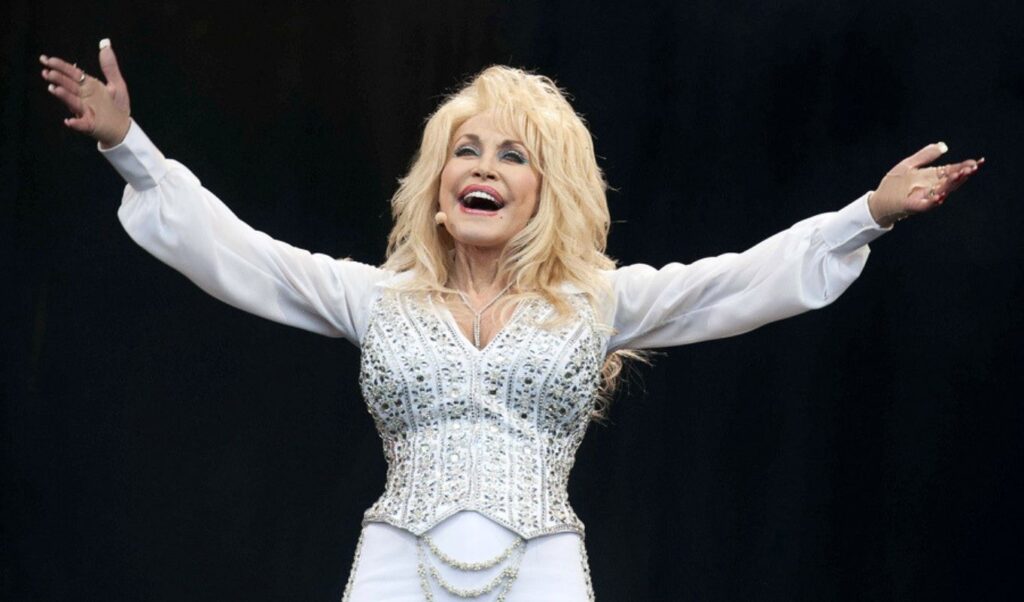
At the age of 80, legendary Dolly Parton, the singer who brought country music to the world, has passed away. Her death was announced by her nephew in a video posted to her official Instagram account.
Trump on Dolly Parton’s death: US flags to fly at half-staff for a week — “The world loves you”
US President Donald Trump paid tribute to Dolly Parton in a post on Truth Social, honoring the “queen of country” and acknowledging the magnitude of her loss for both American and international audiences. The President announced that American flags would fly at half-staff across the entire country for one week as a mark of respect for the legendary singer.
“It is with great sadness that I announce that Dolly Parton, one of the greatest Country Music singers, and so much more, EVER, has just passed away. This is a real loss for millions of people. There has never been anyone like her, and there never will be. In her honor, the American Flag in all of the United States will fly at half-staff for one week, beginning tonight at 6:00 P.M. Rest In Peace, Dolly! The World loves you. President DONALD J. TRUMP,” Trump wrote.
Who was Dolly Parton
Dolly Parton was born on January 19, 1946, in the small town of Sevierville, Tennessee, and grew up in a one-room cabin in the nearby community of Locust Ridge. Her father, Robert Lee Parton, worked as a farmer and construction worker, while her mother, Avie Lee Owens, was a homemaker. Parton was the fourth of 12 children, and by her own account, her family was extremely poor and rural — a background that would ultimately shape her into an enduring symbol of the American working class.
Her mother sang constantly — songs from England, Ireland, and Wales that told a story. “Mama had this haunting voice, and, Lord, you felt it,” Parton wrote in her 2020 book Dolly Parton, Songteller, co-written with Robert K. Oermann. At around the age of six, she wrote her first song: “Little Tiny Tasseltop,” an ode to her cornstalk-haired doll. Her mother carefully kept it in a shoebox.
“I loved that little doll,” Parton wrote decades later. “I expressed myself and my feelings through writing — I’m sure what I was thinking was: ‘Well, Tasseltop needs to have a song about her.’” She got her first real guitar at eight years old. Whenever her mother had guests, she would say: “I want you to hear this song this little thing made up. It’s really good.” By the age of 10, Parton had already begun writing what she called “songs that make you cry” — about heartbreak and tragedy.
She was singing on a local radio station by the age of 11, and by 13 she was performing at the Grand Ole Opry, the legendary weekly country music concert in Nashville, Tennessee. After graduating high school, she moved to Nashville to pursue a music career and began a celebrated partnership with country singer Porter Wagoner, which included a long-running stint on his television show and 14 top-10 duets. She wrote her breakthrough hit “I Will Always Love You” as a farewell to Wagoner when she decided to pursue a solo career.
On her very first day in the country music capital, Parton met Carl Dean, an asphalt worker. They would marry two years later, in 1966. Throughout their long marriage, Dean stayed out of the spotlight and never joined her on tour, though he served as the inspiration for many of her greatest songs — including “Jolene,” which was inspired by a red-haired bank teller who had taken a shine to Dean.
In 2008, at the age of 62, Dolly Parton released a single in which she described herself as “just a backwoods Barbie, too much makeup, too much hair.” Yet across six decades of shaping country music, she was so much more than that. She won 11 Grammy Awards, including a Lifetime Achievement Award, and with timeless classics such as “Coat of Many Colors,” “Jolene,” and “I Will Always Love You,” she became one of the best-selling recording artists of all time, with over 100 million records sold.
Parton’s authentic personality — combined with her towering blonde hairdos, sequined costumes, and electrifying stage presence — endeared her to Americans of all walks of life and helped bring country music to a global audience. She developed her signature look inspired by a woman she once saw walking through her Tennessee hometown in tight skirts and high heels, with red nails and red lipstick. “I thought she was beautiful. But everyone said, ‘She’s trash!'” Parton wrote in her 2023 book Behind the Seams: My Life in Rhinestones. “I laughed and said, ‘Well, if that’s trash, that’s what I want to be when I grow up!'”
She also made clear that she wanted her appearance to amplify — not overshadow — her talent. Over the years, Parton hosted a television variety show, starred in major films, and even created her own theme park, Dollywood, a beloved tourist attraction in her home state of Tennessee — all alongside her distinguished work as a songwriter.
But perhaps the quality that gave her lasting brilliance was her ability to connect with people. During the COVID-19 pandemic, Parton donated $1 million to vaccine research at Vanderbilt University in 2020, making her one of the earliest funders of the Moderna vaccine’s development. She ran a childhood literacy program for preschool-aged children across the United States, as well as in Canada, the United Kingdom, Australia, and Ireland, and provided scholarships to high school students in the Tennessee county where she was born.
That county erected a life-size statue of her in front of the courthouse as a gesture of gratitude, though Parton herself declined a separate proposal for a statue in her honor in Nashville in 2021, saying: “With everything that’s going on in the world, I don’t think that putting me on a pedestal is appropriate at this time.” It was this ability to stay true to her roots — combined with her devotion to hard work and her studiously apolitical stance — that broadened her appeal to both conservatives and liberals alike in an increasingly polarized America.