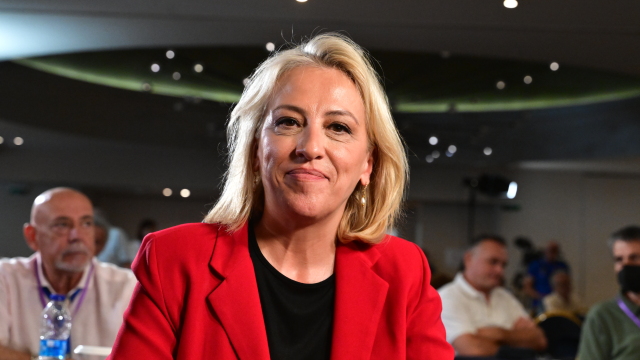
Rena Dourou is speaking openly about her own experience with menopause in a deeply personal post, while also addressing the prejudices that, as she points out, continue to follow women as they age. Her reflection was inspired by Brooke Shields’ book No Way I’m Calling It Aging, which prompted her to open a conversation about age, women’s health, and the urgent need to stop treating menopause as something women should stay silent about.
The president of SYRIZA’s parliamentary group, referencing a passage from Shields’ book stating that “only one in five obstetricians-gynecologists has been trained in menopause, even though half the population will experience it at some point in their lives,” notes: “Lately I’ve been realizing more and more how lucky I am. I’m going through menopause with relatively mild symptoms — I haven’t even needed a fan so far — and I have someone by my side who understands what this transition means.”
In her post, she closes with a postscript that reads: “Just wait till you hear what friends — and ‘friends’ — have to say about their… menopausal president.”
Rena Dourou’s post about menopause
Read Rena Dourou’s full post
“August came in hard. With images of destruction, with losses, with deep wounds inflicted on places, people and our natural environment — a heaviness that stayed with all of us. Some of those losses were personal. And somehow, my usual Sunday book got set aside. There are moments when you simply can’t find it in you to turn to the next page.
And yet, even in difficult times, books have a way of finding their way back into our lives. So I made a choice that, a few years ago, I would have struggled to imagine for myself.
If someone had told me, back when I was a student of Chantal Mouffe, Ernesto Laclau, Menelaos Givalos and other great professors, that one day I would be holding a Brooke Shields book in my hands — without the slightest awkwardness — I probably wouldn’t have believed them.
And yet… I found myself reading No Way I’m Calling It Aging, translated by Antzi Kounadi, published by Bell.
I opened it with curiosity. Very quickly, I started underlining.
“Women become invisible as we age. Society trains us to believe that our worth is tied to our youth, our beauty, and our ability to meet the expectations of others.”
Sadly, that wasn’t hard for me to believe at all.
I haven’t had children. I haven’t tried to look younger than my age. And I’ve spent almost my entire adult life in a space where a woman’s appearance, age, tone of voice and self-confidence are often commented on more than her ideas. So I wasn’t simply reading those pages. On many of them, I felt as though someone was describing a familiar reality.
“From a young age, we are taught to treat our bodies as a constant work in progress.
How paradoxical… To be asked to defeat time, and at the same time to be criticized if we try to do so.”
“When a man shows confidence, he’s considered a leader. When a woman does the same, she’s often labeled difficult or arrogant.”
Women in public life learn early on that there is a standard that shifts — but only for us. If you raise your voice, you’re aggressive. If you don’t, you lack backbone. The bar keeps moving, but only for women.
And then came the passage that, more than any other, made me stop reading:
“It is study after study that has found a gender bias in the medical field, resulting in women’s pain not being taken seriously — and therefore not being relieved.”
This may be one of the oldest prejudices against women. From the era when their pain was attributed to “hysteria,” to today, when scientific studies show it is still being underestimated. The centuries have changed. The attitudes have not changed nearly enough.
And a little further on:
“Only one in five obstetricians-gynecologists has been trained in menopause, even though half the population will experience it at some point in their lives.”
Lately I’ve been realizing more and more how lucky I am. I’m going through menopause with relatively mild symptoms — I haven’t even needed a fan so far — and I have someone by my side who understands what this transition means. And of course, I also have my friend Olga Petsoglou, who knows everything there is to know about menopause and never leaves a question unanswered.
That is precisely why I feel I have a responsibility to speak up. For the women who are going through menopause far more difficult. For those who are struggling financially, who don’t have a supportive environment or a partner who understands them, who can’t easily find the information and care they need, and who still hear that “it’s all in their head” or that “that’s just what getting older feels like.”
That’s why, for some time now, I’ve made the decision to talk about menopause at every opportunity — publicly and privately. I’m glad that lately more and more women with a public platform — actresses, singers, journalists — are choosing to do the same. These voices matter, because they are opening a conversation that for decades has been pushed to the margins.
But the real goal is for no woman to have to stay silent. For all women to be able to speak without fear and without shame. And especially those who lack visibility, who face financial hardship, or who don’t have the supportive environment that would help them claim the care and understanding they deserve.
So enjoy freely and without guilt.
P.S. I hope that one day the things that should be obvious will become public conversation — without needing a famous woman to open the door.
P.S. 2. The photo was taken in front of a wonderful painting by Faidra Kazantzaki, depicting a street market — people, movement, colors, all the vibrancy of everyday city life. Faidra is a young artist who looks at the city and its people with her own distinctive eye. I’ve been following her since she was little and, though I may not see her as often as I’d like, I take great joy in watching her grow, move forward and create.
P.S. 3. And now that I think about it… just wait till you hear what friends — and ‘friends’ — have to say about their… menopausal president!”