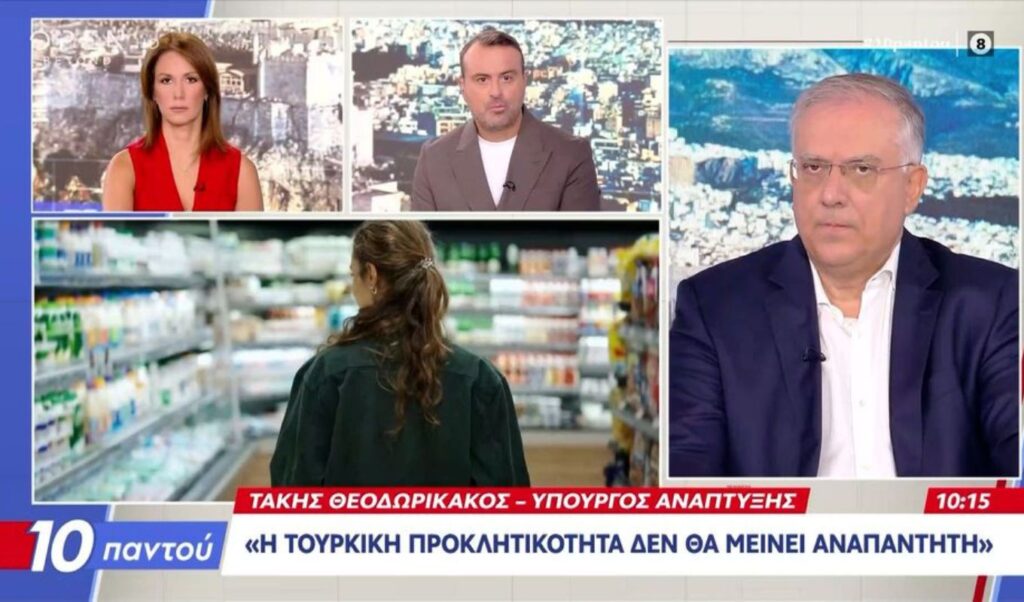
Greece’s Minister of Development, Takis Theodorikakos, outlined the full range of policies being implemented by the Ministry of Development and the broader government to support disposable income for Greek families — through interventions aimed at reducing the cost of living, strengthening the productive economy, and creating more and better-paying jobs. He made these remarks on Thursday morning (20/08) in an interview with OPEN television.
Read also: Theodorikakos on negative food inflation in July: “We continue the fight to reduce the cost of living — we are not resting on our laurels”
Regarding the national price reduction initiative, Theodorikakos announced that it will launch on August 31, with the final list of products and their respective discounts to be confirmed by the end of the following week. “What matters to me is not the exact number of product codes included. What matters is that these are mass-consumption products — products that affect the average Greek household and the average Greek family: food, basic necessities, and basic household maintenance items,” he stressed, noting that the process is already well underway, with hundreds of product codes already involved.
Takis Theodorikakos: What he said about product prices
He clarified that for a product to be included in the initiative, the price reduction must be at least 5%, lasting between two and four months, while some products are expected to see double-digit percentage cuts. The initiative will cover all main product categories, including food, everyday essentials, and back-to-school supplies.
“The initiative will certainly include school supplies, since in the first days of September, families with children face the expense of buying school materials,” he said. He added: “For someone who closely tracks how much they spend at the supermarket, reducing their monthly cost by €40 or €50 for a period of time is a significant matter.”
Addressing inflation
Citing Eurostat data for July, according to which food inflation in Greece stood at -0.4% on an annual basis and -2.3% compared to June — recording the lowest monthly change among eurozone countries — the Minister of Development noted that this development demonstrates that the agreement to keep prices in check during the summer months is working. “This does not mean, of course, that the prices of all products have fallen, or that there are no products whose prices have increased,” he clarified, adding: “We are not celebrating and we are certainly not complacent. We are working alongside market stakeholders for the benefit of society, because our responsibility — alongside job creation and wage improvements — is to have a fairer, more functional, and more competitive market.”
What he said about transforming the productive model
Turning to the transformation of Greece’s productive model and the strengthening of its industrial sector, Theodorikakos stated: “We have completely overhauled the strategy and mindset behind the Development Law. As we speak, approximately 500 productive investments in the industrial sector are currently underway, 95% of which are taking place in regional areas, in the Greek provinces, and particularly in border regions.”
He highlighted that 60,000 additional jobs have been created in the industrial sector over the past seven years, with average annual gross earnings hovering around €25,000 — higher than the economy-wide average. “We want to further strengthen the role of modern Greek industry,” he said, emphasizing that boosting productivity and competitiveness means better wages, more opportunities for young people, and a more resilient economy.
Ministry of Development interventions
Connecting the Ministry of Development’s interventions to the government’s broader income support strategy, Theodorikakos said: “There is clearly a cost-of-living problem. What is important is to have a strategy for how to address it — both fundamentally and through targeted, timely interventions. We are doing both. Addressing the root causes means better wages, a more productive economy, more investments, better jobs, and more employment opportunities.”
He reminded viewers that the minimum wage has increased by 40% in recent years and that the average wage now exceeds €1,500 per month. He also highlighted specific government measures for young workers and household support: “Young people up to the age of 25 who are working pay no income tax, and those up to 30 pay half the standard rate. Additionally, those who rent their homes receive one month’s rent per year as state support. These are concrete measures and policies designed to support citizens.”
Repaying the public debt
On the repayment of €13 billion in public debt, Theodorikakos said that reducing it is a matter of responsibility toward future generations. “We have the ability to repay part of our debt, and we are doing so because we want to leave a lighter debt burden for younger people and future generations. I don’t believe there is any parent who would want debt to keep growing in their household and then pass it on to their children,” he said.
Responding to Turkish provocations
Finally, responding to a question about Turkish provocations, Theodorikakos was unequivocal: “None of our sovereign rights are up for discussion with anyone — and certainly not with Turkey. We always refer to areas that fall under our country’s sovereignty in accordance with international law, and that is non-negotiable. I believe our neighbors must understand that escalations and confrontations of this kind over self-evident national sovereign rights will neither go unanswered nor produce any practical result in the reality of our relations,” he added.
He stressed that all parties have a duty to safeguard national unity and “to remain vigilant and prepared for any threat or provocation that may arise.”