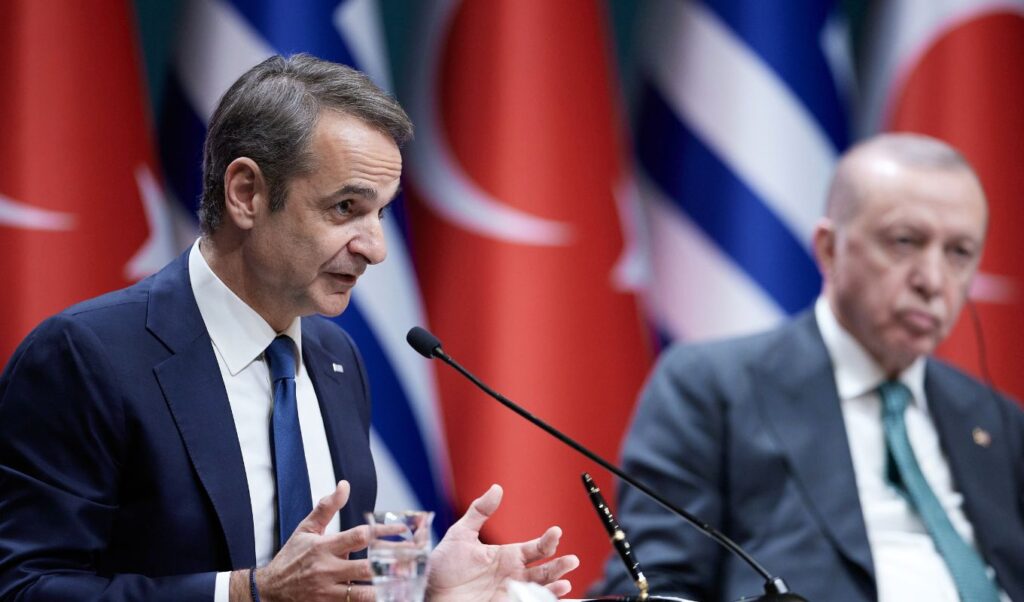
September is shaping up to be a particularly complex month for the Greek government, as relentless Turkish provocations are pushing national security issues to the forefront of the political agenda — running parallel to the economic announcements expected from Kyriakos Mitsotakis at the Thessaloniki International Fair (TIF). Behind the scenes of economic package preparation, the Prime Minister’s office is being forced to simultaneously manage Turkish revisionism and mounting pressure from the right-wing of the political spectrum, led by former Prime Minister Antonis Samaras, over the government’s so-called “calm waters” foreign policy approach.
Mitsotakis faces turbulent waters from rivals and ultra-nationalists
The former Prime Minister wasted no time following Ankara’s announcement of two presidential decrees, once again challenging the effectiveness of the government’s strategy and accusing it of pursuing a policy of appeasement that Turkey interprets as weakness. This rhetoric is exerting considerable pressure on the traditional right-wing base of New Democracy, which has never been comfortable with this approach to Greek-Turkish relations and continues to watch developments with growing unease. As a result, the Prime Minister’s office is being forced to justify the conditions that led to the Athens Declaration — at a time when the Greek Armed Forces were already racing to repair the deep wounds inflicted on military readiness by the austerity-era defense budget cuts.
The broader situation makes the political landscape even more demanding, requiring the government to simultaneously project strength and resolve toward Turkey and the international community, while rallying domestic support — particularly as work on the undersea electrical interconnection is set to begin next month. This development could very well prompt Turkey to escalate its provocations at sea in a renewed bid to blur sovereign boundaries in Greek waters.
Athens, operating in close coordination with Paris and Nicosia, intends to elevate the pressure to the highest level ahead of the EU Summit in October. The goal of this trilateral axis is to remind all parties that Greek and Cypriot borders are, simultaneously, the external borders of the European Union.
Implementing this strategy hinges on the meaningful protection of key European energy and development projects, with the Great Sea Interconnector (GSI) serving as the spearhead. The entry of the French investment fund Meridiam into the shareholding structure of the project’s implementing body effectively transforms the Greece-Cyprus-Israel electrical interconnection into a distinctly European undertaking of high strategic value. This development fundamentally shifts the balance of power on the ground: the upcoming marine surveys and seabed operations are no longer merely a national technical procedure, but a project shielded by French — and broader European — political backing. When Greek authorities issue the critical NAVTEX to reserve the maritime zone in September, Ankara will be confronted not simply with Athens, but with European and French interests protected under international maritime law.
In any event, the possibility of targeted sanctions — initiated by Athens and backed by strict EU countermeasures — also remains on the table as a deterrent against Ankara’s revisionist tactics, should the situation deteriorate further. While the opposition is openly pressing the government to demand the immediate imposition of sweeping EU sanctions against Turkey, accusing it of retreating from national “red lines” and allowing the “calm waters” narrative to collapse, Greece’s diplomatic approach continues on a more measured but steadily escalating trajectory.
Greece’s objective is to make clear to Europe, and by extension to the United States, that Turkey’s actions constitute a blatant violation of international law and the UN Convention on the Law of the Sea (UNCLOS). The GSI, moreover, does not operate in isolation — it is organically linked to the planned India-Middle East-Europe Economic Corridor (IMEC). Washington now views the Greece-Cyprus-Israel electrical interconnection as a key pillar in reducing the Eastern Mediterranean’s exposure to external interference.
Any Turkish obstruction would therefore not merely target European interests, but would directly challenge Washington’s own strategic planning for regional energy security. Viewed through this lens, Athens will continue to position itself as a pillar of security and stability in the broader Eastern Mediterranean, contrasting its own adherence to international law and the Law of the Sea with Turkey’s conduct — and standing ready to counter any attempt to create facts on the ground in the Aegean. The Greek side already has a fully documented file prepared, detailing the latest violations, inflammatory statements by Turkish officials, and a series of unilateral actions. Against this backdrop of heightened tension, it remains an open question whether Kyriakos Mitsotakis will meet with Recep Tayyip Erdoğan on the sidelines of the UN General Assembly in New York this September.
Violations and aerial dogfight
Turkey is escalating its provocations over the Aegean, with 25 airspace violations recorded yesterday by armed fighter jets. In one incident, the situation escalated into a dogfight after a Turkish pilot refused to comply with orders. Ankara appears to be playing with fire, given the well-established superiority of the Greek Air Force — raising speculation that it may actually be seeking to engineer an “incident” for which Greece could be blamed.
Harsh criticism
On the domestic front, the latest Greek-Turkish tensions have become a central flashpoint in political debate, with the opposition launching sharp criticism at the government over its handling of national security issues, and Antonis Samaras preparing to re-enter the political spotlight when he deems the moment right.
PASOK spokesman Kostas Tsoukalas stated that “the ‘calm waters’ narrative is collapsing, exposing the dead ends of the foreign policy pursued by the Mitsotakis government,” while simultaneously calling on the government to request that the European Union impose sanctions on Ankara. Mr. Tsoukalas stressed the need to “avoid repeating the inaction seen in previous cases, such as the Turkey-Libya memorandum and the obstruction of cable-laying off Kasos.”
Originally published in Apogevmatini