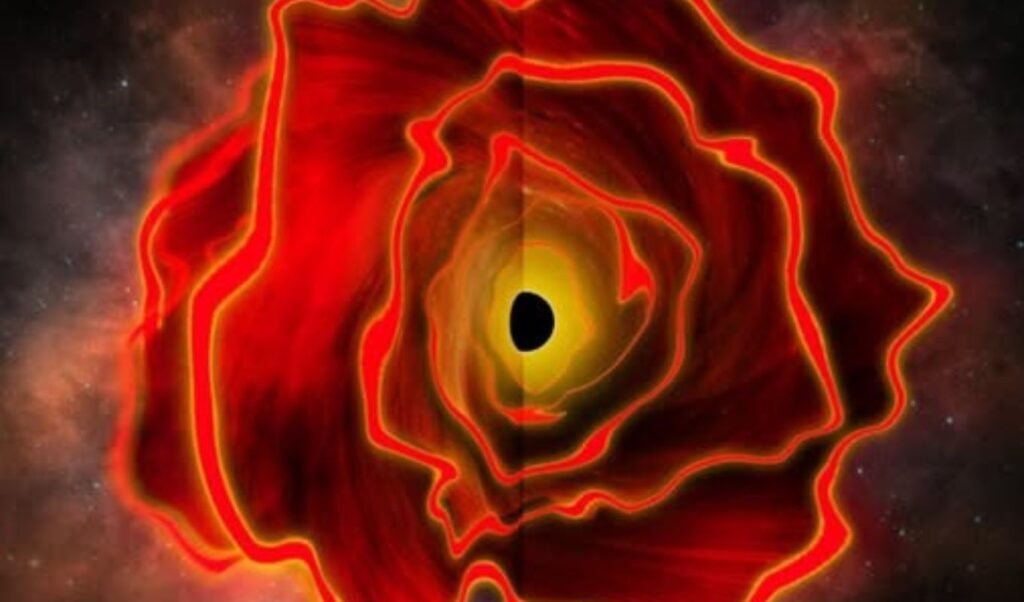
Scientists appear to have discovered a black hole star. They describe their findings in a new study published in Nature, emphasizing that its red glow illuminates from the depths of space. The poetic way it appears is, in fact, tangible reality. According to the data released, the object is roughly the size of our solar system — a finding confirmed through observations made by the James Webb Space Telescope. Scientists are lavishing praise on the telescope’s capabilities, calling it an instrument capable of transforming our understanding of the universe. This is how they came upon so-called “cloaked stars,” which they have named “black hole stars” — located at the greatest observable distance possible. The term is something of a playful label, however, as scientists believe these are black holes surrounded by gas that is only minimally — if at all — identified. Dense and luminous, this gas has yet to be clearly defined.
The age of the universe through the lens of the “black hole star”
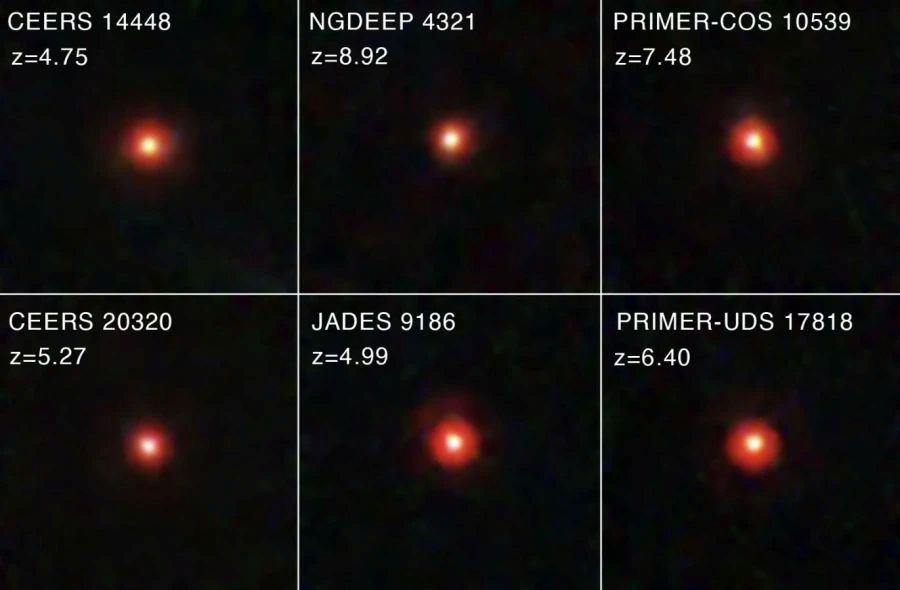
What makes this remarkable is that this particular “black hole star” dates back to a time when the universe was just 660 million years old — a staggering fact when you consider that the universe is now approaching 14 billion years of age. The JWST has released images in which the object appears as one of many bright, reddish dots the telescope has detected in the early universe.
The object, known as MoM-BH*-1, displays a number of unusual properties, despite initially resembling a large star. It is not a star, say the scientists behind the study — primarily because it emits roughly 100 billion times more energy than any star could produce through nuclear fusion. Even by the standards of the early universe, when it formed, this is an extraordinarily luminous object.
Furthermore, part of its light vanishes abruptly. Stars can produce a similar signal when their atmospheres absorb specific wavelengths of light, but in the case of MoM-BH*-1, the effect is far too intense to be explained by normal stellar behavior. Researchers believe that a vast quantity of exceptionally dense gas is absorbing this light.
These clues led scientists to the “black hole star” hypothesis. At the center of MoM-BH*-1, there would be a black hole devouring matter and releasing enormous amounts of energy. Surrounding it would be a massive shell of gas. The energy would pass through this gas before escaping into space, and in the process, it would take on certain characteristics we would normally expect to find in starlight.
What are the red dots?
This hypothesis could help solve yet another mystery revealed by the JWST. The telescope has been detecting small red dots in the early universe with striking frequency, and their origin remains uncertain. They do not fit neatly into the usual categories of deep space objects. Scientists have proposed various explanations, including the possibility that they are compact, star-filled galaxies, black holes hidden behind dust, or systems entirely unlike anything we observe in the present-day universe.
“Black hole stars” are also among the proposed explanations. MoM-BH*-1 is of particular interest in this area of research because, unlike other red dots, its black hole appears to almost completely overshadow the galaxy surrounding it.
“Every little red dot is consistent with the possibility of being a black hole star embedded in a typical galaxy of the early universe. But what makes MoM-BH*-1 special is that the black hole star essentially outshines its host galaxy entirely, meaning we are seeing almost exclusively the light from the black hole star itself,” said Rohan Naidu, lead author of the study, who conducted the research while at MIT.