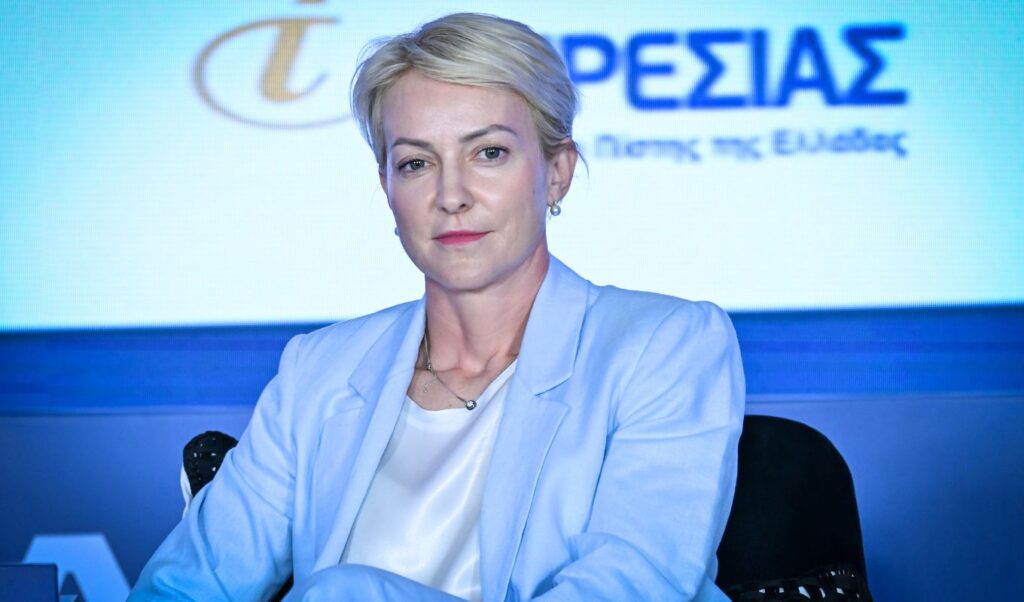
“Turkey cannot create rights against third countries through a unilateral act,” stressed the spokesperson of New Democracy, Alexandra Sdoukos, speaking on SKAI 100.3 and OPEN TV. “To the extent that the parks announced by Turkey occupy international waters, their unilateral establishment is illegal,” she added.
Alexandra Sdoukos: “Turkey’s actions carry no legal effect”
In greater detail, Ms. Sdoukos emphasized that “these actions by Turkey carry no legal effect whatsoever and do not in any way affect Greece’s sovereign rights. To the extent that the parks announced by Turkey occupy international waters, their unilateral establishment is illegal. Under the Law of the Sea, no state has the right to unilaterally establish marine protected areas beyond its own national waters.
Greece, for its part, proceeded with the designation of marine environmental protection parks in accordance with international law, its international obligations, and its sovereign rights. Turkey had previously announced it would do something similar, except it attempted to incorporate the marine parks into its well-known, broader agenda of illegal claims. So what we have here is an attempt to dress up old and illegal Turkish territorial claims in an environmental guise.” She further stressed that “Turkey cannot create rights against third countries through a unilateral act. This has already been proven with the Turkey-Libya memorandum.
Turkey signed it with the Libyan side — in its current composition and without parliamentary ratification — but that does not mean it acquired international legitimacy. It did not bind Greece and ultimately produced no rights at Greece’s expense. This became evident in the drilling agreements we concluded. No one paid any attention to that memorandum; no one sought Turkey’s permission or its opinion.”
“We use every single day to make our country stronger”
When asked about the strategy of “calm waters,” Alexandra Sdoukos pointed out that “we never had the illusion that Turkey had permanently changed its policy or abandoned its revisionist ambitions. We don’t want calm waters just so we can say everything has been resolved.
It is, however, positive to reduce the risk of an incident and, where genuine willingness existed on the other side, to explore the possibility of resolving the one dispute Greece recognizes — the delimitation of the continental shelf and the Exclusive Economic Zone — either through agreement or, under the right conditions, by referral to The Hague. Most importantly, though, we did not let this time go to waste. We used it to make Greece economically stronger, diplomatically more powerful, and defensively far better prepared.
The country was elected to the UN Security Council, strengthened its trilateral cooperation frameworks with Cyprus, Egypt, and Israel, and developed strategic relationships with the United Arab Emirates and Saudi Arabia. At the same time, it concluded a strategic partnership agreement with France — which includes a mutual defense assistance clause — and further upgraded its strategic relationship with the United States. On the defense front, it substantially reinforced the Armed Forces with Rafale jets, Belharra frigates, the upgrade of F-16s to the Viper standard, as well as structural and operational reforms.
None of this happened by chance. These are all components of a specific strategy — one in which we engage without illusions, pursue stability without complacency, and use every single day to make our country stronger,” she concluded, adding that “if Turkey chooses to escalate tensions again, it will find itself facing a Greece that is far stronger and far better prepared than the Greece we inherited in 2019.”
“We must maintain dialogue not only when there is room for agreement, but also to keep channels between countries open — and of course to respond whenever our rights are violated,” she noted.
“National issues are not a battleground for petty partisan politics”
When asked about the stance of former Prime Minister Samaras, she recalled that “the former prime minister has spoken with Erdoğan; they have met, and rightly so. He engaged in dialogue with him and clearly maintained all of the country’s red lines, because dialogue does not mean betrayal — it is absurd to even suggest it — nor does it mean concession. After all, every prime minister over the past 30 years has sought communication with Turkey, and that did not make any of them less patriotic. That is what the current prime minister is also trying to do today.”
She underlined that “national issues are not a battleground for petty partisan politics. It is far too easy to say that we are more patriotic and others are less so. But what we are talking about here is the national interest of our country.”
What she said about the public debt
Ms. Sdoukos spoke about the early repayment of €13 billion in public debt within 2026, noting that “after nearly 16 years, this will result in Greece no longer being the most indebted country in Europe — and I believe this is a very significant investment in the future of our children, who should not have to pay for the mistakes we made. Early repayment generates real benefits: Greece is repaying loans at a lower interest rate than what it would cost to borrow today, and for every €1 billion repaid ahead of schedule, we save approximately €30 million.”
Responding to opposition criticism that the funds should not have been directed toward debt reduction, she argued that “this is a false dilemma, because supporting society and reducing public debt are not opposing policies. A responsible government must do both. Those making this criticism, however, must first explain why they believe it is acceptable to leave future generations with an enormous debt they did not create. This is a matter of political principle. We cannot fund the present by sending the bill to our children.”
Mitsotakis’ upcoming announcements
Regarding Prime Minister Kyriakos Mitsotakis’ upcoming announcements at the Thessaloniki International Fair, Ms. Sdoukos noted that what we can expect is “a prime minister who returns the dividend generated by economic growth back to society — not money that doesn’t exist and empty promises, but permanent, costed measures,” concluding that “we want to support people who are struggling to make ends meet, as well as the backbone of the Greek economy: small and medium-sized businesses and the self-employed.”
Ms. Sdoukos also stated that “the ruling of the Third Division of the Council of State does not say that the law is unconstitutional. We should not be creating risks and fears for people, families, and students. What we have here is a ruling from the Third Division of the Council of State which states that certain administrative issues need to be resolved. It is the state’s responsibility to establish strict rules, to monitor their implementation, and to correct whatever needs correcting.
The competent authorities will correct whatever needs to be corrected, and under no circumstances — as the Ministry of Education has already announced — is the academic year of students who have already enrolled at risk.”