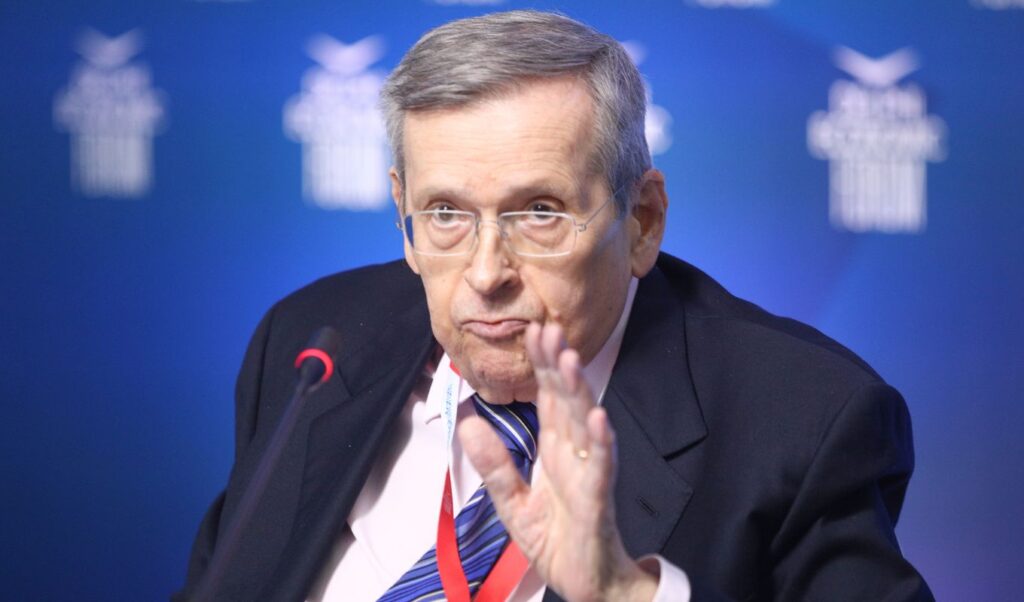
Former minister Stefanos Manos has passed away at the age of 87, following health problems he had been facing in recent years. The veteran politician, whose decades-long public presence was defined by his advocacy for liberal economic policies, was also known for interventions that frequently sparked intense political debate.
Stefanos Manos’ political career spanned more than three decades. He was first elected to parliament in 1977 with New Democracy, following years of experience in the business world, and subsequently held a series of government positions and ministerial portfolios.
Who was Stefanos Manos
Born in Athens in December 1939, Stefanos Manos studied mechanical engineering at the Swiss Federal Institute of Technology in Zurich and later earned an MBA from Harvard University. Before entering politics, he had worked for approximately eleven years in the private sector.
His parliamentary career began in 1977 and continued, with interruptions, for nearly three decades. During his political career, he served as minister of the Environment, National Economy, and Finance, leaving a particularly strong mark on issues of economic policy and the functioning of the state.
A political journey defined by liberal conviction
His path was not confined to New Democracy. In the late 1990s, he pursued an independent political course and, in April 1999, announced the founding of the Liberals party, seeking to give distinct political expression to economic liberalism.
He later collaborated with PASOK, appearing on the party’s national list in the 2004 elections, and in subsequent years became involved once again in reformist and liberal political ventures.
He was also among the founding figures associated with the creation of Drasi (Action), whose leadership he assumed before resigning as party president in 2012, while continuing to remain active in public debate.
An often “heretical” voice
Stefanos Manos maintained a prominent presence in public discourse until his final years, through articles, interviews, and public interventions. His views on taxation, pension reform, state-owned enterprises, privatizations, the functioning of the state, and structural reforms frequently placed him outside the mainstream political consensus and drew sharp reactions.
He consistently championed the need to reduce state intervention, improve public administration efficiency, and pursue deeper structural changes in the economy. This political identity made him one of the most recognizable — and often controversial — voices in the Greek liberal sphere. His long and complex relationship with New Democracy was also the subject of frequent retrospectives and critical commentary on his part regarding the party’s direction.
Even after stepping back from active party politics, he continued to engage in public affairs, maintaining his personal blog and writing on issues of economics, politics, and public administration.