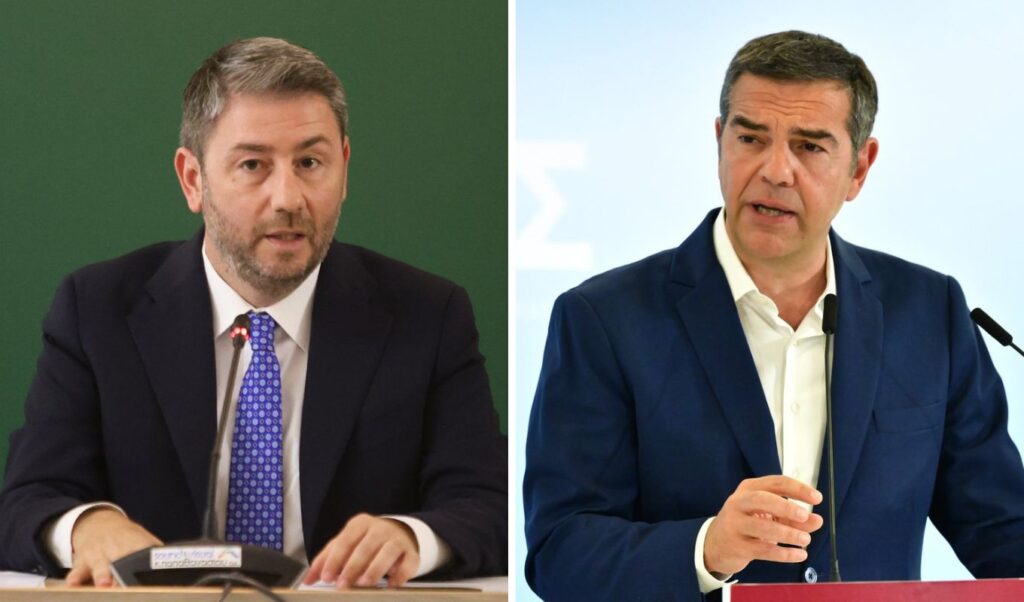
In the iconic Greek film Της κακοµοίρας (The Miserable), directed by Dinos Katsouridis, one of the most memorable exchanges between comedians Kostas Hatzichristos and Nikos Rizos goes like this: “Are you picking a fight?” asks Hatzichristos. “Yes, I am,” replies Rizos. “Well then, I’m not,” Hatzichristos shoots back. This classic bit of comic dialogue feels strikingly relevant to the ongoing clash between Alexis Tsipras and Nikos Androulakis, each blaming the other for starting it. Chronologically, it was SYRIZA that fired the first shot, with a statement referencing the debts of New Democracy and PASOK to the banks — a statement to which PASOK headquarters responded with unusually sharp rhetoric.
Read also: Nikos Androulakis: The battle with Alexis Tsipras at the Thessaloniki International Fair to emerge as Mitsotakis’s main rival — and the internal party tensions
SYRIZA appeared to subsequently dial back its tone — as reflected in the more measured language of its members appearing on political panels. PASOK, on the other hand, chose to keep the confrontation alive at every opportunity. Using comments Tsipras made in an interview with in.gr about his conduct toward vested interests during his time as prime minister as a pretext — even though there was no direct reference to PASOK — the party issued a series of statements claiming that Tsipras “leads not a political party, but a limited liability company whose shareholders are domestic oligarchs, with himself as managing director.” Even without being directly provoked, PASOK chose this kind of harsh and politically offensive language against Tsipras. Going even further, the party branded him the “mastermind, organizer and driving force behind the mud-slinging campaign against the democratic progressive camp, gleefully carried out by specific far-right media outlets.”
PASOK’s logic and Anna Diamantopoulou’s hard-line stance against Tsipras
Explaining the party’s reasoning, Anna Diamantopoulou — one of PASOK’s most hardline voices when it comes to Tsipras — argued on SKAI television that the former prime minister was the one who opened hostilities by attacking PASOK and directing more criticism at the opposition than at the government. “PASOK cannot respond to this attack with Christian forgiveness — turning the other cheek,” said the party’s head of strategic planning. For his part, Tsipras — despite the fierce broadside from PASOK — resisted the temptation to engage in an intra-center-left feud. In the same widely discussed interview, he stated: “For us, there is no hostility. The parties of the broader democratic progressive camp are not our enemies. We are rivals.” Revealing his tactical approach toward PASOK, he made clear that “it takes two to have a fight — what we call ‘arguing with yourself.’ We are not going to follow them into that fight.” Taken together, these developments highlight the enormous distance between PASOK headquarters on Charilaou Trikoupi Street and SYRIZA’s offices on Amalias Avenue.
Androulakis’s order for a full-frontal attack on Tsipras
Although the two parties theoretically operate within the same ideological neighborhood, their confrontation is expected to hit a fever pitch on the road to the next elections. It is clear that Androulakis has instructed the PASOK party machine to launch a direct, personal offensive against Tsipras, positioning him as the party’s primary opponent. This is, after all, a matter of political survival for PASOK: prevailing in the center-left arena is essential, since failure to do so would almost certainly trigger centrifugal forces — possibly as early as election night.
At the same time, some party members are anxious about whether this strategy against Tsipras will actually deliver results — and more importantly, whether it will help PASOK win over broader sections of the electorate, including swing voters sitting between PASOK and SYRIZA. So far, no significant divergences have emerged among senior opposition figures. What has been observed are differences in tone during public appearances. A notable exception was Theodoros Margaritis, a member of the Political Council, who wrote in an op-ed in Ta Nea that there should be no walls between the parties, calling for “any disagreements to focus on policy issues and alternative proposals, rather than a soap opera of hatred and animosity.”
In any case, September is a milestone for PASOK, when Androulakis will have completed his appearance at the Thessaloniki International Fair, where he will present his party’s governing program and polling data will offer a clearer picture. This means that PASOK’s strategy toward SYRIZA — and more broadly — could be reassessed at the start of autumn. Meanwhile, Tsipras appears convinced that the audiences he speaks to have no appetite for shouting matches and confrontation, which is why he shows no inclination to follow PASOK into aggressive territory. The question for the SYRIZA leader, however, is whether he will maintain this stance all the way to the election — or whether the political climate will eventually force him to pick up the gauntlet in response to PASOK’s accusations about ties to vested interests and insinuations about his party’s funding.
Published in Parapolitika newspaper