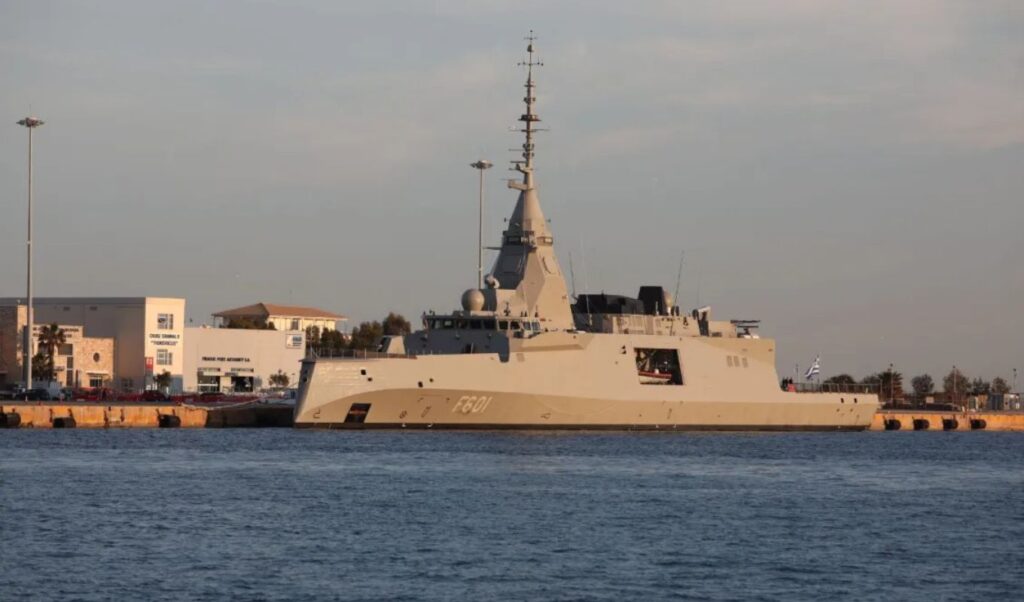
The delivery of the second Greek FDI frigate “Nearhos”, expected on October 30, and its imminent arrival in Greek waters in early November — along with the third Greek FDI frigate, “Formion,” which is in an advanced stage of construction and has already entered sea trials — mark a turning point for Greece’s naval power and the geostrategic architecture of the Eastern Mediterranean.
At a critical juncture where regional balances are being redefined and maritime zones are becoming arenas of intensifying competition, the operational integration of the second Belharra is not merely a technical fleet upgrade — it is a projection of deterrence and national sovereignty, sending a clear message to allies and adversaries alike.
The operational impact of the frigate “Nearhos”
The arrival of the frigate “Nearhos” substantially reinforces Greece’s military presence in a strategically vital maritime region. Equipped with state-of-the-art radar systems, advanced anti-aircraft defense, and anti-submarine warfare capabilities, the new frigate transforms the operational landscape in the Southeastern Mediterranean, enabling the Hellenic Navy to monitor and control vast maritime frontlines with precision. On the geopolitical level, this development repositions Athens as a central pillar of security and stability across the wider Mediterranean basin.
At the same time, Greece’s enhanced naval presence not only protects its sovereign rights but also strengthens its role as a credible partner within NATO and the European Union — at a time when energy security, the protection of undersea infrastructure, and the safeguarding of international sea lanes sit at the top of the global agenda. In this context, Greece gains greater leverage in the region’s diplomatic and military processes. The integration of “Nearhos” into Greece’s operational arsenal sends a multi-layered message in every direction, confirming that the country possesses both the will and the means to defend its interests — shaping the security environment in Southeastern Europe as a leading actor.
One of the most advanced and fully digitized surface warships in the world
The frigate “Nearhos,” the second unit of the FDI HN (Belharra) class in the Hellenic Navy, designed by French defense company Naval Group, is one of the most advanced and fully digitized surface warships in the world. With a displacement of approximately 4,500 tons, a length of 122 meters, a beam of 17.7 meters, and a CODAD propulsion system delivering 32,000 kW, it achieves a top speed of 27 knots. It boasts a range of 5,000 nautical miles at a cruising speed of 15 knots, offering 45 days of operational autonomy for a crew of approximately 110–120 personnel.
At the heart of its operational capabilities lies the revolutionary Thales SeaFire digital AESA S-band electronically scanned radar, which provides simultaneous surveillance and target tracking at ranges of up to 500 kilometers.
Its anti-submarine warfare umbrella is considered among the finest in the world, while its heavy armament includes 32 Aster 30 Block 1 surface-to-air missiles in four Sylver A50 octuple launchers for long-range area air defense, 8 Exocet MM40 Block 3c anti-ship missiles, a RAM Block 2B close-in weapon system with 21 missiles, an Oto Melara 76mm main gun, two Leonardo Lionfish 20mm remote-controlled cannons, and torpedo tubes for MU90 Impact torpedoes.
The program will be completed with the fourth Greek FDI HN frigate, “Themistoklis,” whose delivery is currently scheduled for late 2028. The key distinction is that “Themistoklis” will be built from the outset with the most advanced Greek configuration, featuring even greater capabilities than the other three vessels.
The acquisition of these four frigates does not simply offer a numerical boost — it secures a decisive technological and qualitative superiority in the maritime theater of the Eastern Mediterranean and the Aegean, tipping the operational balance in Greece’s favor. The new frigates also make the Hellenic Navy a formidable force in anti-submarine warfare. The most defining feature, however, lies in their network-centric character. As floating command and data-processing hubs, the Belharras distribute a complete, real-time operational picture of the theater to Rafale and F-16 Viper fighter jets and the rest of the armed forces’ assets, functioning as true force multipliers.
Frigate FDI “Nearhos” — key specifications
- 4,500 tons displacement
- 122 meters in length
- 17.7 meters beam
- 32,000 kW CODAD propulsion system output
- 5,000 nautical miles range
- 15 knots cruising speed
- 45 days operational autonomy for a crew of 110–120
Armament:
- 32 Aster 30 Block 1 surface-to-air missiles
- 4 Sylver A50 octuple launchers for long-range area air defense
- 8 Exocet MM40 Block 3c anti-ship missiles
- 1 RAM Block 2B close-in weapon system with 21 missiles
- 1 Oto Melara 76mm main gun
- 2 Leonardo Lionfish 20mm remote-controlled cannons
Published in Apogevmatini