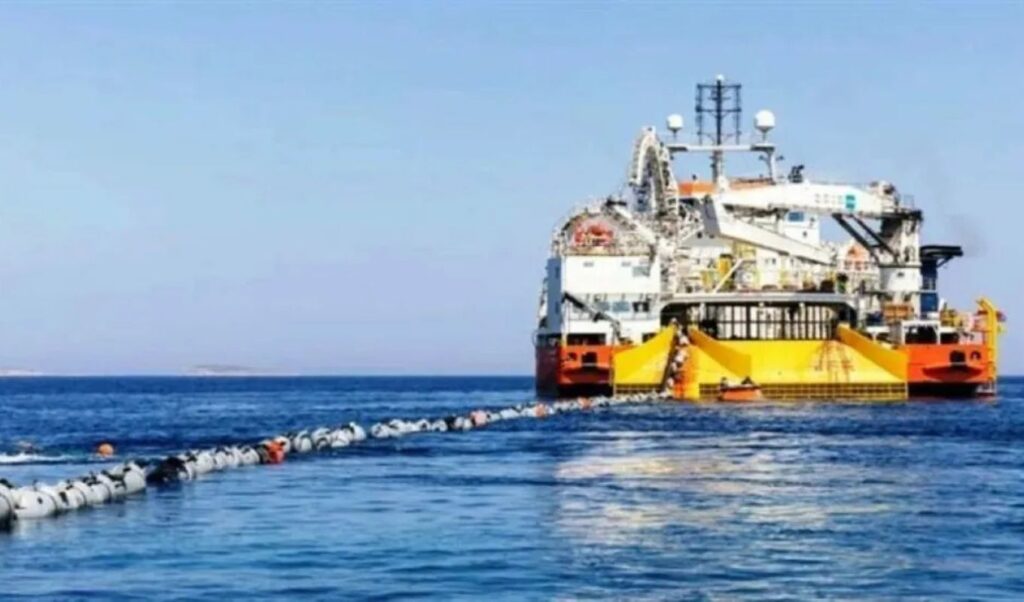
The United States wants the laying of the submarine cable and the electrical interconnection of Greece, Cyprus, and Israel to become a top priority for the Greek government and its Eastern Mediterranean policy. The completion of the Great Sea Interconnector appears so urgent that the request came as a bipartisan initiative. Notably, the electrical interconnection is described as being directly linked to the India-Middle East-Europe Economic Corridor (IMEC), making it central to the broader US strategic agenda for the region. This request came shortly after the signing in Athens of an agreement for the entry of French investment group Meridiam as the majority shareholder in the Great Sea Interconnector company.
Lawmakers seek classified briefing on obstacles
The letter was addressed to US Secretary of State Marco Rubio and Ben Black, head of the Development Finance Corporation (DFC). The bipartisan initiative was led by Democratic Representative Brad Schneider and his Republican colleague Gus Bilirakis. The letter was also co-signed by Representatives Jake Auchincloss, Dan Goldman, Craig Goldman, and Haley Stevens. “The Eastern Mediterranean will play a vital role as a gateway to IMEC, and the Great Sea Interconnector represents a key strategic infrastructure project central to the development of the corridor,” the American legislators state in their letter.
The lawmakers argue that Washington has a clear interest in developing infrastructure that strengthens its partners, diversifies energy routes, and deepens regional cooperation. They also frame such projects as a viable alternative to infrastructure controlled by strategic rivals of the United States.
According to the letter, interconnecting the electricity networks of Greece, Cyprus, and Israel would create an energy axis among key US partners. The representatives particularly emphasize that the project will help end Cyprus’s energy isolation, strengthen Israel’s energy supply security, and enable two-way electricity flows between Europe and the Eastern Mediterranean.
Also notable is the lawmakers’ reference to the geopolitical challenges surrounding the project’s completion. At the close of the letter, they request a classified briefing from the Trump administration to discuss the “geopolitical challenges” that could affect its finalization.
The “key gateway” to IMEC
The letter’s authors also place the GSI within the broader framework of the Eastern Mediterranean Gateway Act — the bipartisan legislative initiative introduced by Schneider and Bilirakis in May 2025. The bill formally recognizes the Eastern Mediterranean as a key gateway to IMEC and includes an explicit reference to the Great Sea Interconnector among the energy infrastructure projects that could form the foundation for connecting India and the Gulf with Europe.
The initiative has already been approved at the level of the House Foreign Affairs Committee, with parallel progress made in the Senate, reinforcing the bipartisan dimension of efforts to secure greater American engagement in the Eastern Mediterranean.
Seen through this lens, the legislators present the project as part of a broader architecture linking Eastern Mediterranean energy security, IMEC, and the United States’ geoeconomic competition with other major global powers.