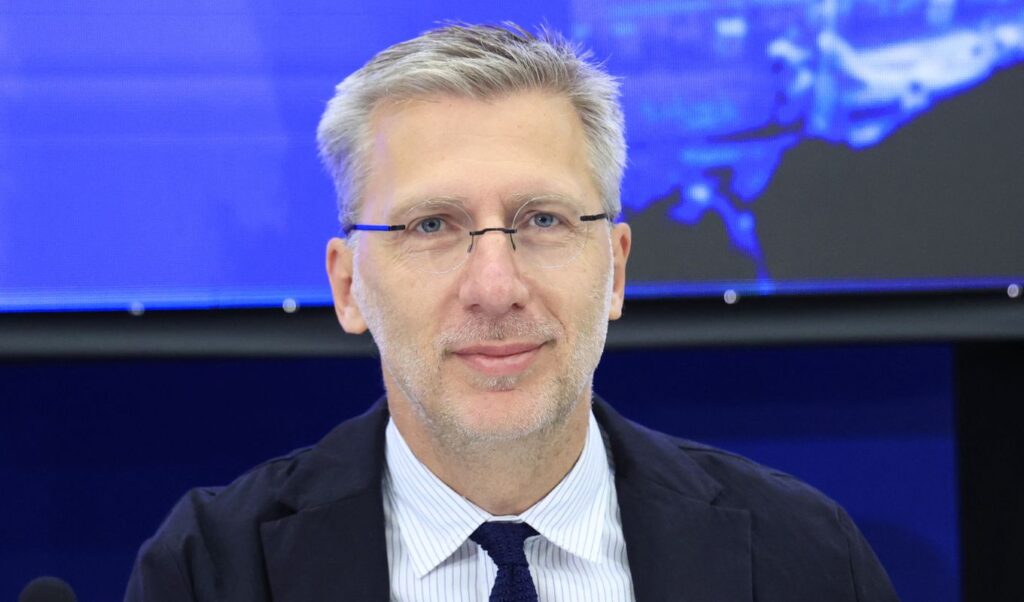
On the occasion of tomorrow’s (13/8) 22nd anniversary of the opening of the 2004 Olympic Games, Greece’s Minister of State, Akis Skertsos, published a post reflecting on the Athens Olympic Sports Complex (OAKA). “We invested in OAKA because we believe that a safe, modern, and accessible public space is part of the quality of life that every citizen deserves, wherever they live,” he noted. “By the end of September, we will have delivered an essentially brand-new OAKA,” he added.
Akis Skertsos: “OAKA can become a landmark for the entire Athens basin”
Below is the full text of Akis Skertsos’s post on the Athens Olympic Sports Complex: “Tomorrow marks 22 years since the opening of the Athens Olympic Games. I will remember that day forever — and all the days that followed until the end of the Games — and how proud I felt for our country.
Greece took on a great challenge before the global community and won, showing the world the very best of ourselves. Athens hosted an event that has remained in our collective memory as a great national success. Yet there was a second challenge, equally important, that we did not win. It was the challenge of the day after.
The Olympic Games left behind a valuable infrastructure legacy, one that we paid for as taxpayers. However, we failed to create a stable plan in time for the post-Olympic use, operation, and systematic maintenance of these facilities. This is a collective failure. And the wear of time, when it meets the absence of maintenance, is relentless.
OAKA is perhaps the most telling example. A complex unique by Greek standards, which for years did not receive the investment its scale and significance demanded. Since 2022, however, a different effort has begun. For the first time since 2004, a comprehensive renovation and upgrade program for OAKA is being implemented, with the support of the Recovery Fund and under the supervision of the Strategic Investments Unit of the Super Fund, the Ministry of Sports, and the OAKA administration.
The decision to include the OAKA renovation in the Recovery Fund was neither coincidental nor easy. I recall that we conducted extensive negotiations with European authorities specifically for this project — and we prevailed. We invested in OAKA because we believe that a safe, modern, and accessible public space is part of the quality of life that every citizen deserves, wherever they live. And that the state has an obligation to invest in modern, safe, and accessible sports facilities where all citizens, without discrimination, can exercise, enjoy leisure activities, and spend their time productively.
A modern and cohesive city is not just its roads, transport systems, and buildings. It is also its great metropolitan parks. Its green spaces. Its sports infrastructure. Its public spaces that give people the opportunity to meet, move, exercise, and live better. OAKA can and must become such a landmark for the entire Athens basin.
That is why the investment being made today is not just about restoring an aging Olympic facility. It is about how we want Athens to look tomorrow and how we understand public space in a modern European city.
We have therefore designed and are delivering something more than a simple aesthetic renewal, with works across a range of areas including:
- Structural and functional restoration of all buildings
- Energy efficiency upgrades
- Reinforcement of building and sports infrastructure
- Interventions at the swimming pools and velodrome
- New fire safety systems
- Restoration of the metal structures at the entrances, the Wall of Nations, and the Agora
- Upgrading of the surrounding grounds
- And, of course, the restoration of the iconic Calatrava roofs
This is perhaps the most symbolic part of this effort. A world-class architectural work that stood as an emblem of the 2004 Games required, two decades later, extensive structural and functional restoration.
The intervention involves repairing problem areas, restoring the required structural integrity, and replacing elements of the metal structures and polycarbonate panels. There is a lesson here that goes beyond OAKA. A state is not judged solely by its ability to build. It is also judged by its ability to maintain.
It is certainly not easy to construct and inaugurate a new project. But it is equally important and necessary to ensure that it remains functional, safe, and useful 10, 20, or 30 years later. That is precisely what we need to change.
By the end of September, we will have delivered an essentially brand-new OAKA. The real challenge, however, begins the day after — for all of us — so that twenty years from now, we will not need another major and costly rescue operation.
We already have a plan in place for the operation and maintenance of OAKA so that it is used on a daily basis. It will be a modern metropolitan sports venue, as well as a major public space open to citizens and visitors of the capital.
Because ultimately, this may be the most important legacy we can carry forward from the 2004 Olympic Games: not just to remember what we achieved back then, but to learn how to protect what we created. And that is a challenge we cannot afford to lose this time. We owe our warmest thanks to all the people — and there are very many of them — who have worked day in and day out over these years to deliver a renewed OAKA to all of us.”